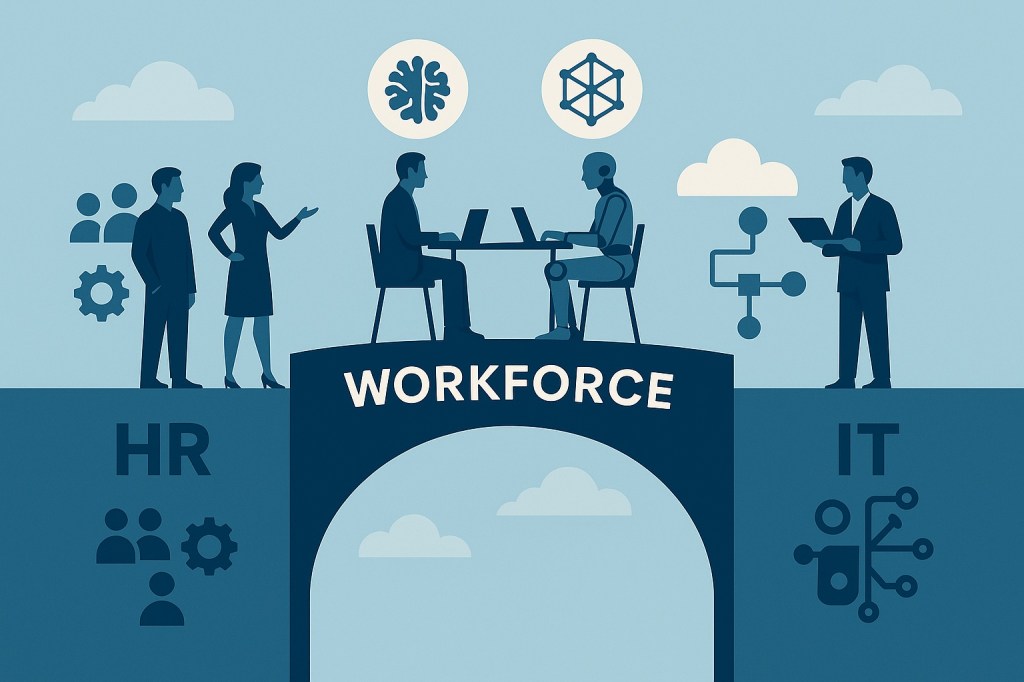
Rewiring the Workforce: Aligning HR and IT in the Age of AI

AI is already changing how teams operate, how leaders make decisions, and how value is delivered to customers. For organizations, this means rethinking not just what work gets done, but how it’s done, and by whom. Therefor it is crucial to think about how we bring Human and AI resource management together.

The 2023 MIT Sloan / BCG study, The Rise of AI-Powered Organizations, found that the most successful companies with AI are those where HR and IT work closely together to redesign processes and roles. That collaboration is critical. If AI is deployed without rethinking how humans and machines collaborate, companies risk missed value, employee resistance, and ethical missteps.


Designing the Hybrid Workforce: Teams, Tasks, and Talent

AI doesn’t eliminate jobs—it changes them. To prepare, organizations need to break down roles into specific tasks:

  • What can be automated?
  • What can be enhanced by AI?
  • What should remain Human-led?

From there, teams can be redesigned around how people and AI tools work together. In practice, this might mean:

  • A customer service team using AI to summarize queries while humans resolve complex issues
  • A product development team using AI to generate design options that humans refine

The HBR article Collaborative Intelligence: Humans and AI Are Joining Forces (Wilson & Daugherty, 2018) highlights five human roles in human-AI collaboration, such as AI trainers, explainers, sustainers, amplifiers and translators. These roles are already emerging in forward-looking teams and should be reflected in new job descriptions and team capabilities.


Organizational Change: Leading Through Disruption

Adding AI isn’t just a tech upgrade—it changes how decisions are made, who makes them, and what leadership looks like. For example:

  • Middle managers might now focus more on coaching and less on reporting, as AI handles data consolidation.
  • Teams may need to consult AI before acting, introducing a new rhythm to collaboration.

Gartner’s 2023 report How to Measure AI-Augmented Employee Productivity stresses that success in AI transformation isn’t just about productivity—it’s about how well teams adapt, collaborate, and trust AI tools. That requires strong change management, hands-on leadership, and clear guidance on when to trust AI versus when to override it.


Performance and Culture in an AI-Augmented Workplace

With AI in the mix, traditional performance reviews fall short. Leaders need to ask:

  • How are employees using AI tools to improve their work?
  • Are decisions more consistent, inclusive, and data-informed?
  • Is the AI system fair and explainable?

The Stanford HAI Annual AI Index Report 2024 shows that AI systems are improving technically, but companies often lack the tools to measure human impact—such as employee trust or the inclusiveness of AI-driven decisions. Stanford HAI provides several frameworks that can be leveraged to measure Human + AI teams performance.


HR + IT: From Functional Silos to Strategic Workforce Partners

To make AI work, HR and IT must be in lockstep. Here’s what that looks like:

  • Shared strategy: Joint planning on where AI will impact jobs and what new skills are needed
  • Reskilling programs: Co-owned initiatives to help employees build digital and AI literacy
  • Data and governance: Shared ownership of tools that measure workforce readiness and ensure responsible AI use

IBM’s 2023 Enterprise Guide to Closing the Skills Gap highlights that companies closing the skills gap at scale have strong HR–IT alignment. It’s not about HR specifying training needs and IT buying tools. It’s about building workforce capabilities together, with shared accountability.


Practical Implementation Guide

Step-by-Step

  1. Start with a vision: What does AI mean for how your people work?
  2. Create joint ownership: HR and IT should lead together from day one
  3. Map current tasks and roles: Where can AI add value or remove friction?
  4. Pilot hybrid teams: Run experiments in one area (e.g., marketing, finance) and scale what works
  5. Define ethical rules: Decide where AI should assist, and where humans must retain control
  6. Track impact: Use KPIs that include both productivity and human experience

Avoid These Pitfalls

  • Launching AI without involving HR
  • Treating AI as an isolated IT solution
  • Ignoring cultural resistance or trust issues
  • Failing to update roles, reviews, or incentives

Patterns That Work

  • Embedding AI in learning programs led by both HR and IT
  • Using AI to support—not replace—human decision-making in recruiting
  • Creating workforce councils to oversee AI ethics and inclusion

Conclusion: Time to Rewire

AI is a shift in how people, teams, and organizations operate. Making that shift successful requires deep collaboration between HR and IT, clear direction from leadership, and a willingness to rethink everything from team design to performance reviews.

Organizations that embrace this challenge with practical steps and shared ownership will not only manage AI’s impact—they’ll harness its full potential to build a smarter, more adaptive workforce.

Maximizing Digital Success with Strategic Workforce Planning

Introduction

In my many years involved in strategy formulation, one of the most undervalued tools, which, when properly used, led to extremely valuable discussions and insight, was Strategic Workforce Planning. When planning a Digital Transformation and aligning with leadership on the expected impact of AI implementations, this can be an extremely valuable tool.

Companies invest heavily in cutting-edge technology, yet many overlook a crucial element: their workforce. Strategic Workforce Planning (SWP) is the bridge between business transformation and workforce readiness. It ensures that organizations have the right talent in place to execute their digital ambitions effectively. Without it, even the most sophisticated technology initiatives risk failure due to skill gaps, resource mismatches, and a lack of strategic alignment.

What is Strategic Workforce Planning?

Strategic Workforce Planning is a structured, forward-looking approach that aligns talent with an organization’s business objectives. It enables companies to proactively address workforce needs, anticipate skill shortages, and develop strategies to build or acquire the necessary capabilities.

SWP is most effective when deployed during periods of transformation—such as digital overhauls, automation initiatives, or AI integration. It follows a structured Four-Step Framework:

  1. Set Strategic Direction – Align workforce planning with business and digital transformation goals, ensuring that talent strategies support overall corporate objectives.
  2. Analyze Current Workforce – Assess existing workforce capabilities, identify skill gaps, and evaluate how well employees are prepared for AI and digital shifts.
  3. Forecast Future Requirements – Predict the skills, roles, and workforce composition required to operate in the future digital environment.
  4. Develop Action Plans – Implement targeted hiring, reskilling, and upskilling initiatives to bridge workforce gaps and ensure operational readiness.

Key Takeaways from Research on SWP & Digital Transformation

Recent research underscores the importance of integrating SWP with digital transformation efforts. Three major reports highlight critical trends:

  • Skill-Based Workforce Management (Boston Consulting Group): Organizations must anticipate skill shortages in AI, automation, and digital transformation. Proactive upskilling and reskilling initiatives will be key to staying competitive.
  • The Role of SWP in the Age of AI (McKinsey & Company): AI-driven automation will drastically reshape workforce structures. Companies must integrate AI-driven forecasting tools into workforce planning to manage these shifts effectively.
  • Mastering Digital Transformation in Workforce Management: The ability to map opportunities and challenges in digital transformation is crucial. SWP helps leaders simulate different workforce scenarios and plan for skill evolution.

The Benefits of a Centralized Workforce Strategy

For executives leading digital transformation, having a single source of truth for workforce planning is a game-changer. A centralized SWP approach provides:

  • Data-Driven Decision-Making – Leaders gain real-time insights into talent readiness and can make informed staffing decisions.
  • Scenario Planning – Organizations can model different workforce scenarios to anticipate talent needs and mitigate risks.
  • Workforce Agility – As digital initiatives evolve, companies can quickly adapt their workforce strategies to align with new priorities.

Linking Digital Transformation to Workforce Utilization

Digital transformation does not just introduce new technologies—it fundamentally changes how work gets done. AI and automation are redefining roles, requiring companies to rethink workforce utilization and occupation structures.

Case Studies in Action:

  • Google has leveraged AI-powered workforce planning tools to anticipate skill needs and align talent development with business priorities. By using data-driven insights, Google ensures that it continuously hires, upskills, and reallocates employees to projects that drive innovation. Their approach integrates predictive analytics, allowing the company to proactively manage workforce transitions as new technologies emerge, ensuring that employees are always equipped with the most relevant skills.
  • ProRail, the Dutch railway infrastructure manager, faced the challenge of increasing efficiency through digitization without expanding its workforce. To address this, ProRail implemented a workforce planning initiative focused on reskilling existing employees in automation and data analytics. This strategic approach enabled ProRail to optimize train traffic management, integrate AI-driven decision-making, and prepare its workforce for a future where digital operations play a central role in rail infrastructure management.
  • Microsoft recognized that the future of work required a significant shift in workforce capabilities. To address this, the company launched large-scale reskilling and learning programs designed to prepare employees for AI and digital advancements. Through initiatives like the Microsoft AI Business School and enterprise-wide learning platforms, Microsoft ensures that its workforce remains competitive in an increasingly AI-driven world. Their SWP strategy includes career path modeling, internal mobility programs, and digital literacy initiatives to align talent with the company’s future vision.

Developing a Talent Plan for the Future

To future-proof their organizations, senior executives must take a proactive approach to workforce planning:

  • Identify future skill requirements based on anticipated digital trends.
  • Develop recruitment, training, and upskilling strategies to bridge gaps.
  • Leverage AI-driven workforce planning tools to enhance talent forecasting.

By treating workforce planning as a strategic function rather than an operational necessity, companies can ensure that they have the right talent in place to drive digital success.

The Role of SWP in the Future of Work

The level of automation in jobs is expected to skyrocket in the coming years. Organizations that fail to integrate workforce planning into their digital strategy risk falling behind. Digital and AI solutions must be seamlessly linked to workforce development, ensuring that employees are prepared for the rapid technological shifts ahead.

Conclusion

Strategic Workforce Planning is not just a tactical HR function—it is a core pillar of successful digital transformation. By embedding SWP into the strategic planning process, organizations can future-proof their workforce, optimize resource utilization, and ensure they have the right talent in place to harness the full potential of AI and automation.

For senior executives and transformation leaders, the message is clear: technology alone will not drive digital success. A well-planned, strategically aligned workforce is the key to turning digital aspirations into operational reality.