Where AI is Already Making a Significant Impact on Business Process Execution – 15 Areas Explained

After exploring a wide range of expert sources—and drawing from my own experience—I collaborated with AI tools (ChatGPT, Gemini, Claude) to create a concise overview of where AI is currently having the biggest impact on business processes. The aim: to bring together the most referenced success areas across functions and reflect on why these domains are leading the way. Recognizing these patterns can help us anticipate where AI is likely to deliver its next wave of value (at the end of the article).

Below are 15 high-impact application areas where AI is already delivering significant value—each explained with clear benefits and real-world examples.


Marketing & Sales

1. Smarter Customer Service Automation
AI-powered chatbots and virtual agents are now central to handling customer inquiries. They can resolve a majority of tickets without human intervention, enabling 24/7 service while reducing costs and improving customer experience. Beyond just scripted replies, these agents learn from interactions to provide increasingly accurate and personalized support, allowing human teams to focus on complex or emotionally sensitive requests.
Example: Industry-wide AI adoption in contact centers, with 88% of firms reporting improved resolution times and reduced overhead (Statista, McKinsey).

2. Personalised Marketing at Scale
AI recommendation engines tailor content and product offerings based on individual browsing behavior, purchase history, and contextual data. This creates more relevant experiences for users and lifts conversion rates. Example, Amazon’s recommendation engine contributes over a third of its e-commerce revenue, proving the model’s commercial impact.

3. Sales Acceleration with AI
AI is transforming sales operations by taking over repetitive tasks like data entry, scheduling, and opportunity scoring. It also enables more informed decisions through predictive analytics, guiding sales teams to focus on leads with the highest conversion potential. Example: Salesforce research reveals that 83% of AI-enabled sales teams saw revenue growth versus 66% without AI. Besides this Salesforce example, I also can share from my personal working experience at Brenntag that AI solutions to guide “next best actions”  for salespeople drives significant impact.


Operations, Manufacturing & Supply Chain

4. Predictive Maintenance Efficiency
Traditional maintenance schedules often lead to unnecessary downtime or surprise equipment failures. AI flips the model by continuously analyzing sensor data to detect anomalies before breakdowns occur. This helps manufacturers schedule maintenance only when needed, extending equipment life and minimizing disruption.
Example: Mitsubishi and others use predictive maintenance tools that have led to up to 50% reduction in unplanned downtime.

5. AI-Powered Quality Control
In industries where product consistency is crucial, AI-enhanced computer vision inspects goods in real time for even the tiniest defects. These systems outperform the human eye in speed and accuracy, ensuring higher product quality and reducing waste from production errors.
Example: Automotive and electronics manufacturers now use AI to identify surface defects, alignment issues, or functional flaws instantly on the line.

6. Smarter Inventory Optimization
AI brings new precision to inventory planning by factoring in historical sales, seasonal trends, macroeconomic indicators, and real-time customer demand. This ensures businesses maintain optimal stock levels—avoiding both overstock and stockouts—while reducing working capital.
Example: Companies using AI in supply chain forecasting report inventory reductions of up to 35% (McKinsey).

7. Logistics Route Optimization
AI’s real-time route planning considers traffic, weather, delivery windows, and driver availability to suggest the most efficient routes. This leads to faster deliveries, fuel savings, and higher customer satisfaction. It also helps logistics providers scale without proportionally increasing operational complexity.
Example: DHL’s AI-driven routing platform reduces mileage per package and improves on-time delivery.


Finance, Accounting & Risk Management

8. Touchless Document Processing
Invoice entry and document reconciliation are among the most repetitive and error-prone tasks in finance. AI automates these workflows by reading, validating, and recording data with high accuracy, drastically reducing processing time and human error.
Example: Large enterprises report cutting invoice processing time by 80% and lowering cost per invoice by over 60%.

9. Smarter Fraud Detection Systems
Modern fraud schemes evolve too rapidly for traditional rules-based systems to catch. AI models can continuously learn from new data and detect suspicious behaviors in real time, flagging anomalies that might otherwise go unnoticed.
Example: A global bank using AI to process checks in real time saw a 50% drop in fraud and saved over $20M annually.

10. Automating Financial Controls
AI supports internal audit and compliance by automatically flagging unusual transactions, reconciling financial data, and generating traceable logs for auditors. This not only boosts confidence in regulatory reporting but reduces the burden on finance teams.
Example:  Deloitte finds AI-led controls improve accuracy, reduce audit costs, and streamline compliance workflows.


HR & Administration

11. Accelerated AI Recruitment
Hiring at scale is time-consuming and prone to bias. AI now supports end-to-end recruitment by screening CVs, analyzing video interviews, and predicting candidate-job fit based on past data. This enables faster, fairer hiring decisions and a better candidate experience.
Example: Unilever’s AI-powered hiring cut time-to-hire by 90%, reduced recruiter workload, and increased hiring diversity by 16%.

12. AI-Powered Admin Assistance
Whether it’s helping employees navigate HR policies or resetting passwords, AI bots respond instantly to internal requests. They resolve issues efficiently and learn from interactions to improve over time, reducing dependency on HR and IT service desks.
Example: AT&T’s HR bot answers thousands of employee questions per month, freeing up support teams and reducing internal wait times.


Software Development & IT Operations

13. AI Code Generation & Testing
AI-assisted development tools help engineers write code, suggest improvements, and run automated tests. This shortens development cycles, reduces bugs, and improves overall code quality. It also democratizes coding by assisting less-experienced developers with best practices.
Example: Enterprises report 20–30% faster feature delivery using AI-assisted development environments.

14. Intelligent IT Service Management
From incident triage to root cause analysis, AI is embedded in IT Service Management platforms to help resolve tech issues automatically. Predictive insights help prevent outages and minimize disruption across business-critical systems.
Example: Leading digitally enabled firms see average resolution time drop by 50%, with improved system reliability and user satisfaction.

15. AI-Driven DevOps Optimization
By analyzing telemetry data and past deployments, AI optimizes build pipelines, monitors production systems, and predicts future resource needs. This ensures smoother rollouts and better infrastructure planning.
Example: Cloud-native companies use AI to reduce deployment failures and improve performance-to-cost ratios in real time.


Why AI Wins in These Areas

Despite the diversity of domains, these success stories share clear commonalities:

  • High process volume: Tasks that are frequent and repetitive gain the most from automation.
  • Structured and semi-structured data: AI performs best where input data is clean or can be normalized.
  • Clear Return On Investment (ROI) levers: The efficiency gains are measurable—reduced cycle time, lowered cost, or increased accuracy.
  • Repeatable workflows: Standardized or rules-based processes allow for predictable automation.

In essence, AI is most effective where complexity meets scale. As more enterprises embed AI into their operations, it is not just making processes faster—it’s reshaping them for quality, agility, and scale in a digital-first world.

Looking ahead, the next wave of AI impact is likely to emerge in areas where unstructured data and human judgment still dominate today. Examples include:

  • Legal and contract management, where AI is starting to support contract drafting, review, and risk flagging.
  • Strategy and decision support, where generative AI can synthesize market trends, customer feedback, and financial data to help leaders shape better strategies.
  • Sustainability tracking, where AI can analyze supply chain and operational data to monitor and reduce environmental impact.

As models become more capable and context-aware, these higher-value and less-structured domains may soon follow the path of automation and augmentation already seen in the 15 areas above.

When Good Intentions Fail – Why Effective Governance Is the Fix

While many organizations focus on technology, data, and capabilities, it’s the governance structures that align strategy with execution, enable informed decision-making, and ensure accountability. Without effective governance, even the most promising digital or AI initiatives risk becoming fragmented, misaligned, or unsustainable.

This article explores how governance typically evolves during transformation, drawing on a framework presented in GAIN by Michael Wade and Amit Joshi (2025). It then outlines best practices and tools for establishing effective governance at every level of transformation—portfolio, program, and project.

The Governance Journey: From Silo to Anchored Agility
Wade and Joshi identify four phases in the evolution of transformation governance:

  • Silo: In this early phase, digital and AI initiatives are isolated within departments. There is little coordination across the organization, leading to duplicated efforts and fragmented progress.
  • Chaos: As a reaction to the issues with the siloed approach, often companies start putting governance in place—but often not very effectively. Leading to a proliferation of processes, tools and platforms.
  • Bureaucracy: In response to chaos, organizations implement formal governance structures. While this reduces risk and increases control, it can also stifle innovation through over-regulation and sluggish decision-making.
  • Anchored Agility: The desired end-state. Governance becomes a strategic enabler—embedded yet flexible. It ensures alignment and control without constraining innovation. Decision-making is delegated appropriately, while strategic oversight is maintained.

Most organisations go through this journey, understanding where your organization is helps to determine what kind of actions are needed and what to improve.

Effective Governance: Moving from Bureaucracy to Anchored Agility
Most successful digital and AI transformations mature into the Bureaucracy and Anchored Agility phases. These are the phases where effective governance must strike a balance between structure and adaptability.

Two proven approaches—PMI and Agile—offer best practices to draw from:

PMI Governance Best Practices

  • Well-defined roles and responsibilities across governance layers
  • Program and project charters to formalize scope, authority, and accountability
  • Clear stage gates, with decision points tied to strategic goals
  • Risk, issue, and change control mechanisms
  • Standard reporting templates to ensure transparency and comparability

PMI’s approach works best in large, complex transformations that require strong coordination, predictable delivery, and control of interdependencies.

Agile Governance Principles

  • Empowered teams with clear decision rights
  • Frequent review cadences (e.g., sprint reviews, retrospectives, and PI planning)
  • Lightweight governance bodies focused on alignment, not control
  • Transparent backlogs and prioritization frameworks
  • Adaptability built into the governance process itself

Agile governance is ideal for fast-evolving digital or AI initiatives where experimentation, speed, and responsiveness are critical.

Moving from Bureaucracy to Anchored Agility, is not moving away from PMI to only Agile Governance principles. Your portfolio probably will have mix of initiatives which leverages one or both of the approaches.

Governance Across Levels: Portfolio, Program, Project
A layered governance model helps ensure alignment from strategy to execution:

Portfolio Level

  • Purpose: Strategic alignment, investment decisions, and value realization
  • Key Bodies: Executive Steering Committees, Digital/AI Portfolio Boards
  • Focus Areas: Prioritization, funding, overall risk and performance tracking

Program Level

  • Purpose: Coordinating multiple related projects and initiatives
  • Key Bodies: Program Boards or Program Management Offices
  • Focus Areas: Interdependencies, resource allocation, milestone tracking, issue resolution

Project Level

  • Purpose: Delivering tangible outcomes on time and on budget
  • Key Bodies: Project SteerCos, Agile team ceremonies
  • Focus Areas: Daily execution, scope management, risk and issue tracking, delivery cadence

Connecting the Layers: How Governance Interacts and Cascades
Effective governance requires more than clearly defined levels—it demands a dynamic flow of information and accountability across these layers. Strategic priorities must be translated into executable actions, while insights from execution must feed back into strategic oversight.

  • Top-down alignment: Portfolio governance sets strategic objectives, funding allocations, and key performance indicators. These are cascaded to programs and projects through charters, planning sessions, and KPIs.
  • Bottom-up reporting: Project teams surface risks, status updates, and learnings which are aggregated at the program level and escalated to the portfolio when needed.
  • Horizontal coordination: Programs often interact and depend on each other. Governance forums at program level and joint planning sessions across programs help manage these interdependencies.
  • Decision and escalation pathways: Clear routes for issue resolution and decision-making prevent bottlenecks and ensure agility across layers.

Organizations that master this governance flow operate with greater transparency, speed, and alignment.

Tools and Enablers for Good Governance
Governance is not just about structure—it’s also about enabling practices and tools that make oversight effective and efficient:

  • Terms of Reference (ToR): Define the mandate, decision rights, and meeting cadence for each governance body.
  • Collaboration & Transparency Tools: Use of platforms like Asana, Confluence, Jira, MS Teams for sharing updates, tracking decisions, and managing workflows.
  • Standardized Reporting: Leverage consistent templates for status, risks, and KPIs to create transparency and drive focus.
  • RACI Matrices: Clarify roles and decision-making authority across stakeholders, especially in cross-functional setups.
  • Governance Calendars: Synchronize key reviews, steerco meetings, and strategic checkpoints across layers.

Lessons from the Field
From my experience, common governance pitfalls include over-engineering (which stifles agility), under-resourcing (especially at the program level), and slow/unclear decision making. Successful governance relies on:

  • Aligned executive sponsorship
  • Clear ownership at all levels
  • Integration of risk, value, and resource management
  • Enabling people to act

Conclusion
In digital and AI transformation, effective governance is not about control—it’s about enablement. It provides the structure and transparency needed to drive transformation, align stakeholders, and scale success. As your organization moves toward Anchored Agility, governance becomes less of a bottleneck and more of a backbone.

Where is your organization on the governance journey—and what would it take to reach the next phase?

Why Centres of Excellence Are the Backbone of Sustainable Transformation

Real-world lessons from building CoEs across domains

In every transformation I’ve led—whether in supply chain, commercial, innovation, or enabling functions—one thing has remained constant: transformation only sticks when it becomes part of the organizational DNA. That’s where Centres of Excellence (CoEs) come in.

Over the years, I’ve built and led CoEs across foundational disciplines, transformation approaches, and specific capabilities. When set up well, they become more than just support groups—they build skill, drive continuous improvement, and scale success.

This newsletter shares how I’ve approached CoEs in three distinct forms, and what I’ve learned about setting them up for lasting impact.


What is a CoE? (From Theory to Practice)

In theory, a CoE is a group of people with expertise in a specific area, brought together to drive consistency, capability, and performance. In practice, I’ve seen them evolve into vibrant communities of practitioners where people connect to:

  • Share business challenges and solutions
  • Scale learnings and continuously evolve best practices
  • Facilitate exchange between experts and users
  • Build a knowledge base and provide education

The most successful CoEs I’ve led were about enabling people to learn from each other, work smarter, and operate more consistently.


Three Types of CoEs I’ve built and led

1. Foundational CoEs – Building Core Capabilities

These are the bedrock. Without them, transformation initiatives often lack structure and miss out on leveraging proven approaches. Examples from my experience include:

  • Program & Project Management CoE
    Built on PMI (PMBoK) and Prince2 standards, this CoE offered training, templates, mentoring, and coaching. It became the go-to place for planning and executing complex programs and projects.
  • Process Management CoE
    Using industry frameworks (e.g., APQC), platforms (ARIS, Signavio), and process mining tools (Celonis, UiPath, Signavio), this CoE helped standardize processes and enabled teams to speak a shared process language and identify improvement opportunities through data.
  • Change Management CoE
    Drawing from Kotter’s principles and other industry best practices, we developed a change playbook and toolkit. This CoE played a critical role in stakeholder alignment and adoption across transformation efforts.
  • Performance Management CoE
    Perhaps less commonly named, but highly impactful. We developed strategy-linked KPI frameworks and supported teams in embedding performance reviews into regular business rhythms.
  • Emerging: AI Enablement CoE
    Looking ahead, I believe the next foundational capability for many organizations will be the smart and responsible use of AI. I’ve begun shaping my thinking around how a CoE can support this journey—governance, tooling, education, and internal use case sharing.

2. Transformation-Focused CoEs – Orchestrating Change Across the Enterprise

Unlike foundational CoEs, these focus on embedding transformation methodologies and driving continuous improvement across functions. In my experience, they’re essential for changing both mindsets and behaviors.

  • Continuous Improvement | Lean CoE
    Anchored in Toyota’s principles, our Lean CoE supported everything from strategic Hoshin Kanri deployment to local Kaizens. It equipped teams with the tools and mindset to solve problems systemically, and offered structured learning paths for Lean certification.
  • Agile CoE
    Created during our shift from traditional project models to Agile, this CoE helped scale Agile practices—first within IT, then into business areas like marketing and product development.
  • End-to-End Transformation CoE
    One of the most impactful setups I was part of. At Philips, in collaboration with McKinsey, we created a CoE to lead 6–9 month E2E value stream transformations. It brought together Lean, Agile, and advanced analytics in a structured, cross-functional method.

3. Capability & Process CoEs – Scaling New Ways of Working

These CoEs are typically created during the scaling phase of transformation to sustain newly introduced systems and processes.

  • Supply Chain CoEs
    I’ve helped build several, covering Integrated Planning, Procurement (e.g., SRM using Coupa/Ariba), and Manufacturing Execution Systems (e.g., SAP ME). These CoEs ensured continuity and ownership post-rollout.
  • Innovation CoE
    Focused on design thinking, ideation frameworks, and Product Lifecycle Management (e.g., Windchill). It enabled structured creativity, process adoption, and skill development.
  • Commercial CoEs
    Anchored new ways of working in e-Commerce, CRM (e.g., Salesforce), and commercial AI tools—helping frontline teams continuously evolve their practices.
  • Finance CoEs
    Supported ERP deployment and harmonized finance processes across regions and business units. These CoEs were key in driving standardization, transparency, and scalability.

Lessons Learned – How to Build an Effective CoE

Having built CoEs in global organizations, here’s what I’ve found to be essential:

  • Start with a Clear Purpose
    Don’t set up a CoE just because it sounds good. Be explicit about what the CoE is solving or enabling. Clarify scope—and just as importantly, what it doesn’t cover (e.g., handling IT tickets).
  • Design the Right Engagement Model
    Successful CoEs balance push (structured knowledge and solutions) with pull (responsiveness to business needs). Two-way communication is critical.
  • Build the Community
    Experts are crucial, but practitioners keep the CoE alive. Foster interaction, feedback, and peer-to-peer learning—not just top-down communication.
  • Leverage the Right Tools
    Teams, SharePoint, Slack, Yammer, newsletters, and webcasts all support collaboration. Establish clear principles for how these tools are used.
  • Measure What Matters
    Track adoption, usage, and impact—not just activity. Set CoE-specific KPIs and regularly celebrate visible value creation.

Closing Thought

CoEs aren’t a magic fix—but they are one of the most effective ways I’ve found to institutionalize change. They help scale capabilities, sustain momentum, and embed transformation into the organization’s ways of working.

If you’re designing or refreshing your CoE strategy, I hope these reflections spark new ideas. I’m always open to exchanging thoughts.

Scaling Digital Transformation: From MVP Success to Enterprise-Wide Impact

In many organizations, digital transformation starts strong but struggles to scale. Initial pilots show promise, yet momentum often stalls when leaders attempt to replicate success across the broader enterprise. Based on my own experience leading global transformations, I’ve found that the key to scaling lies in a phased, learning-driven approach—one that combines fast wins, co-creation, and structured rollout methodology with rigorous focus on adoption and impact.

I’ve applied this phased scaling approach in multiple global transformations—ranging from a Lean-based, end-to-end value chain transformation developed with McKinsey, to process standardization and operating model redesign in Innovation, Commercial, and Supply Chain domains. It also proved highly effective during large-scale ERP implementation programs, where structured rollout and local ownership were critical to success. These experiences shaped the approach outlined below.


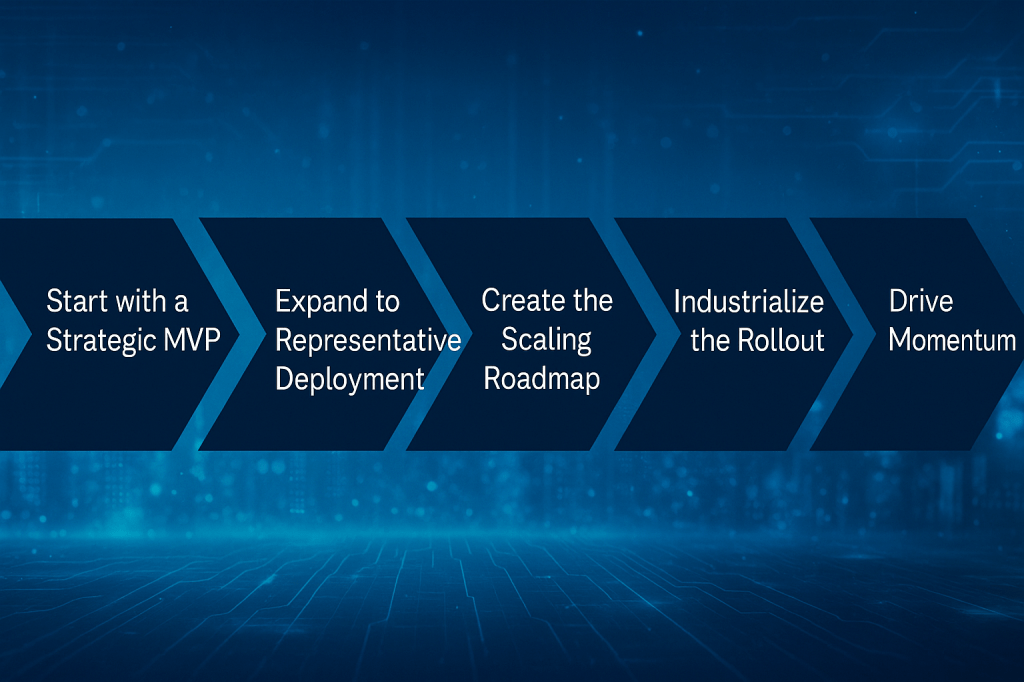
1. Start with a Strategic MVP

Every transformation needs a spark—a Minimum Viable Product (MVP) that proves value fast. This is not about testing technology in isolation but selecting a use case that matters to the business and can deliver tangible outcomes quickly.

In practice:
During a global ERP rollout, we launched the MVP in smaller countries in South America. These markets had limited existing system support, so the gains from automation and standardized processes were immediate and highly visible. It was the ideal environment to test the new design while delivering clear early value to the business.

The goal: build credibility and show that “this works.” More importantly, use this phase to create internal advocates who will help carry the message forward.


2. Expand to a Representative Deployment

Once momentum is created, the next step is critical: move beyond the pilot phase and test your approach in a part of the organization that reflects the broader complexity and scale.

In practice:
In the same ERP program, we selected North America as the next deployment—arguably the toughest environment due to its scale, criticality, and history of customized automation. If we could succeed there, we knew we could scale globally. Through co-creation with local business and functional teams, we built the assets, governance model, and deployment methodology that became the foundation for all subsequent rollouts.


3. Codify Learnings and Create the Scaling Roadmap

After two deployments, you’ll have rich insight into what works, what doesn’t, and what needs to adapt. This is the time to capture and codify those learnings into a repeatable transformation playbook.

In practice:
In the end-to-end Lean transformations, we developed a comprehensive playbook that included standard tools, templates, and real-world examples. We also created resource models and scaling scenarios to support portfolio-level roadmap planning. This gave the transformation program clarity on how to scale with confidence.


4. Industrialize the Rollout

With a clear roadmap in place, the focus shifts to scaling with speed and consistency. This requires an empowered central team that operates as an enabler, that works closely with the business, regional and functional teams.

In practice:
As we scaled our end-to-end transformations from 2 to more than 70 deployments in three years, we enhanced the playbook continuously and established an internal academy. This academy enabled employees to follow a structured learning journey and certify their transformation skills. At the same time, we implemented clear communication strategies and dashboards to track adoption, progress, and value realized—keeping everyone aligned and accountable.


5. Drive Momentum

Scaling isn’t just about delivery—it’s about sustaining energy and belief. Even the best plans will stall without a mechanism to drive momentum and reinforce impact.

In practice:
In the ERP program, we implemented regular health checks to assess deployment progress and identify adoption risks early. Senior leaders were actively involved in championing each phase, reinforcing the “why” and spotlighting success stories across regions. We knew that technical go-live was just the beginning—the real success comes from business adoption, continuous improvement and realized value.


Final Reflections

Many transformations fail at different phases of the journey. Some stumble at the very start by choosing a pilot that is too complex to succeed quickly. Others struggle to make the leap from isolated success to broader relevance. Some lose steam by over-engineering the scale-up, while others fail to sustain momentum once the initial excitement fades.

Next to the examples of what worked, I’ve also seen where things went wrong—or could have gone significantly better. These lessons are just as valuable, and they underscore the importance of staying pragmatic, agile, and focused on value throughout the scaling process.

A successful digital-enabled transformation moves from MVP to full scale through a deliberate series of learnings, adjustments, and investments—not just in technology, but in people, process, and governance.

By starting with fast, meaningful wins, expanding through co-creation, and scaling with discipline, organizations can move from isolated experiments to enterprise-wide impact—with clarity, confidence, and speed.

Why Systems Thinking Is Crucial in Designing Digital Transformations

Digital transformations are hard. Despite bold ambitions, most still fall short—projects stall, teams get overwhelmed, and new technologies fail to deliver lasting value.

One major reason is that many organizations approach transformation in a fragmented, linear way—missing the underlying complexity of the systems they’re trying to change.

Systems thinking offers a powerful alternative. It equips leaders to design transformations that are more coherent, more efficient, and more likely to succeed. The approach helps teams see connections, anticipate ripple effects, and align initiatives across silos. Systems thinking increases the odds that transformation efforts won’t just launch—they’ll land, scale, and sustain real impact. It helps leaders see and communicate the bigger picture, connect the dots across silos, and design smarter interventions that actually stick.


What Is Systems Thinking?

Think of a transformation not as a set of initiatives, but as a connected system. Systems thinking helps you:

  • Spot how parts are connected—across tech, people, data, and processes.
  • Understand ripple effects—how changes in one area can help or hurt others.
  • Design smarter interventions—by targeting the right pressure points, not just the most obvious problem.

Example: Adding AI to customer support won’t drive impact unless you also rethink workflows, retrain staff, align incentives, and adjust how performance is measured. Systems thinking shows you the whole picture.


When to apply Systems Thinking?

Most transformations are cut into initiatives and get locked into “project mode” too early—jumping to solutions before fully understanding the system they aim to change.

That’s why systems thinking is most valuable during the Design and Scoping phase—from shaping strategy to turning it into an actionable plan. It helps:

  • Identify where the real bottlenecks are—not just symptoms.
  • Avoid siloed planning.
  • Create a roadmap that aligns required resources, impact, and ownership.

In the transformations I was involved in the Design and Scoping phase, I always used four angles: People, Process, Data and IT to look at the systems. In combination with bringing in the mindset to think through each of the topics, End to End, we looked across the silo’s and approached the transformation holistically.

In several of the transformations we leveraged experts in this field (like McKinsey, BCG, Accenture and Deloitte) and also publications from leading institutions were used as inspiration. Below a couple of excerpts of what they write about the topic.


What Thought Leaders Say applying System Thinking in Digital Transformation

MIT Sloan highlights that true digital transformation requires more than upgrading technology. Success depends on aligning tech, data, talent, and leadership—treating them as parts of one evolving system. Their research urges leaders to think integratively, not incrementally.

Harvard Business Review stresses the need for adaptive leadership in complex environments. Traditional linear planning falls short in today’s dynamic systems. Leaders must learn to coordinate across organizational boundaries and steer transformation with responsiveness and curiosity.

McKinsey & Company argues that managing transformation complexity demands a systems mindset. They emphasize the importance of understanding how processes, technologies, and people influence one another—revealing hidden dependencies that can derail progress if left unaddressed.

Deloitte offers practical tools to tackle so-called “messy problems” using systems thinking. They advocate mapping interactions and identifying root causes rather than reacting to surface-level symptoms. This approach is especially useful in large-scale enterprise or public-sector transformations.

Boston Consulting Group (BCG) connects systems thinking with platform innovation and agile ways of working. Their work emphasizes the importance of thinking in flows rather than functions—designing transformations around end-to-end customer, data, and value journeys.

Stanford University’s d.school and HAI combine systems thinking with design and AI ethics. Their research underscores the importance of aligning technology, people, and social systems—especially when integrating AI into existing structures. They promote a holistic view to ensure responsible and sustainable change.


How to Apply Systems Thinking in 5 Practical Steps

1. Define the Big Picture
What system are you trying to change?
Start by mapping the environment you want to influence. Identify key players, teams, technologies, and processes involved. Look at how value is created today, where it flows, and where it gets stuck. This helps frame the real scope of the challenge and ensures you don’t miss critical pieces.

2. Spot Key Connections
What influences what?
Once the landscape is clear, explore how the elements interact. Look for patterns, cause-and-effect relationships, and feedback loops. For instance, increasing automation may speed up service but also drive new types of demand. These dynamics are crucial for anticipating second-order effects.

3. Find the Pressure Points
Where can a small change make a big difference?
Focus on areas where a strategic adjustment could generate disproportionate impact. This might be a policy that shapes behavior, a workflow bottleneck, or a metric that drives priorities. The goal is to shift the system in ways that amplify positive change and reduce resistance.

4. Design the Roadmap Around the System
Move the whole system, not just parts.
Align your initiatives across domains—technology, data, process, people, and culture. Sequence interventions so that early wins unlock momentum for deeper shifts. Consider how one change enables another, and make sure efforts reinforce rather than compete with each other.

5. Build in Feedback and Learning
How will you measure and adapt?
Transformations unfold over time. Equip your teams with ways to detect what’s working, what’s not, and where unintended consequences arise. This includes system-level KPIs, qualitative insights, and space for reflection. The ability to course-correct is what makes a systems approach resilient.

Conclusion: The Payoff of Thinking in Systems

When systems thinking becomes a consistent practice, the result is not just better-designed transformation programs—it’s a smarter, more adaptive organization. Leaders begin to anticipate change instead of reacting to it. Teams work across boundaries instead of within silos. And investments create compounding value rather than isolated wins. Ultimately, systems thinking enables transformation efforts to scale with clarity, resilience, and lasting impact.

What We Can Learn from Lego: Three Transformation Lessons

During my recent visit to Lego House in Billund, I was reminded just how much more this iconic brand represents than simply being a maker of plastic bricks. Lego is a great example of smart design, purposeful transformation, and digital innovation. Organizations aiming to stay relevant in a changing market can learn a lot from Lego’s ability to reinvent itself.

In this article, I explore three interconnected dimensions of Lego’s success: how its design principles mirror modern architectural thinking, how the company has transformed while staying true to its purpose, and how it is leveraging digital and AI to lead in both product and operational innovation.


1. Architecture & Design Thinking: From Bricks to Platforms

As a child, I already experienced the smart design of Lego—how one collection of components allowed me to create countless structures. Each brick is designed with a standard interface that guarantees compatibility—regardless of shape, size, or decade of manufacture. This is the physical-world equivalent of APIs in digital architecture: enabling endless creativity through constraint-based design.

Beyond modularity, Lego also embodies platform thinking. With Lego Ideas, they invite users into the design process, allowing them to co-create and even commercialize their models. This open innovation model has helped extend Lego’s reach beyond its internal capabilities.

Lego also uses digital twins to simulate the behavior of physical Lego components and production systems. This enables the company to test product performance, optimize assembly processes, and reduce waste—before anything is physically produced.

Lesson: Embrace modularity—not only in your product and system design but in your organizational setup. Invest in simulation and digital twin technology to test, iterate, and scale with greater speed and lower risk. And treat your users not just as consumers but as contributors to your platform.


2. Organizational Transformation: Reinvention with Purpose

Lego’s transformation journey is a great example of how established companies under pressure can reinvent themselves without losing their DNA. In the early 2000s, Lego faced a financial crisis caused by over-diversification and lack of focus. The turnaround required painful choices: divesting non-core businesses, simplifying product lines, and reconnecting with the company’s core mission—”inspiring and developing the builders of tomorrow.”

But Lego didn’t stop at operational restructuring. It also launched a broader innovation strategy to stay commercially relevant to changing customers. This included launching new experiences like The Lego Movie, which reinvented the brand for a new generation, and partnering with global content leaders such as Disney, Star Wars, and Formula 1 to create product ranges that merged Lego’s design with beloved franchises. These moves helped strengthen the brand and attract new audiences without alienating loyal fans.

Sustainability has become another important dimension—especially for a company built on plastic. Lego has committed to making all core products from sustainable materials by 2032 and is investing heavily in bio-based and recyclable plastics.

Lesson: Transformation isn’t about discarding the old; it’s about strengthening your core value and building on that foundation. Focused innovation, clear communication, and a culture that supports learning, sustainability, and adaptation are crucial.


3. Digital & AI Integration: Enhancing Experience and Performance

As a customer, I’ve already experienced how Lego.com tracks and rewards my purchases. For the younger user group, they’ve developed the Lego Life platform. Here, AI is used to moderate content and create engaging digital experiences for children. Personalization engines recommend content and products based on individual preferences and behaviors.

Lego has embraced digital not just to modernize, but to structurally improve its value chain. Robotics and automation are widely implemented in both production and warehousing. Their supply chain uses real-time data, predictive analytics, and machine learning to forecast demand, optimize production, and manage global inventory.

Perhaps the most innovative example is LegoGPT, an AI model developed with Carnegie Mellon University. It allows users to describe ideas in natural language and receive buildable Lego models in return. By converting abstract intent into tangible design, LegoGPT showcases the power of generative AI to bridge imagination and engineering.

Lesson: Use digital and AI to create meaningful impact—whether by enhancing customer experiences, increasing operational agility, or unlocking new creative possibilities.


Conclusion: Building with Intent

Lego teaches us that true transformation lies at the intersection of smart innovation, strong organizational purpose, and enabling technologies. Its enduring success comes from continually reinterpreting its core principles to meet the needs of a changing world.

For transformation leaders, Lego is more than a nostalgic brand—it’s a masterclass in building the future, one brick at a time.

The Secret Sauce Behind Successful Transformation: Learning Journeys

In the execution-to-integration phase of any transformation, the greatest challenge is rarely the strategy — it’s the sustainability of new ways of working. Systems are deployed, structures reconfigured, and operating models redesigned. Yet months later, familiar patterns resurface, and old behaviors creep back in.

Why? Because true change doesn’t happen in workshops or at go-live milestones. It happens in the daily decisions, habits, and interactions of people across the organization.

This is where learning journeys come in.

Unlike traditional training events — often one-off, content-heavy, and disconnected from real work — learning journeys are spaced, orchestrated experiences designed to embed new skills, mindsets, and behaviors over time. They are:

  • Sequenced over weeks or months to allow for reflection, practice, and reinforcement.
  • Multi-modal, blending digital modules, live sessions, coaching, peer learning, and on-the-job application.
  • Contextualized to individual roles, workflows, and transformation objectives.
  • Integrated into governance and feedback loops to drive ongoing alignment and improvement.

Well-designed learning journeys do more than teach — they transform. They make change tangible, repeatable, and sticky by equipping people to not only understand the new way, but live it every day.


1. Adult Learning Theory: How Adults Learn Best

Research by Malcolm Knowles and successors highlights that adults:

  • Are self-directed.
  • Bring prior experience into the learning process.
  • Want immediate relevance and application.
  • Learn best through problem-solving.

Implication for transformation:
Traditional training sessions or slide decks won’t embed new behaviors. Instead, adults need learning that:

  • Is contextual (tied to their specific role).
  • Offers autonomy (flexibility to explore and apply).
  • Encourages reflection (linking new knowledge with real experiences).

This supports transformation by turning employees into co-creators of change, not just recipients of it.


2. Learning Experience Design : Make It Stick Through Design

Learning Experience Design blends cognitive science, user-centered design, and storytelling to create memorable and effective learning environments. Drawing from design thinking, it emphasizes:

  • Empathizing with learners’ day-to-day.
  • Designing around “moments that matter.”
  • Prototyping and iterating based on feedback.

Implication for transformation:
Learning Experience Design ensures that learning is not generic. For example:

  • Frontline employees might need immersive, task-based simulations.
  • Managers may benefit more from leadership labs and decision-making scenarios.
  • Learning pathways can be designed to mirror the actual rollout of new processes or systems.

This design-first approach increases relevance, reduces friction, and drives higher engagement—key enablers for sustainable transformation.


3. Behavioral Science & Habit Formation: Anchor New Norms

Transformation success is often about small, repeatable behavior changes. Behavioral science — especially the work of James Clear (Atomic Habits) and Charles Duhigg (The Power of Habit) — shows that habits are formed when:

  • Behaviors are simple and easy to start.
  • Triggers and cues are present in the environment.
  • There is immediate reward or reinforcement.

Implication for transformation:
Learning journeys that incorporate behavior design principles:

  • Use nudges to prompt the right actions.
  • Reinforce micro-successes (e.g., feedback after using a new system).
  • Encourage habit stacking (e.g., “after daily team huddle, review dashboard insights”).

Embedding these principles turns learning from a one-off event into an ongoing cycle of behavior reinforcement, helping transformation stick at the individual and team levels.


4. Integration Best Practices: Close the Loop Between Learning and Doing

Many transformations fail in the post-implementation phase because of a disconnect between system rollout, new processes, and human capability. Integration-focused learning journeys:

  • Align with change governance (e.g., steerco and sponsor feedback loops).
  • Include just-in-time learning embedded into the workflow (performance support tools, coaching, etc.).
  • Monitor learning adoption KPIs (e.g., skill application, confidence, usage rates).

Three critical integration elements:

a) Learning must be embedded in the work, not adjacent to it

  • Learning and performance support tools within workflows.
  • Just-in-time content linked to system/process steps.

b) Learning should be part of governance and leadership rituals

  • Incorporating learning metrics into program dashboards.
  • Leaders modelling and discussing learning progress in townhalls and reviews.

c) Learning journeys need to be tracked and adapted over time

  • Use of learning analytics, feedback loops, and continuous improvement.
  • Mechanisms to sunset legacy habits and reinforce new ones.

Together, these principles ensure learning is not a support function but a core engine of transformation delivery.


5. Real-World Examples of Learning Journeys in Action

Microsoft – From Culture Reset to Growth Mindset

  • Journey led by Satya Nadella blending storytelling, role-modeling, and digital learning platforms.
  • Emphasis on curiosity, collaboration, and continuous learning.

Unilever – Scaling Digital Fluency Globally

  • Created a Digital Learning Framework aligned to business capabilities.
  • Personalized learning portals, regional academies, and gamification.

Siemens – MyLearning World as a Platform for Change

  • Centralized platform delivering self-paced, role-based learning.
  • Integration into performance management and project onboarding.

Each example reinforces a core principle: learning drives transformation when it is lived, not just launched.


6. Implementation Blueprint: How to Design and Launch a Learning Journey

Step 1: Define the learning objectives linked to transformation goals

  • What behaviors must change? In which roles?

Step 2: Map the journey — sequence, format, duration

  • Consider phases: Awareness → Enablement → Practice → Reinforcement
  • Blend formats: eLearning, workshops, peer sessions, toolkits, coaching

Step 3: Integrate with business cadence and systems

  • Embed in onboarding, performance reviews, and tool workflows.

Step 4: Mobilize champions and leadership sponsors

  • Leaders should learn with their teams — visibly and vocally.

Step 5: Monitor progress and adapt in real time

  • Use learning analytics, pulse surveys, feedback loops.

Tip: Treat learning like a product — continuously evolving with new features and feedback.


Conclusion: From Learning to Lasting Change

“Transformation sticks when people change how they work — and that only happens through intentional, immersive learning journeys.”

If your transformation includes a plan, a system, and a steering committee — it should also include a learning journey.

Embed Design Thinking in Digital Transformation

What is Design Thinking?

Design Thinking is a human-centered, iterative problem-solving methodology that blends what is desirable from a human point of view with what is technologically feasible and economically viable. It emphasizes empathy, creativity, and experimentation — especially in the face of complex, ambiguous challenges.

This approach has been championed by several leading institutions:

  • IDEO, the design and innovation consultancy that helped formalize and popularize the methodology in the 1990s, defines Design Thinking as “a way to solve problems creatively and put the user at the heart of the process.”
  • Stanford d.school (Hasso Plattner Institute of Design) provides a widely adopted framework for teaching Design Thinking, focusing on empathy, rapid prototyping, and iteration.
  • Harvard Business Review and MIT Sloan Management Review have featured numerous case studies and research articles on the strategic value of Design Thinking in driving innovation and transformation.

Design Thinking is not just about aesthetics or UX — it’s about rethinking the business problem from the outside in. It works particularly well when the problems are not well defined, solutions are not obvious, and buy-in is essential.


When to Apply Design Thinking in a Transformation Journey

Design Thinking is particularly valuable in the following scenarios:

  1. Tackling Complex, Ill-Defined Problems
    Helps navigate ambiguity and uncover the real issues when the challenge is unclear or evolving.
  2. Creating User-Centric Solutions
    Ensures that products, services, or experiences truly meet user needs, boosting adoption and satisfaction.
  3. Driving Innovation
    Encourages breakthrough thinking and novel solutions beyond incremental improvements.
  4. Organizational Transformation
    Reframes complex change challenges and engages stakeholders in co-creating future ways of working.
  5. Cross-Functional Alignment
    Provides a shared process and language for collaboration across diverse teams and disciplines.

How to Apply Design Thinking: The 5 Key Steps

The five-step model used by the Stanford d.school and adopted globally is:

1. Empathize

The foundation of Design Thinking is developing a deep understanding of the users and stakeholders involved.

Key Activities:

  • Conduct user interviews and observations
  • Create empathy maps
  • Shadow users in their natural environment
  • Gather stories and experiences
  • Identify pain points and unmet needs

Tips for Success:

  • Suspend judgment and listen deeply
  • Look for contradictions between what people say and what they do
  • Pay attention to emotional responses and non-verbal cues
  • Seek diverse perspectives across your user base

2. Define

This phase involves synthesizing research insights to clearly articulate the problem you’re trying to solve.

Key Activities:

  • Analyze patterns in your research data
  • Create user personas
  • Develop problem statements or “How Might We” questions
  • Map user journeys to identify opportunities
  • Prioritize which challenges to address

Tips for Success:

  • Frame problems as opportunities
  • Ensure your problem statement is neither too broad nor too narrow
  • Focus on user needs rather than organizational constraints
  • Use the format: “[User] needs a way to [user’s need] because [insight]”

3. Ideate

With a clear problem definition, teams generate a wide range of potential solutions.

Key Activities:

  • Brainstorming sessions
  • Mind mapping
  • Sketch sessions (like Crazy 8s)
  • Analogical thinking exercises
  • Creative provocations and constraints

Tips for Success:

  • Defer judgment—aim for quantity over quality initially
  • Build on others’ ideas
  • Encourage wild ideas to stretch thinking
  • Stay focused on the problem statement
  • Combine and refine ideas before moving to prototyping

4. Prototype

This phase transforms ideas into tangible forms that can be experienced and tested.

Key Activities:

  • Create low-fidelity prototypes (paper, cardboard)
  • Develop digital mockups or wireframes
  • Role-play service experiences
  • Storyboard user journeys
  • Build functional models

Tips for Success:

  • Start simple and rough—prototypes should be quick and inexpensive
  • Focus on the critical aspects you need to test
  • Create just enough detail to get meaningful feedback
  • Remember that prototypes are disposable learning tools, not final products
  • Consider multiple prototype variations when possible

5. Test

The testing phase involves gathering feedback from users interacting with your prototypes.

Key Activities:

  • User testing sessions
  • A/B testing
  • Feedback collection and analysis
  • Observation of prototype interactions
  • Iteration based on learnings

Tips for Success:

  • Test with real users, not just team members
  • Ask open-ended questions
  • Watch what users do, not just what they say
  • Be prepared to return to earlier phases based on feedback
  • Document both successes and failures

Positioning Design Thinking Within the Transformation Toolkit

Design Thinking plays a distinct role within the broader transformation toolkit. It complements analytical, strategic, and operational tools by introducing human-centered exploration.

Phase of TransformationKey ObjectiveRelevant ToolsDesign Thinking’s Role
Direction SettingDefine purpose and ambitionVision Canvas, Portfolio AssessmentReframe strategic challenges through user lenses
Problem FramingUnderstand root causesRoot Cause Tree, Current State MappingUncover unmet needs, redefine the real problem
Solution DesignDevelop future-state solutionsJourney Mapping, Value Stream DesignGenerate, test, and refine ideas based on user feedback
ImplementationDeliver and scale changeAgile Delivery, Roadmap PlanningAlign design with adoption and feedback
Continuous ImprovementOptimize and evolvePDCA Cycle, VOC, KPIsRapidly test and iterate small changes that matter to users

Connections to Other Tools:

  • Agile: Design Thinking fuels the Agile backlog with user-validated insights.
  • Journey Mapping: Design Thinking is the mindset powering journey development.
  • Root Cause Analysis: Ensures you’re solving the right problem, not just the obvious one.
  • Business Case Development: Early prototypes validate assumptions before large investments.

Conclusion

Design Thinking brings the voice of the user into the heart of digital transformation. In a landscape driven by technology, data, and speed, it serves as a vital reminder that people are at the core of every transformation.

For transformation leaders, it offers a structured yet creative way to navigate ambiguity, build stakeholder alignment, and reduce the risk of building solutions no one wants. Combined with complementary tools, it can shift the trajectory of change programs from compliance-driven to truly innovation-led.

“Design Thinking is not a process for designers, it’s a process for creators, innovators, and leaders.” — Tim Brown, IDEO

What I Learned from Google & Kaggle’s Generative AI Intensive Course

Last week, I joined over 100,000 participants in a 5-day Generative AI Intensive Course hosted by Google and Kaggle—a free and fast-paced program designed to equip professionals with practical knowledge on how to harness the power of GenAI in real-world settings.

Why did I join? Because GenAI is no longer a concept—it’s here, and it’s evolving faster than most organizations can absorb. As leaders in digital transformation, we can’t afford to wait. We need to understand not just the what, but also the how of these technologies.

This course offered an excellent foundation of the current status of GenAI technologies, how they can be applied today, and even provided glimpses into where they are likely to evolve next.

Below is a summary of the course—structured for executives and transformation leaders seeking clarity on how GenAI will impact their businesses.


Day 1: Foundational Large Language Models & Text Generation

Why it matters: Understanding the fundamentals is critical before scaling GenAI use cases. Day one unpacked the Transformer architecture, the core engine behind tools like ChatGPT and Gemini.

Key Takeaways:

  • LLMs are the brains behind GenAI—they interpret and generate human-like language at scale.
  • Transformer models help these systems understand context and nuance.
  • Fine-tuning allows you to adapt general models to business-specific tasks, such as customer service or marketing.

Google whitepaper: “Foundational Large Language Models & Text Generation”


Day 2: Embeddings and Vector Stores

Why it matters: Without intelligent data structuring, GenAI becomes just another flashy tool. This session focused on how to make AI actually useful inside your organization.

Key Takeaways:

  • Embeddings turn complex data into searchable formats.
  • Vector stores make this information retrievable at speed and scale.
  • Retrieval-Augmented Generation (RAG) combines LLMs with your proprietary data for smarter, context-rich answers.

Google whitepaper: “Embeddings & Vector Stores”


Day 3: Generative AI Agents

Why it matters: GenAI is moving beyond chatbots—into agents that can autonomously perform tasks, interact with systems, and even make decisions.

Key Takeaways:

  • AI agents integrate tools, logic, and memory to act independently.
  • Platforms like LangChain and Vertex AI Agents provide orchestration layers for real-world applications.
  • Think of these as junior digital employees—capable of assisting operations, support, or analysis at scale.

Google whitepapers: “Agents” and “Agents Companion”


Day 4: Solving Domain-Specific Problems Using LLMs

Why it matters: Generic models only take you so far. Tailoring AI to your industry delivers far more strategic value.

Key Takeaways:

  • Domain-specific LLMs adapt to unique challenges in sectors like healthcare and cybersecurity.
  • SecLM enhances threat detection and response capabilities in cybersecurity.
  • MedLM supports clinical workflows and patient information retrieval in healthcare.

Google whitepaper: “Solving Domain-Specific Problems Using LLMs”


Day 5: Operationalizing GenAI on Vertex AI with MLOps

Why it matters: Scaling GenAI requires more than a good prompt—it demands structured deployment, governance, and monitoring.

Key Takeaways:

  • MLOps for GenAI adapts best practices from machine learning to this new frontier of GenAI applications.
  • Understanding the GenAI lifecycle—from experimentation to production—is key to long-term success.
  • Platforms like Vertex AI help organizations deploy and manage GenAI responsibly and at scale.

Google whitepaper: “Operationalizing Generative AI on Vertex AI using MLOps”


My Reflections

This course reinforced a simple truth: GenAI is becoming more capable rapidly. And like any capability, it needs strategy, structure, and experimentation to create real business value.

If you’re in a leadership role, here are three questions to reflect on:

  1. Where can GenAI complement or augment your current operations?
  2. Do you have the data foundation to make it effective?
  3. Are you equipping your teams to experiment safely and learn quickly?

What’s Next

I’ll be diving deeper into some of these topics in future articles —especially GenAI agents and domain-specific applications.

Let’s continue learning and leading—together


Scenario Planning in Digital Transformation – Navigating Uncertainty with Strategic Foresight

In the many years I have been involved in strategic planning and roadmap formulation, scenario planning has been one of the most important tools. Especially in a digital landscape where the pace of change is exponential and unpredictable, scenario planning is extremely relevant. Transformation leaders must grapple with a range of unknowns: Which technologies will emerge as dominant? Will customers adopt faster or slower than anticipated? Will regulators accelerate or delay disruption?

Scenario planning offers a strategic approach to prepare for multiple plausible futures—enabling organizations to act with agility rather than react in crisis.


Why Scenario Planning is Crucial in Digital Transformation

Unlike traditional forecasting, scenario planning is not about predicting a single future—it’s about preparing for many. This becomes especially critical in digital transformation where:

  • Technology shifts are nonlinear and often abrupt (e.g. AI take off)
  • New competitors can emerge from adjacent industries
  • Adoption rates vary widely across geographies and customer segments
  • Cultural readiness and organizational agility are as important as tech choices

Scenario planning empowers transformation leaders to test strategies against uncertainty, align cross-functional teams, and invest with confidence, even amid ambiguity.


What Leading Research Tells Us

A cross-section of top-tier research provides a strong foundation for scenario planning in digital transformation:

🔹 IMD (Wade & Macaulay, 2018)

  • Advocates for shorter scenario horizons (2–3 years) to match digital transformation’s faster cycles.
  • Emphasizes the role of Digital Business Agility: hyperawareness, informed decision-making, and fast execution.
  • Recommends cross-functional scenario teams to ensure alignment across business, tech, and operations.

🔹 McKinsey: Next-Generation Operating Model

  • Positions scenario planning as a tool to test digital operating models built around customer journeys and integrated tech stacks.
  • Reinforces cross-silo collaboration and the sequencing of initiatives based on scenario readiness.

🔹 Deloitte: Digital Transformation 2.0

  • Introduces the Axes of Uncertainty approach to model digital-specific futures.
  • Brings in cultural transformation as a key variable in scenario evaluation.
  • Uses scenario planning to bridge divergent assumptions across business units.

🔹 Gartner: Scenario Planning for IT Leaders

  • Offers actionable frameworks for CIOs to translate digital strategy into adaptive execution.
  • Advocates modular, digital-first planning responsive to rapid tech shifts.

🔹 World Economic Forum: Digital Transformation Initiative (DTI)

  • Emphasizes ecosystem collaboration as essential to capturing digital value.
  • Provides value creation and capture frameworks to assess digital investments.
  • Highlights industry-specific scenarios and introduces the interactive “Scenario Game” tool for engaging, agile planning.

How Digital Scenario Planning Differs from Traditional Approaches

Traditional Scenario PlanningDigital Scenario Planning
5–10+ year horizons2–3 year horizons
Broad economic/political driversTech adoption, digital disruption
Siloed strategic teamsCross-functional collaboration
Linear review cyclesAgile, iterative refresh cycles
Culture often overlookedCulture is a central scenario lens

A Step-by-Step Guide to Scenario Planning in Digital Transformation

This guide synthesizes the most actionable elements from the research above:

Step 1: Define the Focus and Time Horizon

  • Choose a pivotal transformation question (e.g., platform strategy, AI deployment, customer engagement).
  • Set a 2–3 year horizon (per IMD) to match the pace of digital evolution.

Step 2: Identify Key Drivers and Critical Uncertainties

  • Form a cross-functional team (strategy, IT, ops, HR, marketing).
  • Identify external drivers and critical uncertainties (e.g., AI regulation, platform dominance, customer trust).
  • Prioritize variables by impact and uncertainty.

Step 3: Build the Scenario Matrix

  • Apply the Axes of Uncertainty method (Deloitte): Select two high-impact uncertainties to define four distinct scenarios.
  • Craft compelling names and short narratives (e.g., “Trust Deficit”, “AI Gold Rush”).
  • Incorporate culture, tech adoption, and ecosystem dynamics.

Step 4: Stress-Test Strategy and Culture

  • Evaluate each initiative across all scenarios:
    • What’s robust across all futures?
    • What’s conditional?
    • Where does culture enable or block execution?
  • Use WEF’s value creation and capture framework to refine prioritization.

Step 5: Define Early Warning Indicators

  • Develop a set of signals (regulatory shifts, competitor actions, adoption trends).
  • Assign accountability for scenario monitoring and review.

Step 6: Integrate into Governance and Portfolio Planning

  • Use scenarios to:
    • Guide steering committee strategy reviews
    • Align investment portfolios to scenario robustness
    • Shape adaptive transformation roadmaps

From Planning to Strategic Resilience

Scenario planning doesn’t eliminate uncertainty—it turns it into a strategic asset. In digital transformation, it enables bolder decisions, faster adaptation, and stronger cross-functional alignment.

By combining the frameworks from IMD, McKinsey, Deloitte, Gartner, and the World Economic Forum, organizations can embed scenario planning into their transformation governance and create a culture of preparedness and agility.

Ready to explore your digital future? Try the WEF Scenario Game to get started. Or you can also start exploring with your favourite LLM’s what relevant scenarios could be for your organisation.