Balancing between Balcony and Dance Floor – Tip for Leadership in Digital Transformation

The “Balcony and Dance Floor” metaphor, introduced by Ronald Heifetz and Marty Linsky, offers a powerful framework for balancing hands-on leadership with strategic oversight. Leaders must be immersed in execution (the dance floor) while also stepping back to gain a broader perspective (the balcony). Striking this balance is crucial for digital transformation success.

Understanding the Metaphor in a Digital Transformation Context

  • The Dance Floor: This represents the daily execution of digital initiatives—overseeing system rollouts, engaging with teams, managing stakeholder concerns, and addressing immediate roadblocks. Leaders who remain solely on the dance floor risk being overwhelmed by operational challenges, losing sight of strategic priorities.
  • The Balcony: This vantage point provides the necessary space to assess overall progress, identify patterns, and anticipate challenges. A balcony perspective allows leaders to ensure that digital initiatives align with long-term business goals, rather than being reactive to short-term operational issues.

Applying the Concept to Digital Transformation Leadership

  1. Maintaining Strategic Alignment: Leaders must continuously step onto the balcony to ensure digital transformation initiatives align with broader business objectives. Without this, transformation efforts may become disjointed or lose executive sponsorship.
  2. Balancing Execution with Reflection: While hands-on engagement is necessary to drive momentum, leaders should also create time for reflection, whether through strategic reviews, executive meetings, or external benchmarking.
  3. Empowering Teams While Providing Vision: Leaders should guide digital transformation by setting a clear vision from the balcony but allow teams to execute with autonomy on the dance floor. This approach fosters innovation while maintaining alignment with the strategic roadmap.
  4. Leveraging Data and Insights: Digital transformation generates vast amounts of data. Leaders must use this data to inform their balcony perspective, identifying trends and adjusting strategies as necessary.
  5. Ensuring Adaptability: Transformation initiatives rarely go as planned. A leader’s ability to move between the dance floor and balcony ensures they can adjust strategies dynamically, responding to challenges without losing sight of the ultimate goal.

The Leadership Imperative

Effective digital transformation leaders seamlessly transition between execution and strategic reflection. Those who remain only on the dance floor risk micromanagement and burnout, while those who stay only on the balcony may become disconnected from execution realities. By mastering this balance, leaders can guide their organizations through digital transformation with clarity, resilience, and adaptability.

In an era of rapid technological evolution, adopting the “Balcony and Dance Floor” approach is more than a leadership technique—it is a necessity for driving sustainable digital change.

The Right Question: Importance of Defining Problems for Effective AI and Digital Solutions


Why Problem Definition is Critical in Digital Transformation

In the rush to adopt digital and AI solutions, many organizations fall into a common trap—jumping straight to implementation without clearly defining the problem they aim to solve. This often leads to expensive failures, misaligned solutions, and wasted effort.

Defining the right problem is not just an operational necessity but a strategic imperative for executives leading digital transformation. A well-framed problem ensures that technology serves a real business need, aligns with strategic goals, and delivers measurable impact.

As Albert Einstein famously noted:
“If I had an hour to solve a problem, I’d spend 55 minutes thinking about the problem and 5 minutes thinking about solutions.”

This article presents a practical framework for defining problems effectively—leveraging structured problem-solving methods such as Lean Thinking’s “5 Whys,” root cause analysis, and validated learning to guide better decision-making.


A Practical Framework for Problem Definition

Step 1: Identify the Symptoms

A common mistake is confusing symptoms with root problems. AI or digital solutions often get deployed to address surface-level inefficiencies, but without understanding their underlying causes, organizations risk treating the wrong issue.

  • Gather data and observations:
    Use operational data, system logs, financial reports, and performance metrics to identify inefficiencies or gaps.
  • Leverage customer and employee feedback:
    Conduct surveys, analyze customer support transcripts, and interview employees to gain qualitative insights.
  • Avoid rushing to conclusions:
    Be wary of “obvious” problems—many inefficiencies stem from deeper systemic issues.

💡 Example: A retail company notices declining online conversion rates. Instead of assuming they need a chatbot for engagement, they investigate further.


Step 2: Uncover the Root Causes

Once symptoms are identified, the next step is to determine their underlying cause.

  • Use the “5 Whys” technique:
    Repeatedly ask “Why is this happening?” until you uncover the fundamental issue.
  • Employ Fishbone (Ishikawa) Diagrams:
    Categorize possible causes into key areas such as process inefficiencies, technology gaps, and human factors.
  • Conduct stakeholder workshops:
    Cross-functional teams bring diverse perspectives that help uncover hidden issues.

💡 Example: A financial services company automates loan approvals to reduce delays. But using the “5 Whys,” they realize the real issue is fragmented customer data across legacy systems, not just a slow approval process.


Step 3: Craft a Clear Problem Statement

Once the root cause is determined, the problem must be precisely defined to ensure alignment and clarity.

  • Use the “Who, What, Where, When, Why, How” framework:
    Articulate the problem in a structured manner.
  • Make the statement SMART (Specific, Measurable, Achievable, Relevant, Time-bound):
    Avoid vague, high-level issues that lead to unfocused solutions.
  • Tie the problem to business impact:
    How does this problem affect revenue, efficiency, customer satisfaction, or competitive advantage?

Example Problem Statement:
“The customer support team’s average resolution time is 15 minutes, which is 5 minutes over our goal, due to the lack of a centralized customer knowledge base. This is leading to lower customer satisfaction and higher support costs.”


Step 4: Validate the Problem

Before investing in a full-scale solution, the problem definition must be validated to ensure it is correctly framed.

  • Test assumptions through small-scale experiments or prototypes:
    A/B testing, proof-of-concepts, or simulations can validate whether solving this problem has the expected impact.
  • Gather feedback from stakeholders:
    Ensure alignment across business units, IT teams, and end users.
  • Iterate if needed:
    If the problem statement doesn’t hold up under real-world conditions, refine it before proceeding.

💡 Example: A hospital wants AI-driven diagnostics to reduce misdiagnoses. A pilot project reveals that inconsistent patient data, not diagnostic errors, is the real issue—shifting the focus to data standardization rather than AI deployment.


Conclusion: Problem Definition as a Competitive Advantage

Executives must ensure that problem definition precedes solution selection in digital transformation. By following a structured framework, leaders can avoid costly missteps, align digital investments with business priorities, and drive real impact.

The best AI or digital solution in the world cannot fix the wrong problem. Taking the time to define the problem correctly is not just best practice—it’s a competitive advantage that enables sustainable transformation and long-term success.


What’s Your Experience? Let’s Continue the Conversation!

How do you approach problem definition in your digital and AI initiatives? Have you faced challenges in aligning solutions with real business needs?

💬 Join the conversation in the comments below or connect with me to discuss how your organization can improve its problem-definition process.

📩 Subscribe to my newsletter on LinkedIn https://bit.ly/3CNXU2y for insights on digital transformation and leadership strategies.

🔍 Need expert guidance? If you’re looking to refine your digital or AI strategy, let’s connect—schedule a consultation to explore how we can drive transformation the right way.


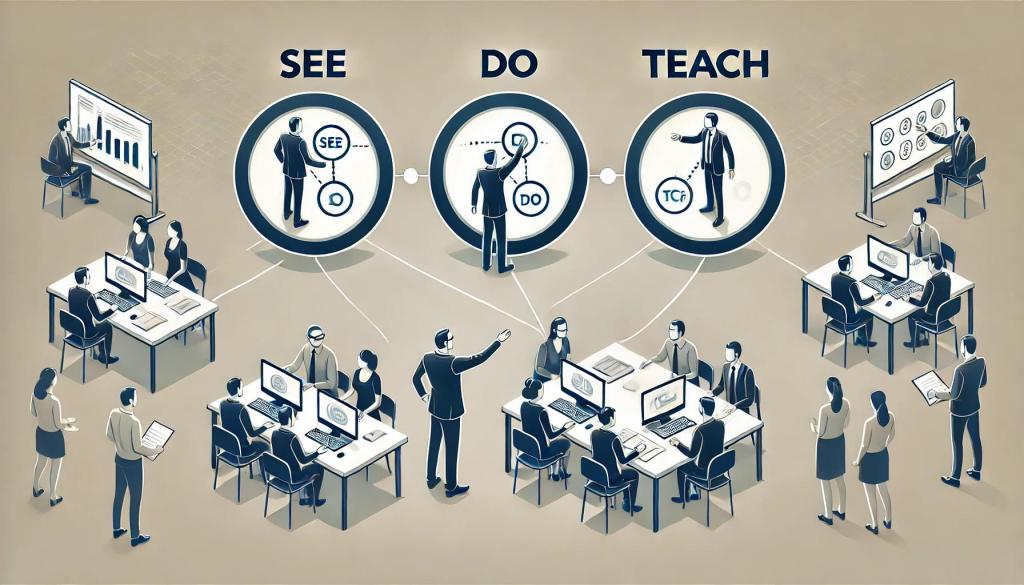
See Do Teach Method – A Powerful Approach to Learning and Capability Building

The See Do Teach method is a transformative approach to skill acquisition, team development, and leadership building. Rooted in experiential learning, it creates a dynamic cycle of observation, practice, and instruction that ensures not only the mastery of tasks but also the empowerment of individuals to become educators themselves. Here’s why it works so effectively and how it can be applied.


Why the See Do Teach Method Works

The See Do Teach method is built on the principle of active engagement, which is proven to improve retention and understanding. Each stage builds on the last, creating a progressive learning pathway that embeds skills deeply: 1. Observation Enhances Understanding: Seeing a task performed by an expert provides learners with a clear example of success, demystifying the process and showcasing best practices. 2. Practice Solidifies Skills: Doing the task immediately after observing allows learners to apply their newfound knowledge in a safe environment, with room for feedback and improvement. 3. Teaching Deepens Expertise: Explaining and demonstrating a skill to others reinforces the teacher’s mastery and ensures that knowledge is disseminated effectively across teams.


Breaking Down the Steps

Step 1: See

Observation is the foundation of the See Do Teach method. In this stage, learners watch a skilled individual perform a task, noting critical steps, techniques, and nuances.

Example: In order to train people inside the organization to become transformation managers, I worked with one of the big 4 strategic consultancies to show actual projects in the organization to our candidates.

Step 2: Do

After observing, learners move on to hands-on practice. Here, they replicate the task under guidance, applying what they’ve seen while gaining firsthand experience.

Example: After observing the expert consultants on one or two projects, the roles changed, with the internal teams executing the projects and the expert consultants reviewing and giving advice.

Step 3: Teach

The final stage involves teaching the newly learned skill to others. This step requires learners to organize their understanding and communicate it effectively, cementing their knowledge.

Example: After executing a couple of projects themselves, the internal teams became teachers to the next cohort of candidates (and the external consultants phased out) in their See-Do cycle.


The Flywheel Effect

The See Do Teach method operates as a flywheel—a self-reinforcing cycle that gains momentum over time. As learners become teachers, they perpetuate the process, creating a culture of continuous learning and growth. Over time, this approach not only spreads knowledge but also cultivates leadership qualities and drives organizational excellence.

Example in Practice: A company adopts the See Do Teach method to train employees on a new software system. Initially, a few experts demonstrate its usage (See). Next, these employees practice and refine their skills (Do). Finally, they teach the system to others (Teach). Within weeks, the organization’s proficiency with the software grows exponentially, reducing reliance on external trainers and fostering a collaborative learning environment.


Conclusion

The See Do Teach method is a simple yet profound approach to learning that combines observation, hands-on practice, and teaching. By embedding this cycle into your organization or personal development strategies, you can create a robust framework for skill acquisition, team growth, and leadership development. Over time, the method becomes a powerful flywheel, driving sustainable success and empowering individuals to achieve their full potential.