Book Review: Digital Transformation – Survive and Thrive in an Era of Mass Extinction

Although already published in 2019 (more than 5 years ago), this book points several concepts still very relevant in the fast changing world of Digital Transformation. Below a summary of these concepts and recommended actions

In Digital Transformation, technology visionary Thomas Siebel offers a compelling and pragmatic guide for business leaders confronting the rapidly converging forces of cloud computing, big data, artificial intelligence (AI), and the Internet of Things (IoT). These technologies are creating an extinction-level event for legacy business models. Siebel contends that digital transformation is not optional—it is a matter of survival.

Drawing on his experience as founder of C3.ai, Siebel presents a clear strategic playbook and numerous real-world examples that demonstrate how companies across sectors can reinvent themselves using digital technologies. His message is direct: act now, or risk irrelevance.


Key Concepts

1. The Four Technology Pillars

  • Cloud Computing – On-demand computing infrastructure enabling scalability and speed
  • Big Data – Massive, diverse datasets that can be analyzed in real-time
  • Artificial Intelligence (AI) – Predictive, adaptive algorithms that learn from data
  • Internet of Things (IoT) – Billions of connected devices generating actionable data

2. A Mass Extinction Event for Legacy Businesses

  • Over half of Fortune 500 companies have disappeared since 2000
  • Disruption is hitting all industries—not just tech
  • Traditional business models are no longer sustainable

3. Digital Transformation Is a Strategic Reinvention

  • Not about marginal gains—requires full-scale operating model redesign
  • Core focus on operational efficiency, customer experience, and new value creation

4. Data as the Foundation for AI

  • Success with AI requires clean, integrated, and governed enterprise data
  • Enterprises must break down data silos and standardize architecture

5. Speed and Scale as Differentiators

  • Companies must move fast, think big, and deliver value quickly
  • Long, drawn-out transformations are no longer viable

6. Real-World Case Studies

  • Enel – Predictive maintenance across its global energy grid
  • Royal Dutch Shell – AI for well safety, energy trading, and asset optimization
  • U.S. Department of Defense – AI and IoT for battlefield awareness

Implementation Recommendations

1. Modernize Your Tech Stack

  • Shift from legacy systems to modern, elastic cloud infrastructure

2. Centralize and Unify Data

  • Build a data integration layer across all business units
  • Ensure governance and real-time accessibility

3. Deploy High-Value AI Use Cases First

  • Focus on predictive maintenance, customer churn, fraud detection, etc.

4. Adopt Agile and DevOps at Scale

  • Encourage continuous delivery and rapid iterations

5. Re-skill and Upskill the Workforce

  • Provide training in AI, data science, and cloud technologies

6. Build a Cross-Functional Operating Model

  • Blend business, IT, and data science in unified delivery teams

7. Create a Transformation Office

  • Establish a dedicated team with budget, authority, and board-level visibility

Siebel’s 10-Point CEO Action Plan

  1. Declare Digital Transformation a Strategic Priority
  2. Establish a Digital Transformation Office (DTO)
  3. Unify Enterprise Data Architecture
  4. Identify High-Impact Use Cases
  5. Deploy Agile Methodologies
  6. Form Cross-Functional Teams
  7. Invest in AI and IoT Capabilities
  8. Lead Cultural Change from the Top
  9. Develop Digital Talent and Skills
  10. Track Progress and Iterate Continuously

Final Thoughts

Digital Transformation by Thomas Siebel is a must-read for executives seeking to lead their organizations through an era of exponential change. The convergence of cloud, big data, AI, and IoT isn’t just a tech revolution—it’s a business survival imperative. With practical insights, a strong strategic framework, and a CEO-focused action plan, this book is a blueprint for industrial-scale reinvention.

Highly recommended for leaders ready to move from intention to impact.
How Continuous Improvement (PDCA and Kaizen) drives Adoption and Value in Digital Transformation

Why Continuous Improvement Matters in Digital Transformation

Many digital transformations falter after implementation. Technologies go live, but the full value often remains unrealized. One key reason? A lack of embedded, ongoing improvement practices.

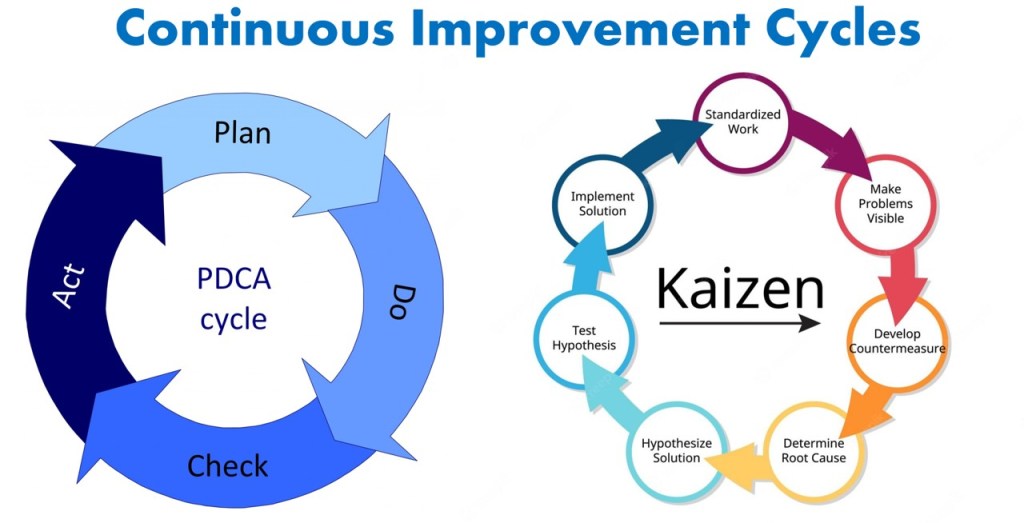
Continuous Improvement Cycles—specifically PDCA (Plan–Do–Check–Act) and Kaizen—provide the discipline required to keep improving after deployment. They shift the mindset from “project completion” to continuous value optimization, embedding a culture that learns, adapts, and evolves.

The impact is well-documented:

💡 According to McKinsey & Company (2021), organizations that embed continuous improvement into their digital transformations are 2.5 times more likely to report successful outcomes than those focused solely on implementation.

📊 A Deloitte study (2022) found that 78% of organizations that sustained their digital transformation benefits had formalized continuous improvement processes, compared to just 31% of those that didn’t.

Real transformation success isn’t just about launching change—it’s about sustaining and evolving it continuously.


PDCA: A Structured Learning Loop for the Digital Age

The PDCA cycle, originally developed by W. Edwards Deming, remains foundational in continuous improvement. In today’s digital environment, it has been enhanced with real-time data, agile delivery, and user-centered design.

1. Plan

Define the opportunity and craft a value-aligned, testable intervention.

  • Traditional: Diagnose the current state, set improvement goals, design the change.
  • Digital Evolution: Use analytics to identify friction points, apply design thinking to understand user needs, and define digital KPIs aligned with business outcomes. Prioritize minimal viable changes over complex upfront plans.

2. Do

Test the change in a low-risk environment and gather real-world feedback.

  • Traditional: Pilot changes, document execution, and support implementation.
  • Digital Evolution: Use feature flags for controlled rollouts, run A/B tests, automate behavioral data capture, and deploy rapidly to shorten time-to-feedback.

3. Check

Assess impact and extract learnings.

  • Traditional: Compare actual results to expectations, conduct retrospectives, identify lessons.
  • Digital Evolution: Monitor via real-time dashboards, use automated testing, apply UX research, and leverage predictive analytics to detect patterns.

4. Act

Scale what works—or iterate again.

  • Traditional: Standardize successful practices, communicate changes, revisit unresolved issues.
  • Digital Evolution: Automate through CI/CD pipelines, codify learnings into playbooks, build communities of practice, and use retrospectives to institutionalize learning.

✅ When PDCA is adapted with digital enablers, it becomes a strategic engine for transformation value realization—not just an operational tool.


Kaizen: Creating a Culture of Relentless Improvement

Where PDCA offers structure, Kaizen—meaning “change for better”—injects continuous improvement with energy, ownership, and culture. Originating from Japanese manufacturing excellence, it is a philosophy that emphasizes daily, incremental progress driven by everyone in the organization.

Core Principles of Kaizen

  1. Continuous, Incremental Improvement
    • Small, low-cost changes compound into significant long-term impact.
    • Especially valuable in digital contexts, where feedback loops are fast and ongoing.
  2. Process Focus
    • Kaizen targets flawed processes, not people.
    • Teams are encouraged to map and improve end-to-end workflows—not just surface-level symptoms.

💡 Insight: In many digital failures, technology isn’t the issue—process design is. Kaizen helps uncover complexity and inefficiencies that digital tools alone can’t solve.

  1. Elimination of Waste (Muda)
    • Waste is any activity that doesn’t add customer value. Kaizen uses the TIMWOODS framework to identify eight key forms of waste:
TypeDigital Example
TransportRedundant data transfers between systems
InventoryUnused data, reports, or stored digital assets
MotionExcessive navigation in systems or interfaces
WaitingDelayed approvals, system lags
OverproductionFeatures or reports no one uses
OverprocessingManual re-checks due to low trust in automation
DefectsRework from bugs, data errors
Skills (Underuse)Not tapping into employee creativity and insight
  1. 🧭 Transformation Tip: Process mining and automation can help eliminate waste—but without a Kaizen mindset, digital solutions may just replicate analog inefficiencies.
  2. Employee Involvement and Ownership
    • Those closest to the work are best positioned to improve it.
    • Kaizen encourages bottom-up contributions, while leaders provide the tools, time, and recognition.

🟢 Example: A logistics firm equipped teams with tablets to log small improvement ideas. In six months, they implemented over 200 enhancements—resulting in a 12% productivity lift.

  1. Standardization of Improvements
    • Once something works better, it becomes the new standard.
    • This locks in gains while setting the stage for the next cycle of improvements.

“Without standards, there can be no improvement. For improvement to happen, changes must be made.”
Masaaki Imai, father of Kaizen


Making It Stick: Enablers of Success

To embed continuous improvement in your transformation:

  • Leadership Commitment – Role-model curiosity and support learning-by-doing.
  • Digital Enablers – Use analytics, process mining, and feedback loops to identify what to improve.
  • Training & Empowerment – Equip teams to run their own improvement cycles.
  • Recognition – Celebrate both the small wins and the mindset behind them.

From One-Off to Ongoing

Transformation is not a finish line—it’s a journey of continuous alignment and adaptation. PDCA and Kaizen offer practical, proven ways to embed improvement into the DNA of your organization, ensuring digital capabilities evolve with business needs.

Organizations that adopt these cycles at scale don’t just implement change—they sustain it, extend it, and accelerate its value.

AI and Digital Transformation Insights from the GDS CIO Summit

Last week, I had the pleasure and privilege of attending and speaking at the GDS CIO Summit – Noordwijk | March 12-13 2025, where I joined around 150 senior leaders from the tech industry. Over two days, we explored some of the most pressing topics shaping our industry today and those that will define the near future. It came as no surprise that 84% of CIOs consider AI a top priority, yet many are still figuring out how to effectively integrate it into their business strategies.

From Vision to Value – IT as a Competitive Advantage

The summit opened with a fantastic panel discussion featuring Angelika Trawinska van Bolhuis ( Dyson), Claudio FINOL (Fyffes), and Cameron van Orman (Planview). A key theme that emerged: IT is no longer just an enabler but a core driver of business strategy—capable of creating either competitive advantage or disadvantage.

Organizations are shifting from project-based ROI thinking to a product and business value-driven approach, requiring agile, dynamic planning and tools like Planview to align IT initiatives with evolving business priorities.

AI’s Growing Impact – The Need for Real-Time Insights

AI was a dominant theme throughout the event, and Kai Waehner (Confluent) led a deep dive into how real-time data fuels AI success. Many infrastructures aren’t designed for this shift, but event-driven architectures and data streaming are emerging as critical enablers.

One standout insight: 2025 is poised to be the year of “Agentic AI”—where autonomous AI agents collaborate in real time to optimize operations. Businesses that prepare for this transformation now will gain a significant competitive edge.

The Future of Work – Productivity, Transparency & AI Integration

How can organizations improve productivity and alignment? Sven Peters (Atlassian) shared fascinating insights into modern Systems of Work. High-performing teams don’t operate in silos; they align around OKRs (Objectives & Key Results) with full transparency.

At Atlassian, they have a simple but highly effective approach: ✅ Weekly 280-character updates to keep work visible ✅ Monthly check-ins to assess progress ✅ Quarterly reviews to refine objectives

AI is deeply embedded in this process, assisting teams in defining OKRs and structuring projects in a smarter way.

AI Regulations, Security & Workforce Evolution

The regulatory landscape around AI is evolving rapidly, particularly in Europe, and Ulrika Billström (OpenText) provided a compelling look at how companies must adapt. AI orchestrators are emerging, capable of managing multiple AI agents to drive large-scale innovation.

A key trend: Instead of moving data to AI, AI is now being deployed closer to where the data resides, fundamentally changing how organizations structure their AI ecosystems.

Day 2 – Real-Time Data & Trust

I had the honor of opening Day 2 alongside Ellen Aartsen ( KPN ), Joshan Meenowa (The KraftHeinz Company), and Ben Thompson ( GDS Group) in a discussion on how data fuels real-time decision-making.

A key question we tackled: How “real-time” does data actually need to be? While not every use case requires real-time data, all use cases require trusted data. Transparency, governance, and reducing reliance on alternative, non-trusted data sources are key to success.

AI Lifecycle Challenges – Managing Rapid Evolution

Kevin K. ( Airia – Enterprise AI Simplified ) shed light on a major challenge: the rapid pace of AI development. With 6,000–8,000 new AI models being created every week, companies struggle to keep up.

The solution? AI orchestration layers—which sit between the data, source systems, and AI models—are becoming essential to manage AI lifecycles efficiently and ensure tangible ROI.

The CIO’s Role is Evolving – Business Leadership is Key

In an insightful discussion with Alan Guthrie ( Calderys) and Alexander Press (Sanofi), we explored how the role of the CIO is undergoing a fundamental shift.

Today’s CIOs must: ✔ Operate at strategic, tactical, and operational levels ✔ Set clear technology guardrails while fostering innovation ✔ Shift IT functions toward product-driven organizations

Technology leadership alone is no longer enough—CIOs must now be business leaders.

Maximizing Tech Investments – Understanding TCO & ROI

To close the summit, @ManishNirmal ( Vimeo) provided a valuable session on how to assess the true Total Cost of Ownership (TCO). Hidden costs—such as training, migration, and operational impact—often make or break the business case for tech investments.

His recommendation? Use frameworks like MEDDIC (Metrics, Economic Buyer, Decision Criteria, Identify Pain, Champion) to map tech solutions based on real business value.

One of the most memorable takeaways: Crawl before you walk, walk before you run—but standing still is not an option.


Final Thoughts

The GDS CIO Summit was a fantastic opportunity to exchange insights with industry leaders and explore where AI and digital transformation are headed. A huge thank you to the GDS Group, especially Sophie Charnaud for her support, and all the brilliant speakers and participants for making it such an insightful event!

Balancing between Balcony and Dance Floor – Tip for Leadership in Digital Transformation

The “Balcony and Dance Floor” metaphor, introduced by Ronald Heifetz and Marty Linsky, offers a powerful framework for balancing hands-on leadership with strategic oversight. Leaders must be immersed in execution (the dance floor) while also stepping back to gain a broader perspective (the balcony). Striking this balance is crucial for digital transformation success.

Understanding the Metaphor in a Digital Transformation Context

  • The Dance Floor: This represents the daily execution of digital initiatives—overseeing system rollouts, engaging with teams, managing stakeholder concerns, and addressing immediate roadblocks. Leaders who remain solely on the dance floor risk being overwhelmed by operational challenges, losing sight of strategic priorities.
  • The Balcony: This vantage point provides the necessary space to assess overall progress, identify patterns, and anticipate challenges. A balcony perspective allows leaders to ensure that digital initiatives align with long-term business goals, rather than being reactive to short-term operational issues.

Applying the Concept to Digital Transformation Leadership

  1. Maintaining Strategic Alignment: Leaders must continuously step onto the balcony to ensure digital transformation initiatives align with broader business objectives. Without this, transformation efforts may become disjointed or lose executive sponsorship.
  2. Balancing Execution with Reflection: While hands-on engagement is necessary to drive momentum, leaders should also create time for reflection, whether through strategic reviews, executive meetings, or external benchmarking.
  3. Empowering Teams While Providing Vision: Leaders should guide digital transformation by setting a clear vision from the balcony but allow teams to execute with autonomy on the dance floor. This approach fosters innovation while maintaining alignment with the strategic roadmap.
  4. Leveraging Data and Insights: Digital transformation generates vast amounts of data. Leaders must use this data to inform their balcony perspective, identifying trends and adjusting strategies as necessary.
  5. Ensuring Adaptability: Transformation initiatives rarely go as planned. A leader’s ability to move between the dance floor and balcony ensures they can adjust strategies dynamically, responding to challenges without losing sight of the ultimate goal.

The Leadership Imperative

Effective digital transformation leaders seamlessly transition between execution and strategic reflection. Those who remain only on the dance floor risk micromanagement and burnout, while those who stay only on the balcony may become disconnected from execution realities. By mastering this balance, leaders can guide their organizations through digital transformation with clarity, resilience, and adaptability.

In an era of rapid technological evolution, adopting the “Balcony and Dance Floor” approach is more than a leadership technique—it is a necessity for driving sustainable digital change.

Unlocking Value in Digital Transformation with VDT & BRM

The Importance of Value Driver Trees and Benefit Realization Management in Digital Transformation

Digital transformation is not just about implementing new technologies—it is about generating real, measurable business value. Too often, organizations invest in digital initiatives without a clear understanding of how these efforts contribute to strategic goals, leading to wasted resources and unfulfilled expectations. I could have put this tool as well in the Strategy to Plan section, since you will need these insights already when setting up a transformation. Due to it’s focus on Sustainable Value Creation you find it here.

To ensure digital transformation delivers tangible benefits, organizations need structured approaches that tie initiatives to business value. Value Driver Trees (VDT) provide a visual and analytical way to break down how value is created, while Benefit Realization Management (BRM) ensures that transformation initiatives deliver the expected outcomes. By integrating these two approaches, organizations can bridge the gap between strategy and execution, ensuring every initiative contributes to meaningful business impact.

This article explores these frameworks, their interaction, and provides a step-by-step guide for implementing them effectively in digital transformation initiatives.


Understanding the Approaches

1. Value Driver Tree (VDT)

A Value Driver Tree (VDT) is a structured framework that breaks down an organization’s high-level business objectives into actionable and measurable components. It helps leaders identify the key levers that drive financial and operational performance.

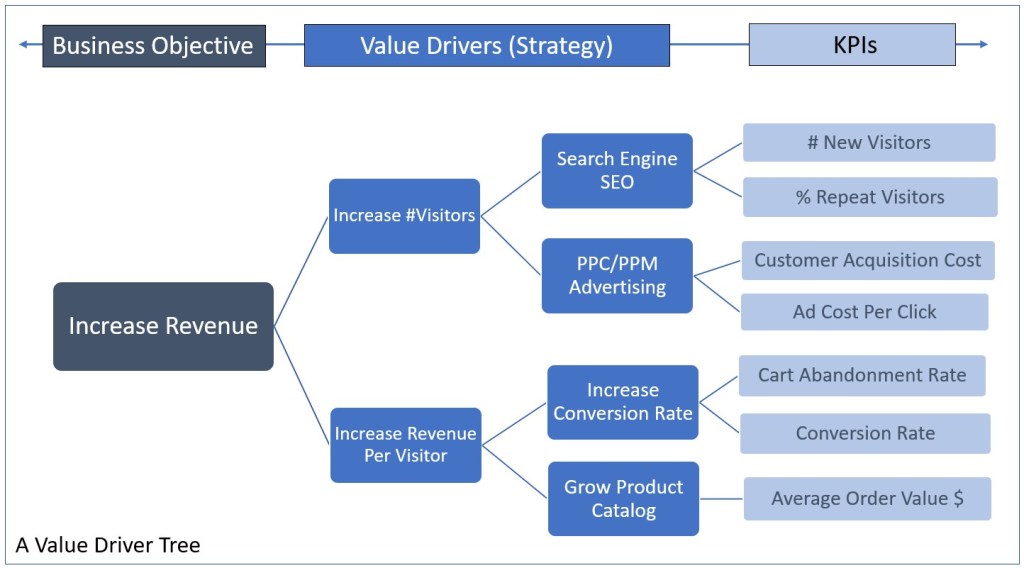
Example: VDT for Retail e-Commerce Growth

Goal: Increase e-Commerce Revenue

👉 Sales Volume Growth
 🔹 Improve Website Conversion Rate
 🔹 Increase Traffic via Digital Marketing
👉 Average Order Value Increase
 🔹 Personalized Product Recommendations
 🔹 Bundled Pricing Strategy
👉 Customer Retention Improvement
 🔹 Loyalty Program Enhancements
 🔹 Improved Customer Support Response Time

This hierarchical breakdown helps organizations prioritize initiatives that have the most impact on revenue growth. Below one more example from the web on how to look at Value Drivers/KPIs.


2. Benefit Realization Management (BRM) – PMI Approach

PMI’s Benefit Realization Management (BRM) framework provides a structured approach to ensure that projects and programs deliver measurable benefits that align with strategic objectives. It consists of three key phases:

  1. Benefit Identification: Define expected benefits, align them with strategic goals, and establish key performance indicators (KPIs).
  2. Benefit Execution: Monitor benefits realization through governance and stakeholder engagement during project execution.
  3. Benefit Sustainment: Ensure ongoing measurement and reinforcement of benefits post-project completion.

Example: BRM in an ERP Implementation

Objective: Improve Operational Efficiency Through an ERP System
👉 Benefit: Reduced Order Processing Time
 🔹 Initiative: Automate manual order entry processes
 🔹 KPI: Reduce order processing time from 48 hours to 12 hours
👉 Benefit: Lower IT Costs
 🔹 Initiative: Consolidate legacy systems into a unified ERP platform
 🔹 KPI: Reduce IT maintenance costs by 30%

By applying BRM, organizations can ensure that digital transformation projects remain focused on delivering real business benefits rather than just implementing technology for technology’s sake.


How VDT and BRM Interact

VDT and BRM complement each other by linking high-level business value drivers with structured benefit realization processes. Here’s how they work together:

  1. VDT Identifies Key Business Drivers → Helps organizations understand where value comes from.
  2. BRM Ensures Benefits Are Tracked and Realized → Ensures projects are aligned with value drivers and measured effectively.
  3. VDT Provides a Data-Driven Basis for Prioritization → Helps select the most impactful initiatives.
  4. BRM Embeds Value Tracking into Governance → Ensures sustained realization of benefits post-implementation.

By integrating VDT and BRM, organizations can establish a clear, data-driven transformation roadmap and ensure continuous value creation.


Implementation Plan

Step 1: Develop a Value Driver Tree

  • Identify overarching business objectives (e.g., revenue growth, cost reduction, customer experience enhancement).
  • Break them down into measurable value drivers and initiatives.
  • Assign KPIs to each driver to establish clear tracking mechanisms.

Step 2: Align BRM to the Value Driver Tree

  • Define benefits based on value drivers.
  • Create a Benefits Dependency Network mapping initiatives to expected benefits.
  • Assign accountability for benefit realization.

Step 3: Establish Governance and Measurement

  • Integrate benefit tracking into program governance.
  • Set up regular benefit reviews (e.g., quarterly assessments).
  • Adjust strategies if expected benefits are not materializing.

Example: Applying VDT and BRM in a Digital Transformation Initiative

Scenario: A Bank’s Digital Banking Transformation

Step 1: Develop a Value Driver Tree

Goal: Enhance Digital Banking Experience
👉 Increase Mobile App Adoption
 🔹 Simplify Onboarding Process
 🔹 Improve User Interface & Experience
👉 Reduce Customer Support Costs
 🔹 Introduce AI-powered Chatbots
 🔹 Automate Fraud Detection Alerts

Step 2: Align BRM to VDT

BenefitKPIInitiativeMeasurement
Higher Mobile Adoption% of active usersUX RedesignMonthly user growth rate
Lower Support CostsReduction in live callsAI Chatbot DeploymentCall volume trend
Increased SecurityFraud incident reductionAI-driven fraud detectionFraud report metrics

Step 3: Governance & Tracking

  • Regular executive reviews track realized vs. projected benefits.
  • Adjustments made based on data insights and customer feedback.

Conclusion: Driving Digital Transformation Success with VDT and BRM

Successful digital transformation requires more than just implementing technology—it demands a structured approach to ensure value realization. By leveraging Value Driver Trees (VDT) and Benefit Realization Management (BRM) together, organizations can:

✅ Clearly define how transformation initiatives contribute to business objectives.
✅ Prioritize efforts based on quantifiable value impact.
✅ Continuously track and adjust for sustained benefit realization.

To drive real business outcomes, organizations should integrate these frameworks into their transformation governance, ensuring a clear line of sight from strategic objectives to measurable benefits.

Call to Action

If your organization is embarking on a digital transformation journey, start by building your Value Driver Tree and structuring a Benefit Realization Framework. Need help applying these methods? Let’s discuss how to tailor them to your organization’s needs.

Effective Risk Management in Digital Transformation

1. Introduction

Organizational transformations represent some of the most complex undertakings in business. According to research by McKinsey & Company (2019), nearly 70% of transformations fail to achieve their stated objectives, with inadequate risk management frequently cited as a contributing factor.

Effective risk management requires a structured approach where risks are identified, assessed, and mitigated at the appropriate levels:

  • Portfolio Risks – Strategic risks impacting the entire transformation, requiring executive oversight. Examples include: resource allocation, organizational capacity for change, external (market/regulatory) and financial sustainability risks.
  • Program Risks – Cross-project risks affecting multiple initiatives, managed at the program level. Examples include: interdependencies/resource conflicts between projects, timeline/milestone risks, development, technical integration, adoption, and benefit realization risks.
  • Project Risks – Operational and execution risks handled by project teams. Examples include: scope/requirements, schedule, budget, resource, quality, performance, team capability/capacity, and stakeholder acceptance risks.

A clear governance structure ensures that risks are escalated to the right level—whether the Executive Steering Committee, Program Leadership, or Project Management—for timely decision-making and intervention.

2. Risk Management in Transformation Governance

To embed risk management into transformation governance effectively, organizations must:

  • Define risk ownership at different levels (executive, program, project).
  • Establish governance bodies with clear escalation mechanisms.
  • Integrate risk reviews into decision-making forums.
  • Ensure risk reporting is transparent, structured, and aligned with transformation objectives.

3. Risk Assessment & Mapping Tools

Several proven tools can help organizations systematically assess and map risks:

  1. Risk Matrix (Probability vs. Impact): Prioritizes risks based on likelihood and severity.
  2. Risk Breakdown Structure (RBS): Categorizes risks by type (strategic, organizational, operational, financial, technical, change management, etc.).
  3. Bow-Tie Analysis: For high-priority risks, visualizes potential causes, consequences, and controls for a given risk.
  4. Monte Carlo Simulations: Provides probabilistic forecasting for risk impact on budgets and timelines.
  5. SWIFT (Structured What-If Technique): Facilitates structured brainstorming on potential risks.

Each of these tools helps organizations gain visibility into risks and prepare for effective mitigation.

4. Mitigation Planning & Execution

Risk mitigation involves defining structured responses based on the nature and severity of risks:

  • Avoid: Eliminating the risk by altering the transformation approach.
  • Mitigate: Reducing the impact or probability through proactive measures.
  • Transfer: Shifting the risk to a third party (e.g., insurance, outsourcing).
  • Accept: Acknowledging the risk with contingency plans in place.

A Risk Register should be maintained to track risks, owners, mitigation actions, timelines, resources, and follow-ups. Additionally, mitigation progress should be reviewed in governance forums to ensure accountability and timely interventions.

5. A Step-by-Step Guide to Implementing Risk Management

  1. Risk Management Framework: Agree on the objectives, structure, policies, and procedures.
  2. Risk Identification: Engage stakeholders and put mechanisms in place across all levels to surface risks early.
  3. Risk Assessment: Use structured tools to break risks down, categorize them, and evaluate the likelihood and impact.
  4. Risk Prioritization: Align risk priorities with transformation goals and organizational risk appetite.
  5. Mitigation Strategy Development: Define risk responses (avoid, transfer, mitigate, accept) and allocate necessary resources.
  6. Governance & Oversight: Integrate risk reviews into transformation governance structures, with dedicated risk review sessions.
  7. Ongoing Monitoring & Communication: Establish reporting mechanisms, including risk trend reporting, and continuous improvement processes.

6. Example – Global Financial Services Transformation

A major financial institution undertaking a digital transformation employed a three-tiered risk management approach:

Portfolio Level (Executive Steering Committee)
The ESC focused on strategic risks including regulatory compliance, competitive disruption, and organizational capacity for change. They established quarterly “risk deep dives” where each transformation workstream presented their top risks and mitigation strategies. The ESC maintained a portfolio-level risk contingency reserve, allocating funds to address emerging risks based on severity and alignment with strategic priorities.

Program Level (Transformation Office)
The Transformation Office implemented a “Risk Guild” comprising risk owners from each workstream who met bi-weekly to identify cross-program dependencies and risks. They employed a sophisticated risk visualization dashboard that highlighted interdependencies between workstreams and potential cascading impacts. The office also maintained a centralized risk register with automated escalation of risks that exceeded defined thresholds.

Project Level (Agile Teams)
Individual teams incorporated risk identification into their sprint planning and retrospectives, with “risk spikes” allocated to investigate high-priority uncertainties. Teams used “risk-adjusted story points” to account for implementation uncertainties in their capacity planning. A “see something, say something” culture encouraged anyone to raise potential risks through a simple digital form.

The results were impressive: while industry benchmarks suggested that 70% of financial services transformations fail to meet objectives, this institution achieved 85% of its targeted benefits within the planned timeframe.

7. Common Pitfalls and How to Avoid Them

Risk Management as Compliance Exercise

  • Problem: Risk management becomes a bureaucratic checkbox exercise rather than a decision-making tool.
  • Solution: Focus on decision-relevance by integrating risk discussions directly into key decision points. Emphasize how risk information has influenced specific decisions. Use concrete, specific risk descriptions rather than generic categories.

Overemphasis on Documentation

  • Problem: Teams spend more time documenting risks than managing them.
  • Solution: Simplify documentation requirements, focusing on action-oriented information. Implement user-friendly tools that minimize administrative burden. Establish “one source of truth” rather than duplicative risk registers.

Failure to Close the Loop

  • Problem: Identified risks have mitigation plans, but no one follows up on implementation.
  • Solution: Implement clear accountability for mitigation actions with regular status reviews. Treat high-priority risk mitigations as projects with defined deliverables, timelines, and resources. Celebrate successful risk mitigation.

Risk Isolation

  • Problem: Risk management operates in isolation from other management processes.
  • Solution: Integrate risk considerations into strategic planning, resource allocation, and performance management. Use consistent language and frameworks across processes. Ensure risk owners participate in relevant decision forums.

Static Approach

  • Problem: Risk register becomes a static document that doesn’t evolve with changing circumstances.
  • Solution: Implement regular risk refresh cycles. Establish triggers for out-of-cycle risk reviews based on internal or external events. Create mechanisms to identify and assess emerging risks.

8. Conclusion

Risk management in organizational transformation is not a peripheral activity but a central governance function that enables informed decision-making and increases the likelihood of success. By implementing a multi-layered approach that addresses portfolio, program, and project risks, organizations can navigate the inherent uncertainties of transformation with greater confidence.

The tools, frameworks, and step-by-step guide outlined in this article provide a roadmap for implementing robust risk management practices. However, the most important factor is creating a risk-aware culture where identifying and managing risks becomes part of everyone’s responsibility.

The Right Question: Importance of Defining Problems for Effective AI and Digital Solutions


Why Problem Definition is Critical in Digital Transformation

In the rush to adopt digital and AI solutions, many organizations fall into a common trap—jumping straight to implementation without clearly defining the problem they aim to solve. This often leads to expensive failures, misaligned solutions, and wasted effort.

Defining the right problem is not just an operational necessity but a strategic imperative for executives leading digital transformation. A well-framed problem ensures that technology serves a real business need, aligns with strategic goals, and delivers measurable impact.

As Albert Einstein famously noted:
“If I had an hour to solve a problem, I’d spend 55 minutes thinking about the problem and 5 minutes thinking about solutions.”

This article presents a practical framework for defining problems effectively—leveraging structured problem-solving methods such as Lean Thinking’s “5 Whys,” root cause analysis, and validated learning to guide better decision-making.


A Practical Framework for Problem Definition

Step 1: Identify the Symptoms

A common mistake is confusing symptoms with root problems. AI or digital solutions often get deployed to address surface-level inefficiencies, but without understanding their underlying causes, organizations risk treating the wrong issue.

  • Gather data and observations:
    Use operational data, system logs, financial reports, and performance metrics to identify inefficiencies or gaps.
  • Leverage customer and employee feedback:
    Conduct surveys, analyze customer support transcripts, and interview employees to gain qualitative insights.
  • Avoid rushing to conclusions:
    Be wary of “obvious” problems—many inefficiencies stem from deeper systemic issues.

💡 Example: A retail company notices declining online conversion rates. Instead of assuming they need a chatbot for engagement, they investigate further.


Step 2: Uncover the Root Causes

Once symptoms are identified, the next step is to determine their underlying cause.

  • Use the “5 Whys” technique:
    Repeatedly ask “Why is this happening?” until you uncover the fundamental issue.
  • Employ Fishbone (Ishikawa) Diagrams:
    Categorize possible causes into key areas such as process inefficiencies, technology gaps, and human factors.
  • Conduct stakeholder workshops:
    Cross-functional teams bring diverse perspectives that help uncover hidden issues.

💡 Example: A financial services company automates loan approvals to reduce delays. But using the “5 Whys,” they realize the real issue is fragmented customer data across legacy systems, not just a slow approval process.


Step 3: Craft a Clear Problem Statement

Once the root cause is determined, the problem must be precisely defined to ensure alignment and clarity.

  • Use the “Who, What, Where, When, Why, How” framework:
    Articulate the problem in a structured manner.
  • Make the statement SMART (Specific, Measurable, Achievable, Relevant, Time-bound):
    Avoid vague, high-level issues that lead to unfocused solutions.
  • Tie the problem to business impact:
    How does this problem affect revenue, efficiency, customer satisfaction, or competitive advantage?

Example Problem Statement:
“The customer support team’s average resolution time is 15 minutes, which is 5 minutes over our goal, due to the lack of a centralized customer knowledge base. This is leading to lower customer satisfaction and higher support costs.”


Step 4: Validate the Problem

Before investing in a full-scale solution, the problem definition must be validated to ensure it is correctly framed.

  • Test assumptions through small-scale experiments or prototypes:
    A/B testing, proof-of-concepts, or simulations can validate whether solving this problem has the expected impact.
  • Gather feedback from stakeholders:
    Ensure alignment across business units, IT teams, and end users.
  • Iterate if needed:
    If the problem statement doesn’t hold up under real-world conditions, refine it before proceeding.

💡 Example: A hospital wants AI-driven diagnostics to reduce misdiagnoses. A pilot project reveals that inconsistent patient data, not diagnostic errors, is the real issue—shifting the focus to data standardization rather than AI deployment.


Conclusion: Problem Definition as a Competitive Advantage

Executives must ensure that problem definition precedes solution selection in digital transformation. By following a structured framework, leaders can avoid costly missteps, align digital investments with business priorities, and drive real impact.

The best AI or digital solution in the world cannot fix the wrong problem. Taking the time to define the problem correctly is not just best practice—it’s a competitive advantage that enables sustainable transformation and long-term success.


What’s Your Experience? Let’s Continue the Conversation!

How do you approach problem definition in your digital and AI initiatives? Have you faced challenges in aligning solutions with real business needs?

💬 Join the conversation in the comments below or connect with me to discuss how your organization can improve its problem-definition process.

📩 Subscribe to my newsletter on LinkedIn https://bit.ly/3CNXU2y for insights on digital transformation and leadership strategies.

🔍 Need expert guidance? If you’re looking to refine your digital or AI strategy, let’s connect—schedule a consultation to explore how we can drive transformation the right way.


Maximizing Digital Success with Strategic Workforce Planning

Introduction

In my many years involved in strategy formulation, one of the most undervalued tools, which, when properly used, led to extremely valuable discussions and insight, was Strategic Workforce Planning. When planning a Digital Transformation and aligning with leadership on the expected impact of AI implementations, this can be an extremely valuable tool.

Companies invest heavily in cutting-edge technology, yet many overlook a crucial element: their workforce. Strategic Workforce Planning (SWP) is the bridge between business transformation and workforce readiness. It ensures that organizations have the right talent in place to execute their digital ambitions effectively. Without it, even the most sophisticated technology initiatives risk failure due to skill gaps, resource mismatches, and a lack of strategic alignment.

What is Strategic Workforce Planning?

Strategic Workforce Planning is a structured, forward-looking approach that aligns talent with an organization’s business objectives. It enables companies to proactively address workforce needs, anticipate skill shortages, and develop strategies to build or acquire the necessary capabilities.

SWP is most effective when deployed during periods of transformation—such as digital overhauls, automation initiatives, or AI integration. It follows a structured Four-Step Framework:

  1. Set Strategic Direction – Align workforce planning with business and digital transformation goals, ensuring that talent strategies support overall corporate objectives.
  2. Analyze Current Workforce – Assess existing workforce capabilities, identify skill gaps, and evaluate how well employees are prepared for AI and digital shifts.
  3. Forecast Future Requirements – Predict the skills, roles, and workforce composition required to operate in the future digital environment.
  4. Develop Action Plans – Implement targeted hiring, reskilling, and upskilling initiatives to bridge workforce gaps and ensure operational readiness.

Key Takeaways from Research on SWP & Digital Transformation

Recent research underscores the importance of integrating SWP with digital transformation efforts. Three major reports highlight critical trends:

  • Skill-Based Workforce Management (Boston Consulting Group): Organizations must anticipate skill shortages in AI, automation, and digital transformation. Proactive upskilling and reskilling initiatives will be key to staying competitive.
  • The Role of SWP in the Age of AI (McKinsey & Company): AI-driven automation will drastically reshape workforce structures. Companies must integrate AI-driven forecasting tools into workforce planning to manage these shifts effectively.
  • Mastering Digital Transformation in Workforce Management: The ability to map opportunities and challenges in digital transformation is crucial. SWP helps leaders simulate different workforce scenarios and plan for skill evolution.

The Benefits of a Centralized Workforce Strategy

For executives leading digital transformation, having a single source of truth for workforce planning is a game-changer. A centralized SWP approach provides:

  • Data-Driven Decision-Making – Leaders gain real-time insights into talent readiness and can make informed staffing decisions.
  • Scenario Planning – Organizations can model different workforce scenarios to anticipate talent needs and mitigate risks.
  • Workforce Agility – As digital initiatives evolve, companies can quickly adapt their workforce strategies to align with new priorities.

Linking Digital Transformation to Workforce Utilization

Digital transformation does not just introduce new technologies—it fundamentally changes how work gets done. AI and automation are redefining roles, requiring companies to rethink workforce utilization and occupation structures.

Case Studies in Action:

  • Google has leveraged AI-powered workforce planning tools to anticipate skill needs and align talent development with business priorities. By using data-driven insights, Google ensures that it continuously hires, upskills, and reallocates employees to projects that drive innovation. Their approach integrates predictive analytics, allowing the company to proactively manage workforce transitions as new technologies emerge, ensuring that employees are always equipped with the most relevant skills.
  • ProRail, the Dutch railway infrastructure manager, faced the challenge of increasing efficiency through digitization without expanding its workforce. To address this, ProRail implemented a workforce planning initiative focused on reskilling existing employees in automation and data analytics. This strategic approach enabled ProRail to optimize train traffic management, integrate AI-driven decision-making, and prepare its workforce for a future where digital operations play a central role in rail infrastructure management.
  • Microsoft recognized that the future of work required a significant shift in workforce capabilities. To address this, the company launched large-scale reskilling and learning programs designed to prepare employees for AI and digital advancements. Through initiatives like the Microsoft AI Business School and enterprise-wide learning platforms, Microsoft ensures that its workforce remains competitive in an increasingly AI-driven world. Their SWP strategy includes career path modeling, internal mobility programs, and digital literacy initiatives to align talent with the company’s future vision.

Developing a Talent Plan for the Future

To future-proof their organizations, senior executives must take a proactive approach to workforce planning:

  • Identify future skill requirements based on anticipated digital trends.
  • Develop recruitment, training, and upskilling strategies to bridge gaps.
  • Leverage AI-driven workforce planning tools to enhance talent forecasting.

By treating workforce planning as a strategic function rather than an operational necessity, companies can ensure that they have the right talent in place to drive digital success.

The Role of SWP in the Future of Work

The level of automation in jobs is expected to skyrocket in the coming years. Organizations that fail to integrate workforce planning into their digital strategy risk falling behind. Digital and AI solutions must be seamlessly linked to workforce development, ensuring that employees are prepared for the rapid technological shifts ahead.

Conclusion

Strategic Workforce Planning is not just a tactical HR function—it is a core pillar of successful digital transformation. By embedding SWP into the strategic planning process, organizations can future-proof their workforce, optimize resource utilization, and ensure they have the right talent in place to harness the full potential of AI and automation.

For senior executives and transformation leaders, the message is clear: technology alone will not drive digital success. A well-planned, strategically aligned workforce is the key to turning digital aspirations into operational reality.

Competing in the Age of AI

Although Competing in the Age of AI: Strategy and Leadership When Algorithms and Networks Run the World by Marco Iansiti and Karim Lakhani was published in 2021—and much has happened since, including the launch of ChatGPT—it remains highly relevant. It provides valuable insights into why companies that control digital networks are capturing more and more business value.

Unlike traditional firms that rely on human-driven processes, AI-driven organizations leverage algorithms and digital networks to deliver unprecedented efficiency, scalability, and innovation. Companies such as Amazon, Ant Financial, and Google have shown how AI-powered models can create new markets, redefine value chains, and leave legacy competitors struggling to catch up.

For executives and transformation leaders, the challenge is clear: how can traditional organizations adapt to this new era? How can they integrate AI into their operations to drive agility, innovation, and sustainable competitive advantage? This summary breaks down the book’s key insights chapter by chapter, supplemented with real-world examples and strategic takeaways.


Chapter 1: AI-Centric Organizations – A New Operating Paradigm

Key Takeaways:

  • AI-driven firms operate fundamentally differently from traditional businesses, removing the need for human-driven decision-making at scale.
  • These companies leverage digital networks and algorithms to scale without being constrained by physical assets or labor.
  • AI enables firms to create more agile and adaptive business models, continuously refining their offerings through real-time learning.

Example: Ant Financial

Ant Financial, a subsidiary of Alibaba, transformed the financial services industry by using AI to assess credit risk, detect fraud, and approve loans within seconds—without human intervention. Unlike traditional banks, which rely on manual underwriting processes, Ant Financial’s AI-powered approach allows it to serve millions of customers instantly, with a near-zero marginal cost per transaction.


Chapter 2: AI-Driven Scale, Scope, and Learning – Breaking Traditional Constraints

Key Takeaways:

  • AI allows organizations to scale without the traditional constraints of labor and physical assets.
  • AI-driven companies can expand into adjacent industries more easily than traditional firms.
  • Machine learning continuously improves business models, creating a competitive advantage that compounds over time.

Example: Netflix’s AI-Powered Content Strategy

Netflix uses AI to optimize content recommendations, predict demand for original shows, and personalize the user experience. Unlike traditional media companies that rely on executives to decide what content to produce, Netflix’s AI-driven strategy allows it to maximize engagement, reduce churn, and improve content investments.


Chapter 3: AI and the Transformation of Operating Models

Key Takeaways:

  • AI-driven companies automate decision-making, making operations more efficient and responsive.
  • Traditional processes that rely on human judgment are replaced by real-time algorithmic decision-making.
  • AI-powered platforms connect suppliers, consumers, and partners more efficiently than traditional business models.

Example: Amazon’s AI-Powered Logistics

Amazon’s fulfillment centers use AI-driven robotics and predictive analytics to optimize inventory, reduce shipping times, and anticipate customer demand. This allows Amazon to deliver millions of packages per day with unmatched efficiency compared to traditional retailers.


Chapter 4: Rewiring the Value Chain with AI

Key Takeaways:

  • AI disrupts traditional value chains by enabling direct-to-consumer and on-demand business models.
  • AI enables firms to optimize supply chains, reduce waste, and improve efficiency.
  • Traditional firms struggle to adapt because of legacy processes and siloed data.

Example: Tesla’s AI-Driven Manufacturing

Tesla reimagined the automotive value chain by integrating AI into manufacturing, autonomous driving, and direct-to-consumer sales. Unlike legacy automakers, Tesla collects real-time data from vehicles, allowing it to improve its autonomous driving algorithms and enhance product performance over time.


Chapter 5: The Strategic Challenges of AI-First Companies

Key Takeaways:

  • AI-first companies create network effects, making them difficult to compete with once they achieve scale.
  • Traditional companies must choose whether to compete, collaborate, or transform their models.
  • Ethical issues such as bias, data privacy, and regulatory challenges must be addressed.

Example: Facebook’s AI and Ethical Challenges

Facebook’s AI-powered content recommendation system maximizes engagement but has faced scrutiny for spreading misinformation and bias. This demonstrates that while AI offers business advantages, leaders must also consider its societal impact and ethical responsibilities.


Chapter 6: AI and Competitive Dynamics – A New Battlefield

Key Takeaways:

  • AI reshapes competitive advantage, prioritizing firms with superior data and algorithms.
  • The speed of AI-driven innovation reduces the response time for traditional competitors.
  • Regulatory and policy challenges emerge as AI disrupts traditional industries.

Example: Google vs. Traditional Advertising

Google’s AI-driven ad targeting disrupted the traditional advertising industry, replacing intuition-based media buying with precision-targeted digital advertising. Legacy media companies struggled to keep up as Google and Facebook captured the majority of digital ad revenue.


Chapter 7: Managing the Risks of AI

Key Takeaways:

  • AI introduces new risks such as bias, security vulnerabilities, and lack of transparency.
  • Governance frameworks are essential to ensure responsible AI usage.
  • Organizations must navigate regulatory uncertainty and ethical concerns.

Example: Microsoft’s Responsible AI Initiative

Microsoft has implemented governance structures to ensure AI transparency, mitigate bias, and adhere to ethical principles. This proactive approach highlights the importance of responsible AI leadership.


Chapter 8: Leading in an AI-Driven World

Key Takeaways:

  • Leaders must embrace AI-driven decision-making and foster a data-centric culture.
  • AI literacy is essential for executives guiding digital transformation.
  • Workforce reskilling is critical to aligning human expertise with AI capabilities.

Example: Satya Nadella’s AI-Driven Leadership at Microsoft

Under Nadella’s leadership, Microsoft transformed into an AI-powered enterprise by embedding AI into products and services while ensuring responsible innovation.


Chapter 9: Reinventing the Enterprise for AI

Key Takeaways:

  • Organizations must undergo fundamental redesigns to remain competitive in the AI era.
  • Agile, cross-functional teams replace bureaucratic decision-making structures.
  • AI integration must be continuous, not a one-time project.

Example: Goldman Sachs’ AI Transformation

Goldman Sachs is using AI to automate trading, manage risk, and enhance customer experiences, shifting from a traditional financial services model to an AI-powered financial technology firm.


Chapter 10: The Future of AI and Business Strategy

Key Takeaways:

  • AI will continue to reshape industries, creating new market leaders and rendering others obsolete.
  • Balancing technological innovation with ethical and regulatory concerns is crucial.
  • Firms that fail to evolve their AI strategies risk becoming irrelevant.

Example: AI’s Role in the Future of Healthcare

AI is transforming healthcare through predictive analytics, personalized medicine, and robotic surgery, changing the landscape for providers, insurers, and patients alike.


Actionable Steps for Transformation Leaders

  1. Develop an AI Strategy: Align AI with business objectives and competitive differentiation.
  2. Invest in Data and AI Talent: Build capabilities in AI, data science, and automation.
  3. Redesign Organizational Processes: Move from human-driven to AI-driven decision-making.
  4. Embrace Ethical AI Governance: Ensure AI is transparent, fair, and responsible.
  5. Continuously Adapt: AI is not a one-time project—organizations must continuously evolve.

Final Thought

The AI revolution is not a distant future—it is happening now. Transformation leaders must act decisively to harness AI’s potential, reshape their organizations, and build a sustainable competitive advantage. The choice is clear: adapt or be disrupted.

Enhancing PDCA for Continuous Improvement

The Plan-Do-Check-Act (PDCA) cycle serves as a foundational framework for structured, data-driven continuous improvement. However, to maximize its impact, integrate complementary methodologies at each stage of the cycle. This article explores how you can enhance PDCA with Root Cause Analysis, Agile Execution, Visual Management, Standard Work, and Kaizen Events, all supported by Gemba Walks to ensure alignment with operational realities.


Plan: Identifying and Addressing the Right Causes

Many improvement initiatives fail not because of poor execution, but because they target symptoms rather than root causes. The Plan phase is critical in ensuring that the right problems are being addressed.

  • Utilize Root Cause Analysis techniques like the 5 Whys and Fishbone Diagrams to uncover the fundamental issues rather than applying quick fixes.
  • Involve cross-functional teams in problem identification to ensure diverse perspectives and deeper insights.
  • Clearly define success criteria and key performance indicators (KPIs) to measure the impact of changes.

Personal Experience: In the adoption of a new digital tool, a constant flow of tickets were raised for additional reports. The root cause was not that reports were missing, but people did not trust the data and tried to get reports to show this. Creating more reports is therefor not the solution, building trust in the data is.


Do: Implementing Fast, Iterative Improvements Using Agile

Traditional improvement initiatives often fail due to long implementation cycles that do not adapt to emerging insights. In the Do phase, an Agile approach enables teams to execute improvements iteratively, ensuring quick learning and adaptation.

  • Break down solutions into small, incremental changes rather than large-scale, disruptive overhauls.
  • Use short sprints to test hypotheses, gather feedback, and refine the approach dynamically.
  • Foster a culture of empowerment by enabling frontline employees to take ownership of improvements within their domain.

Personal Experience: Especially shortly after Go Live, people experience all kinds of issues in working with the new system. Logging the issues for the next big release might be tempting from a program perspective, but you lose both the momentum in adopting the solution as well as the business/process performance will lag behind.


Check: Leveraging Daily and Visual Management

Without structured reflection and analysis, even well-intentioned improvement efforts risk failure. The Check phase ensures that the changes implemented are having the desired effect and allows for course corrections.

  • Implement Daily Management Routines, such as stand-up meetings, to assess progress and identify real-time roadblocks.
  • Utilize Visual Management Tools like performance dashboards and Kanban boards to provide clear visibility into key metrics.
  • Conduct regular reviews to assess whether improvements align with strategic objectives.

Personal Experience: Daily management in combination with clear, trustworthy dashboards is one of the most impactful concepts to drive the adoption, performance, and engagement of the teams. It fosters fast feedback and helps to accelerate the PDCA cycle.


Act: Standardizing or Pivoting Based on Results

The final phase of the PDCA cycle ensures that improvements either become standard practice or trigger deeper exploration through structured problem-solving.

  • If the improvement proves effective, incorporate it into Standard Work to sustain the gains.
  • If the problem persists, go deeper by organizing Kaizen Events—intensive, collaborative workshops aimed at breakthrough improvements.
  • Ensure knowledge sharing so that lessons learned from one cycle inform future improvements across the organization.

Personal Experience: Evaluating what works and does not work can be done in different ways, but the important thing is that action is taken—to either sustain and spread the working solution or pivot. When the improvement did not work, it likely requires more analysis and review, and the Kaizen approach can really help here.


The Role of Gemba Walks: Ensuring Alignment with Reality

Supporting this entire PDCA cycle is the practice of Gemba Walks, where leaders go to the actual workplace (Gemba) to observe, engage with employees, and understand challenges firsthand. This prevents a disconnect between strategy and execution, ensuring that improvement efforts are grounded in operational realities.

  • Ask open-ended questions to frontline employees to uncover hidden inefficiencies.
  • Reinforce a culture where continuous improvement is not top-down but co-created with those closest to the work.
  • Identify systemic barriers that require leadership intervention to remove.

Personal Experience: By going to the Gemba, leaders both get a better understanding of what is really happening and show commitment to their teams in leading the transition.


Conclusion: Continuous Improvement as a Leadership Imperative

PDCA, when enhanced with Root Cause Analysis, Agile Execution, Visual Management, Standard Work, Kaizen Events, and Gemba Walks, becomes a powerful engine for continuous improvement. Transformation leaders must champion this approach, ensuring that improvement is not a one-time initiative but a deeply embedded organizational capability.