Fusion Strategy – How real-time Data and AI will Power the Industrial Future

This book by Vijay Govindarajan and Venkat Venkatraman gives excellent insights on how industrial companies can become leaders in this Data and AI-driven age.

Rather than discarding legacy strengths, the book shows how to fuse physical assets with digital intelligence to create new value, drive outcomes, and redefine business models. It gives a compelling and well-structured roadmap for industrial companies to get ready and lead through this digital transformation


From Pipeline to Fusion: A New Strategic Paradigm

Traditional industrial firms have long operated with a pipeline mindset – designing, building, and selling physical products through linear value chains. But in a world where customer needs change in real-time, and where data flows continuously from connected devices, this model is no longer sufficient.

Fusion Strategy introduces a new playbook: combine your physical strengths with digital capabilities to compete on adaptability, outcomes, and ecosystem value. It’s about integrating the trust and scale of industrial operations with the intelligence and speed of digital platforms.


Competing in the Four Fusion Battlegrounds

At the core of the book is a powerful matrix: four battlegrounds where industrial firms must compete – and four strategic levers to win in each: Architect, Organize, Accelerate, and Monetize.

Fusion Products – Embedding intelligence into physical products

This battleground focuses on evolving the traditional product into a smart, connected version that delivers value through both physical functionality and digital enhancements. It shifts the value proposition from one-time transactions to continuous value creation.

  • Architect: Build connected products with embedded sensors and software.
  • Organize: Create cross-functional product-data-software teams.
  • Accelerate: Use real-world usage data to improve iterations and performance.
  • Monetize: Shift to usage-based pricing, subscription models, or data-informed upgrades.

Example: John Deere integrates GPS, sensors, and machine learning into its agricultural equipment, enabling precision farming and monetizing through subscription-based services.

Fusion Services – Creating new layers of customer value

This battleground addresses the transformation from product-centric to outcome-centric offerings. Services become digitally enabled and proactively delivered, increasing customer stickiness and long-term revenue potential.

  • Architect: Design service layers that improve uptime, efficiency, or experience.
  • Organize: Stand up service delivery and customer success capabilities.
  • Accelerate: Leverage AI to scale and automate service interactions.
  • Monetize: Offer predictive maintenance, remote diagnostics, or outcomes-as-a-service.

Example: Caterpillar offers remote monitoring and predictive maintenance for its heavy equipment fleet, increasing operational uptime and generating recurring service revenues.

Fusion Systems – Transforming internal operations

This battleground focuses on using data and AI to reengineer internal processes, improve agility, and reduce cost-to-serve. Real-time operational intelligence becomes a source of competitive advantage.

  • Architect: Digitize plants, supply chains, and operations with real-time visibility.
  • Organize: Break down functional silos; design around data flows.
  • Accelerate: Use AI to optimize scheduling, energy use, or resource allocation.
  • Monetize: Drive efficiency gains and free up capital for reinvestment.

Example: Schneider Electric uses digital twins and data-driven energy management to optimize operations and reduce downtime in its global manufacturing network.

Fusion Solutions – Building platforms and ecosystems

This battleground is about building broader solutions that integrate products, services, and partners. It opens new avenues for value creation through platforms, data sharing, and co-innovation.

  • Architect: Offer modular solutions with open APIs and partner integration.
  • Organize: Orchestrate partner ecosystems that create mutual value.
  • Accelerate: Foster external innovation through developer communities.
  • Monetize: Sell analytics, data products, or platform access.

Example: Tesla is reimagining mobility not just as a product (cars) but as an integrated solution combining electric vehicles, software, energy management, autonomous driving, insurance and charging/energy infrastructure.


The Role of Data Graphs in Fusion Strategy

One of the foundational concepts emphasized throughout Fusion Strategy is the importance of data graphs. These are strategic tools that connect data across silos and enable intelligent, real-time insights.

A data graph is a semantic structure that maps relationships between entities—machines, sensors, people, processes, and locations—into a flexible and navigable format. In fusion strategy, data graphs link physical and digital domains, enabling smarter operations and decisions.

How to build a data graph:

  1. Collect data from operational systems – sensors, ERP -, CRM systems, etc.
  2. Define key entities and relationships – focus on what matters most.
  3. Create semantic linkages – use metadata and business context.
  4. Ensure real-time updates – to maintain situational awareness.
  5. Enable access – for both humans and AI systems.

Why data graphs matter:

  • Provide context for AI and analytics.
  • Enable real-time visibility across assets and systems.
  • Power predictive services, digital twins, and platform innovation.

According to the authors, data graphs are essential for scaling fusion strategies. Without them, it’s difficult to unify insights, drive automation, or deliver integrated digital experiences


Why This Book Stands Out

This is book does not start from the successful digital native companies, but from the leader of the industrial age point of view, describing on how they can become leaders in the digital age.

The structure is what makes it so useful:

  • It gives executives a language to discuss digital opportunities in operational and financial terms.
  • It balances the long-term vision with near-term execution levers.
  • It connects customer value, technology, organization, and monetization in one integrated model.

It’s a strategy-led, boardroom-level guide to competing in the AI era.


My Reflections

  • Applying Fusion Strategy is a shift in how to re-architect your products and business. It requires rewiring how you create, deliver, and capture value.
  • You don’t need to become a tech company. You need to become a fusion company – one that blends operational excellence with digital innovation.
  • Winning in Fusion means rethinking strategy, governance, talent, and incentives – all at once in other words, enabling full transformation.

Fusion Strategy is essential reading for any industrial executive seeking to lead their company through this era of accelerated transformation. It’s not about jumping on the latest AI trend – it’s about designing a future-ready business, grounded in strategy.

The battlegrounds are clear. The tools are available. The time is now.

Revolutionizing Finance with AI Automation

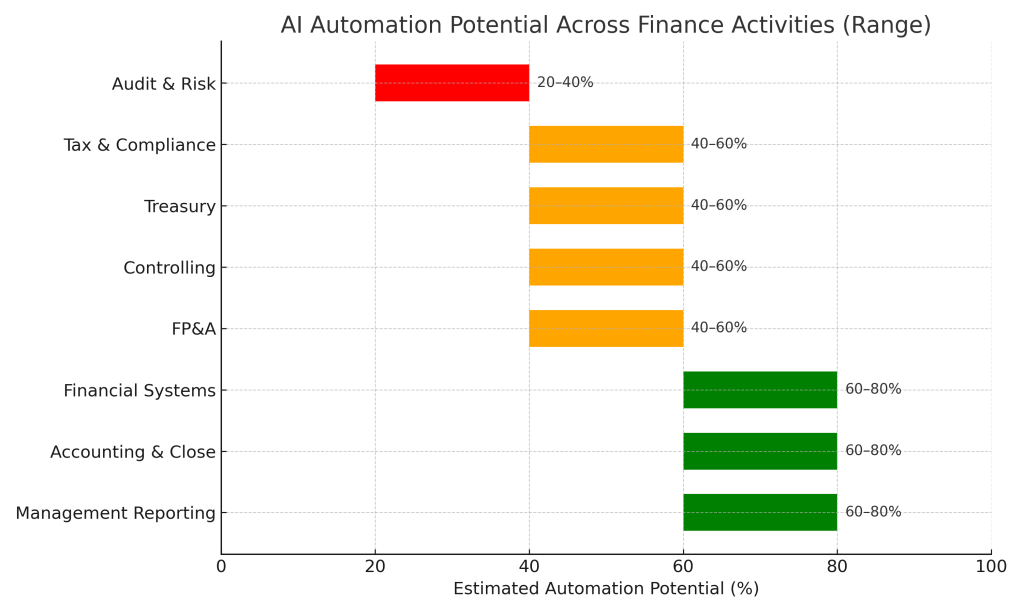
Finance is one of the business functions most primed for disruption through AI. With its high volume of repetitive transactions, rich data environments, and structured processes, the finance and controlling function is uniquely positioned to benefit from automation and intelligent analytics. As AI technologies mature, they are enabling a shift from transactional finance to strategic finance, unlocking new efficiencies, predictive capabilities, and business insights.

The implications are not just technological but organizational. With automation potential ranging from 30% to over 80% across various activities, it is likely that finance teams of the future will require less than 50% of the current workforce for traditional roles. The roles that remain will be more analytical, advisory, and technology-driven.

This article explores the key activities of the Finance function, how AI is transforming each area, and what the finance function could look like in 5–10 years. We also outline two distinct transformation scenarios—one focused on rapid implementation and another on sustainable foundations—to help finance leaders chart their course.

Key Activities of the Finance & Controlling Function and AI’s Impact

  1. Financial Planning & Analysis (FP&A)
    • Activities: Budgeting, forecasting, scenario modeling, variance analysis.
    • AI Impact: Predictive forecasting, automated scenario generation, and anomaly detection increase speed and accuracy.
  2. Management Reporting
    • Activities: Internal performance reports, dashboards, KPI tracking.
    • AI Impact: Natural language generation and self-service analytics personalize insights and automate commentary.
  3. Controlling
    • Activities: Cost control, investment analysis, policy compliance.
    • AI Impact: AI uncovers cost drivers, monitors ROI, and enforces compliance rules automatically.
  4. Accounting & Financial Close
    • Activities: AP/AR, reconciliations, journal entries, intercompany close.
    • AI Impact: OCR, bots, and smart matching drastically reduce manual work and cycle times.
  5. Treasury & Cash Management
    • Activities: Cash forecasting, liquidity management, FX risk, banking.
    • AI Impact: Predictive models optimize cash positions and detect fraud in real time.
  6. Tax & Compliance
    • Activities: Tax classification, filings, regulatory adherence.
    • AI Impact: Automated tax coding, real-time compliance monitoring, and AI-driven audit trails.
  7. Audit & Risk Management
    • Activities: Internal/external audit support, control testing, risk management.
    • AI Impact: Continuous audit monitoring, real-time risk scoring, and policy breach alerts.
  8. Financial Systems & Data Management
    • Activities: ERP management, data quality, automation enablement.
    • AI Impact: Data cleansing, process mining, and AI copilots transform finance operations.

AI Automation Potential Across Finance

AreaAutomation PotentialComments
FP&AModerateForecasting and analysis are automatable, but strategic planning remains human-led.
Management ReportingHighReport generation and commentary can be mostly automated.
ControllingModerateRoutine cost analysis is automatable; investment decisions are not.
Accounting & CloseHighReconciliations and entries are ideal for automation.
TreasuryModerateForecasting and fraud detection can be automated; decisions require oversight.
Tax & ComplianceModerateClassification and monitoring are automatable; legal interpretation is not.
Audit & RiskLow to ModerateMonitoring can be automated; assessments need human judgment.
Financial SystemsHighData tasks and support functions are highly automatable.

The Finance Function in 5–10 Years: AI-Augmented and Insight-Driven
Finance in the future will be lean, real-time, and forward-looking. The traditional role of finance as a scorekeeper will evolve into that of a strategic partner. Key shifts will include:

  • Near real-time closing and continuous forecasting
  • Proactive risk management through AI-driven monitoring
  • AI copilots supporting analysts with real-time insights
  • Self-optimizing processes and embedded business advisory

This transformation also entails a significant redefinition of workforce composition. Many routine roles will be phased out or reshaped, with the remaining talent focused on analytics, business partnering, and data stewardship. Finance teams may operate with less than half the current headcount, but with higher impact and strategic relevance.

Two Roadmap Scenarios for AI Transformation

1. Go Fast: Rapid AI Deployment in High-Impact Areas

  • Focus on automating high-volume, repetitive tasks for fast ROI.
  • Prioritize areas like reporting, financial close, and forecasting.
  • Launch an AI Center of Excellence to scale use cases.
  • Upskill teams in AI tools and data literacy.
  • Risks: Process fragmentation, change fatigue.

2. Build to Last: Strengthen Foundations Before Scaling AI

  • Begin with standardizing processes and modernizing ERP/data.
  • Use process mining to identify where AI fits best.
  • Pilot AI while building trust in systems and data.
  • Drive long-term scalability through structured change management.
  • Risks: Slower benefits realization, loss of momentum.

Conclusion: Finance Leaders Must Shape the AI Journey
AI offers unprecedented potential to elevate finance from an operational function to a strategic powerhouse. Whether choosing to go fast or build to last, success will require clear vision, strong governance, and continuous upskilling.

But leaders must also prepare for the workforce transformation ahead. With many transactional roles set to disappear, reskilling, talent planning, and organizational redesign must become part of the AI roadmap. Finance leaders who act now—balancing ambition with structure—will define the future of the profession and unlock new value for their organizations.

The AI-Savvy Leader: Key Concepts and Actions for Leaders

David De Cremer’s The AI-Savvy Leader: Nine Ways to Take Back Control and Make AI Work has been widely acknowledged by leaders as an essential resource for understanding why AI implementations often fail and, more importantly, how to ensure their success. Among the books I’ve read recently, this stands out as one of the most practical and insightful guides for leaders.

The book provides invaluable insights for navigating the challenges of integrating AI into organizations. Below is a summary, crafted with the assistance of AI (ChatGPT), highlighting the most critical concepts and actionable steps for leaders to take.


1: Learning – Get to Know AI, and Learn to Use It as a Leader

Leaders don’t need to be AI experts, but a foundational understanding of AI’s capabilities and limitations is crucial. This knowledge enables leaders to make informed decisions and oversee AI projects effectively.

Actions for Leaders:

  • Invest time in learning AI fundamentals through workshops or seminars.
  • Regularly consult AI experts to remain informed on advancements.
  • Encourage AI literacy across leadership teams to drive strategic decisions.

2: Purpose – Use Your Purpose to Ask the Right Kind of Questions

AI initiatives should align with the organization’s mission and values. Purpose-driven projects ensure AI is used meaningfully to serve strategic goals.

Actions for Leaders:

  • Define a clear organizational purpose that guides AI projects.
  • Evaluate AI initiatives to ensure alignment with long-term goals.
  • Ask questions like, “How does this AI solution contribute to our mission?”

3: Inclusion – Work in Inclusive Ways to Drive Human-AI Collaborations

Inclusive environments foster better human-AI collaboration by leveraging diverse perspectives. This diversity leads to more innovative and adaptable AI solutions.

Actions for Leaders:

  • Build cross-functional teams to design and implement AI projects.
  • Solicit input from employees, customers, and partners to improve AI solutions.
  • Promote inclusivity to reduce biases in AI systems.

4: Communication – Build a Flat Communication Culture to Drive AI Adoption

Transparent communication accelerates AI adoption and fosters trust. Leaders must ensure open dialogue across all organizational levels.

Actions for Leaders:

  • Establish regular forums to discuss AI initiatives and progress.
  • Use clear, non-technical language when communicating about AI.
  • Encourage feedback loops to address concerns and refine strategies.

5: Vision – Be Visionary in How to Use AI

A strong vision defines how AI will transform the organization and creates a shared sense of purpose. Vision-driven leadership inspires confidence and commitment to change.

Actions for Leaders:

  • Craft and articulate a clear vision for AI’s role in the next decade.
  • Link AI efforts to tangible outcomes, such as improved customer experiences.
  • Share success stories to build enthusiasm and confidence in AI initiatives.

6: Balance – Adopt AI with All Stakeholders in Mind

Balancing stakeholder interests ensures ethical and sustainable AI adoption. This approach builds trust and minimizes resistance to change.

Actions for Leaders:

  • Conduct impact assessments for all AI initiatives.
  • Engage stakeholders—employees, customers, and partners—in discussions about AI.
  • Implement governance frameworks to address ethical challenges.

7: Empathy – Use a Human-Centered Approach to AI Adoption

Adopting a human-centered approach prioritizes user needs, experiences, and trust. This ensures AI enhances rather than disrupts human well-being.

Actions for Leaders:

  • Gather insights from users to understand how AI impacts them.
  • Ensure transparency in how AI systems make decisions.
  • Provide mechanisms for feedback and continuous improvement of AI tools.

8: Mission – Augment (Don’t Automate) to Create Jobs

AI should augment human capabilities rather than replace them. This approach fosters innovation and creates new opportunities.

Actions for Leaders:

  • Identify processes where AI can enhance productivity without job loss.
  • Invest in employee reskilling programs for AI-augmented roles.
  • Communicate how AI can create opportunities for growth and innovation.

9: Emotional Intelligence – Accept That Soft Skills Are the New Hard Skills, and Practice Them

Soft skills like empathy, adaptability, and communication are vital in managing the human side of AI adoption. Emotional intelligence ensures AI serves people effectively.

Actions for Leaders:

  • Develop emotional intelligence within the leadership team.
  • Lead by example, showing empathy and adaptability during AI integration.
  • Address employee concerns with transparency and understanding.

Conclusion: Becoming an AI-Savvy Leader

Leaders play a pivotal role in ensuring AI serves their organization’s purpose while enhancing human capabilities. By following the actionable steps outlined in each chapter of The AI-Savvy Leader, leaders can drive meaningful and ethical AI adoption that aligns with their organization’s values and long-term vision.


Implementing Portfolio Management for Transformations

In setting up portfolio management, I have frequently relied on the materials and thinking of the Project Management Institute (PMI). These resources offer a structured approach to prioritize, execute, and govern transformation initiatives effectively. By aligning projects and programs with strategic objectives, portfolio management empowers leaders to maximize value delivery and adapt to changing circumstances.

Understanding Portfolio Management in Transformations

Portfolio management, as articulated by PMI, involves the centralized management of one or more portfolios to achieve strategic goals. Unlike project or program management, which focuses on delivering specific outputs or outcomes, portfolio management takes a holistic view. It ensures that all initiatives within the portfolio are aligned with organizational strategy, properly resourced, and balanced in terms of risk and reward.

When applied to transformations, portfolio management enables organizations to:

  1. Align Initiatives with Strategy: Ensure all transformation efforts contribute to overarching business goals.
  2. Optimize Resource Allocation: Efficiently distribute finite organizational resources across initiatives to maximize impact.
  3. Balance Risk and Value: Evaluate and manage the risks associated with each initiative while ensuring optimal value delivery.
  4. Monitor and Adapt: Continuously assess portfolio performance and adjust to external and internal changes.

Key Components of Portfolio Management

PMI outlines several key components essential for effective portfolio management:

  1. Portfolio Governance: Establish a decision-making framework that defines roles, responsibilities, and criteria for evaluating and prioritizing initiatives.
  2. Strategic Alignment: Ensure every initiative aligns with the organization’s strategic goals and delivers measurable value.
  3. Performance Management: Track the performance of portfolio components to ensure they deliver expected benefits.
  4. Risk Management: Identify, assess, and mitigate risks at the portfolio level.
  5. Stakeholder Engagement: Actively involve stakeholders to gain insights, address concerns, and ensure buy-in.

Applying Portfolio Management to Transformations

1. Defining a Transformation Portfolio

Begin by identifying all potential initiatives that could support the transformation. These may include process improvements, technology upgrades, workforce development programs, or customer experience enhancements. Categorize and group these initiatives based on their strategic importance, expected benefits, and interdependencies.

2. Establishing Governance Structures

Create a governance framework tailored to the transformation effort. This should include:

  • A portfolio steering committee responsible for prioritizing and approving initiatives.
  • Defined criteria for evaluating initiatives, such as strategic alignment, risk, cost, and potential benefits.
  • Regular review cycles to monitor progress and make data-driven decisions.

3. Prioritizing and Sequencing Initiatives

Use prioritization techniques, such as scoring models or weighted criteria, to rank initiatives based on their alignment with strategic goals, potential impact, and resource requirements. Sequencing initiatives appropriately helps manage dependencies and ensures smooth execution.

4. Resource Optimization

Assess the organization’s resource capacity, including budget, personnel, and technology. Allocate resources to high-priority initiatives while maintaining flexibility to reallocate as needed.

5. Continuous Monitoring and Adaptation

Establish key performance indicators (KPIs) to measure the success of portfolio initiatives. Regularly review portfolio performance to identify underperforming initiatives, reallocate resources, or adjust strategies in response to changing circumstances.

Benefits of Portfolio Management in Transformations

  1. Enhanced Strategic Alignment: Ensures all transformation initiatives are purposefully aligned with business goals.
  2. Increased Efficiency: Optimizes the use of resources across initiatives, reducing waste and duplication.
  3. Improved Decision-Making: Provides leaders with clear visibility into portfolio performance, enabling informed decisions.
  4. Risk Mitigation: Proactively identifies and addresses risks, reducing the likelihood of costly setbacks.
  5. Agility: Allows organizations to adapt quickly to evolving market conditions and business needs.

Case Example: Portfolio Management in a Digital Transformation

Consider the following example of how a company would apply the:

  • Identify Initiatives: Key initiatives include implementing an ERP system, automating commercial and supply chain processes, and launching employee upskilling programs.
  • Prioritize Projects: The ERP implementation is prioritized as it serves as the foundation for other initiatives, which can then roll out with higher speed and effectiveness.
  • Allocate Resources: Budget and personnel are allocated based on the strategic importance and interdependencies of initiatives, considering organizational resource capacity.
  • Monitor Progress: KPIs such as system adoption rates, productivity improvements, and training completion rates are tracked to measure success.
  • Adapt Plans: When process disruptions occur, resources are reallocated to initiatives focused on fixing critical issues.

This approach results in a cohesive, strategically aligned transformation that delivers measurable improvements in efficiency and capability.

Conclusion

Portfolio management provides a robust framework for navigating the complexities of business transformations. By aligning initiatives with strategic goals, optimizing resource allocation, and maintaining agility, leaders can drive meaningful change and deliver lasting value. Adopting PMI’s portfolio management principles equips organizations with the tools needed to turn ambitious transformation visions into reality.

Defining Strategy & Objectives: Leveraging SWOT, BSC, and OKRs for Business Success

In my decades of experience guiding strategy across diverse industries, three tools have consistently proven invaluable in defining strategic priorities and translating them into actionable business objectives:

  • SWOT (Strengths, Weaknesses, Opportunities, Threats): A classic tool to evaluate internal strengths and weaknesses alongside external opportunities and threats, providing a foundation for strategic direction.
  • BSC (Balanced Scorecard): A comprehensive framework for translating vision into a cohesive strategy by aligning performance measures across four critical dimensions: Financial, Customer, Internal Processes, and Learning & Growth.
  • OKRs (Objectives & Key Results): A goal-setting methodology that connects organizational priorities with measurable outcomes, ensuring alignment from leadership to individual contributors.

By combining SWOT, BSC, and OKRs, you can create a powerful and structured approach to crafting and executing strategy, particularly in fast-evolving environments like digital transformation. Below, I’ll guide you step-by-step on how to leverage these tools together for maximum impact.


1. Start with SWOT for Strategic Context

  • Purpose: Assess the internal and external environment to identify key factors that will influence your strategy and transformation.
  • Steps:
    1. Strengths: Identify what your organization does well (e.g., strong brand, skilled workforce, innovative culture).
    2. Weaknesses: Pinpoint areas for improvement (e.g., outdated systems, skill gaps).
    3. Opportunities: Highlight trends and external factors to capitalize on (e.g., market demand for digital solutions, emerging technologies).
    4. Threats: Recognize external risks (e.g., competition, regulatory challenges).

Output:

  • A clear understanding of your strategic position.
  • Prioritized areas to address through transformation initiatives.

Example:
Opportunity: Growing demand for AI-powered customer service → Translate into a strategic initiative in the BSC.


2. Use BSC to Build the Strategic Framework

  • Purpose: Translate insights from the SWOT analysis into a cohesive strategy by defining objectives across four perspectives (Financial, Customer, Internal Processes, and Learning & Growth).
  • Steps:
    1. Map SWOT findings to the BSC perspectives:
      • Strengths align with opportunities in Financial and Customer perspectives.
      • Weaknesses inform Internal Processes and Learning & Growth goals.
      • Threats guide risk mitigation strategies.
    2. Develop a strategy map:
      • Financial: Increase digital revenue by 25%.
      • Customer: Improve digital customer experience.
      • Internal Processes: Automate customer service workflows.
      • Learning & Growth: Upskill employees in AI technologies.
    3. Assign KPIs for each objective to measure success.

3. Deploy OKRs to Drive Execution

  • Purpose: Break down the high-level goals from the BSC into actionable, measurable objectives and key results for teams and individuals.
  • Steps:
    1. Define Objectives aligned with BSC goals:
      • Objective (from Learning & Growth): Upskill employees in AI technologies.
    2. Set Key Results to track progress:
      • Key Result 1: Train 80% of employees in AI basics by Q2.
      • Key Result 2: Certify 30% of employees in advanced AI tools by Q3.
    3. Cascade OKRs to teams and individuals:
      • Team Goal: Develop a company-wide AI training program.
      • Individual Goal: Complete AI certification by Q2.
    4. Track and adapt OKRs quarterly to ensure alignment with strategic priorities.

Example:
OKR Objective: “Improve digital customer engagement.”

  • Key Results:
    • Launch a new mobile app by Q2.
    • Increase app adoption rate by 20% within 6 months.
    • Achieve an NPS of 70+ for app users.

4. Create Feedback Loops and Monitor Progress

  • Use BSC to monitor long-term strategic outcomes through lagging indicators.
  • Use OKRs to track short-term execution progress through leading indicators.
  • Regularly review SWOT to reassess internal and external dynamics and adjust priorities.

Example Monitoring:

  • BSC KPI: Customer Satisfaction Score (CSAT) = 85% (measured quarterly).
  • OKR Key Result: Resolve 90% of customer queries within 24 hours (measured monthly).
  • SWOT Insight: Competitor launching a similar app → Accelerate product updates.

How They Work Together

  1. SWOT identifies where to focus the strategy by analyzing your environment.
  2. BSC builds a structured, holistic strategy to address SWOT findings.
  3. OKRs break down the strategy into actionable goals and drive execution across teams.

Benefits of the Combined Approach

  • Strategic Alignment: SWOT ensures relevance; BSC provides structure; OKRs drive execution.
  • Agility: OKRs enable rapid adaptation to changing conditions without deviating from the overarching strategy.
  • Measurability: BSC tracks long-term outcomes, while OKRs track immediate results, ensuring balanced performance management.
  • Focus: SWOT and BSC prioritize initiatives, and OKRs ensure focus on execution.

By leveraging SWOT, BSC, and OKRs together, organizations can create a clear, actionable roadmap for strategy implementation and transformation, balancing long-term vision with short-term adaptability.