Why Continuous Improvement Matters in Digital Transformation
Many digital transformations falter after implementation. Technologies go live, but the full value often remains unrealized. One key reason? A lack of embedded, ongoing improvement practices.
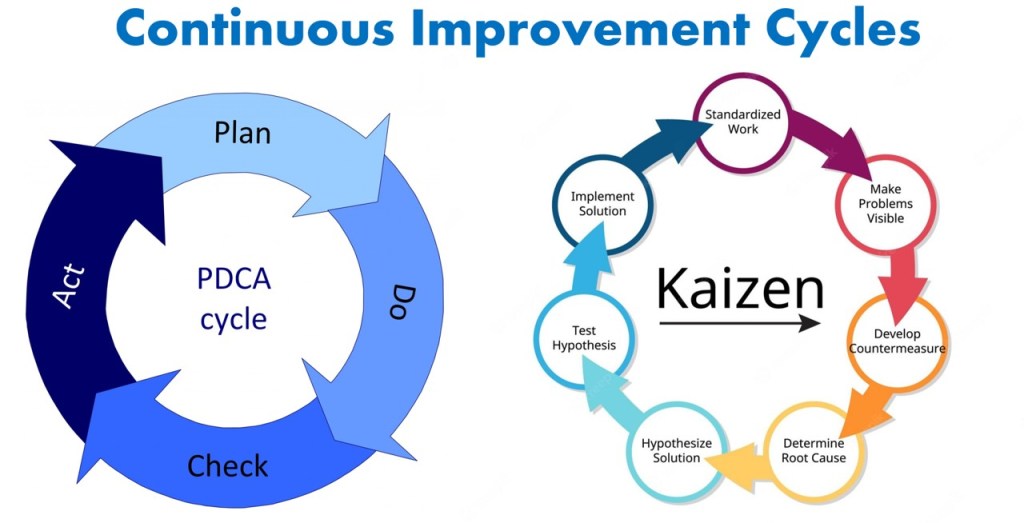
Continuous Improvement Cycles—specifically PDCA (Plan–Do–Check–Act) and Kaizen—provide the discipline required to keep improving after deployment. They shift the mindset from “project completion” to continuous value optimization, embedding a culture that learns, adapts, and evolves.
The impact is well-documented:
💡 According to McKinsey & Company (2021), organizations that embed continuous improvement into their digital transformations are 2.5 times more likely to report successful outcomes than those focused solely on implementation.
📊 A Deloitte study (2022) found that 78% of organizations that sustained their digital transformation benefits had formalized continuous improvement processes, compared to just 31% of those that didn’t.
Real transformation success isn’t just about launching change—it’s about sustaining and evolving it continuously.
PDCA: A Structured Learning Loop for the Digital Age
The PDCA cycle, originally developed by W. Edwards Deming, remains foundational in continuous improvement. In today’s digital environment, it has been enhanced with real-time data, agile delivery, and user-centered design.
1. Plan
Define the opportunity and craft a value-aligned, testable intervention.
- Traditional: Diagnose the current state, set improvement goals, design the change.
- Digital Evolution: Use analytics to identify friction points, apply design thinking to understand user needs, and define digital KPIs aligned with business outcomes. Prioritize minimal viable changes over complex upfront plans.
2. Do
Test the change in a low-risk environment and gather real-world feedback.
- Traditional: Pilot changes, document execution, and support implementation.
- Digital Evolution: Use feature flags for controlled rollouts, run A/B tests, automate behavioral data capture, and deploy rapidly to shorten time-to-feedback.
3. Check
Assess impact and extract learnings.
- Traditional: Compare actual results to expectations, conduct retrospectives, identify lessons.
- Digital Evolution: Monitor via real-time dashboards, use automated testing, apply UX research, and leverage predictive analytics to detect patterns.
4. Act
Scale what works—or iterate again.
- Traditional: Standardize successful practices, communicate changes, revisit unresolved issues.
- Digital Evolution: Automate through CI/CD pipelines, codify learnings into playbooks, build communities of practice, and use retrospectives to institutionalize learning.
✅ When PDCA is adapted with digital enablers, it becomes a strategic engine for transformation value realization—not just an operational tool.
Kaizen: Creating a Culture of Relentless Improvement
Where PDCA offers structure, Kaizen—meaning “change for better”—injects continuous improvement with energy, ownership, and culture. Originating from Japanese manufacturing excellence, it is a philosophy that emphasizes daily, incremental progress driven by everyone in the organization.
Core Principles of Kaizen
- Continuous, Incremental Improvement
- Small, low-cost changes compound into significant long-term impact.
- Especially valuable in digital contexts, where feedback loops are fast and ongoing.
- Process Focus
- Kaizen targets flawed processes, not people.
- Teams are encouraged to map and improve end-to-end workflows—not just surface-level symptoms.
💡 Insight: In many digital failures, technology isn’t the issue—process design is. Kaizen helps uncover complexity and inefficiencies that digital tools alone can’t solve.
- Elimination of Waste (Muda)
- Waste is any activity that doesn’t add customer value. Kaizen uses the TIMWOODS framework to identify eight key forms of waste:
| Type | Digital Example |
| Transport | Redundant data transfers between systems |
| Inventory | Unused data, reports, or stored digital assets |
| Motion | Excessive navigation in systems or interfaces |
| Waiting | Delayed approvals, system lags |
| Overproduction | Features or reports no one uses |
| Overprocessing | Manual re-checks due to low trust in automation |
| Defects | Rework from bugs, data errors |
| Skills (Underuse) | Not tapping into employee creativity and insight |
- 🧭 Transformation Tip: Process mining and automation can help eliminate waste—but without a Kaizen mindset, digital solutions may just replicate analog inefficiencies.
- Employee Involvement and Ownership
- Those closest to the work are best positioned to improve it.
- Kaizen encourages bottom-up contributions, while leaders provide the tools, time, and recognition.
🟢 Example: A logistics firm equipped teams with tablets to log small improvement ideas. In six months, they implemented over 200 enhancements—resulting in a 12% productivity lift.
- Standardization of Improvements
- Once something works better, it becomes the new standard.
- This locks in gains while setting the stage for the next cycle of improvements.
“Without standards, there can be no improvement. For improvement to happen, changes must be made.”
— Masaaki Imai, father of Kaizen
Making It Stick: Enablers of Success
To embed continuous improvement in your transformation:
- Leadership Commitment – Role-model curiosity and support learning-by-doing.
- Digital Enablers – Use analytics, process mining, and feedback loops to identify what to improve.
- Training & Empowerment – Equip teams to run their own improvement cycles.
- Recognition – Celebrate both the small wins and the mindset behind them.
From One-Off to Ongoing
Transformation is not a finish line—it’s a journey of continuous alignment and adaptation. PDCA and Kaizen offer practical, proven ways to embed improvement into the DNA of your organization, ensuring digital capabilities evolve with business needs.
Organizations that adopt these cycles at scale don’t just implement change—they sustain it, extend it, and accelerate its value.
 Best of Digital Transformation