The AI Strategy Imperative: Why Act Now

Two weeks ago, I completed IMD’s AI Strategy & Implementation program. It made the “act now” imperative unmistakable. In this newsletter I share the overarching insights I took away; in upcoming issues I’ll go deeper into specific topics and tools we used.


AI is no longer a tooling choice. It’s a shift in distribution, decision-making, and work design that will create new winners and losers. Leaders who move now—anchoring execution in clear problems, strong data foundations, and human–AI teaming—will compound advantage while others get trapped in pilots and platform dependency.


1) Why act now: the competitive reality

Distribution is changing. AI assistants and agentic workflows increasingly mediate buying journeys. If your brand isn’t represented in answers and automations, you forfeit visibility, traffic, and margin. This is a channel economics shift: AI determines which brands are surfaced—and which are invisible.

Platforms are consolidating power. Hyperscalers are embedding AI across their offerings. You’ll benefit from their acceleration, but your defensibility won’t come from platforms your competitors can also buy. The durable moat is your proprietary data, decision logic, and learning loops you control—not a longer vendor list.

Agents are getting real. Think of agents as “an algorithm that applies algorithms.” They decompose work into steps, call tools/APIs, and complete tasks with minimal supervision. Agent architectures will reshape processes, controls, and talent—pushing leaders to design for human–AI teams rather than bolt‑on copilots.


2) The paradox: move fast and build right

The cost of waiting. Competitors pairing people with AI deliver faster at lower cost and start absorbing activities you still outsource. As internal production costs fall faster than coordination costs, vertical integration becomes attractive—accelerated by automation. Late movers face margin pressure and share erosion.

The risk of rushing. Many efforts stall because they “build castles on quicksand”—shiny proofs‑of‑concept on weak data and process foundations. Value doesn’t materialize, trust erodes, and budgets freeze. Urgency must be paired with disciplined follow up so speed creates compounded learning.


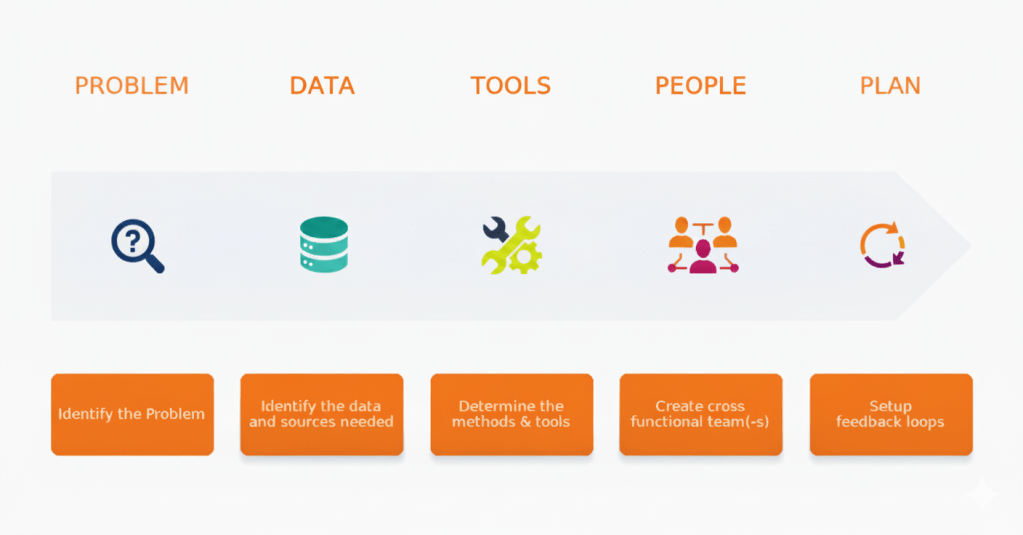
3) A durable path to value: the 5‑Box Implementation Framework

A simple path from strategy deck to shipped value:

  1. Problem. Define a single business problem tied to P&L or experience outcomes. Write the metric up front; make the use case narrow enough to ship quickly.
  2. Data. Map sources, quality, access, and ownership. Decide what you must own versus can borrow; invest early in clean, governed data because it is the most sustainable differentiator.
  3. Tools. Choose the lightest viable model/agent and the minimum integration needed to achieve the outcome, keep it simple.
  4. People. Form cross‑functional teams (domain expertise + data + engineering + change) with one accountable owner. Team design—not individual heroics—drives performance.
  5. Feedback loops. Instrument production to compare predicted vs. actual outcomes. The delta gives valuable insights and becomes new training data.

Your defensive moat is data + people + decisions + learning loops, not your vendor list.


4) Moving the Human Workforce to more Complex Tasks

While AI absorbs simple and complicated work (routine tasks, prediction, pattern recognition), the human edge shifts decisively to complex and chaotic problems—where cause and effect are only clear in retrospect or not at all. This economic reality forces immediate investment in people as internal work is increasingly handled by AI–human teams.

The immediate talent pivot. Leaders must signal—and codify—new “complexity competencies”: adaptive problem‑solving, systems thinking, comfort with ambiguity, and AI product‑ownership (defining use cases, data needs, acceptance criteria, and evaluation).

Organizational design for learning.

  • Security: Build psychological safety so smart experiments are rewarded and failures fuel learning, not blame.
  • Convenience: Make adoption of new AI tools easy—frictionless access, clear guidance, and default enablement.
  • Process: A weak human with a tool and a better process will outperform a strong human with a tool and a worse process. Define roles, handoffs, and measurement so teams learn in the loop.

5) Where ROI shows up first

There is a lot of discussion on where AI really shows it benefits and there are four areas, where we see consistent reporting about:

Content. Marketing and knowledge operations see immediate throughput gains and more consistent quality. Treat this as a production system: govern sources, version prompts/flows, and measure impact.

Code. Assistance, testing, and remediation compress cycle time and reduce defects. Success depends on clear guardrails, reproducible evaluation, and tight feedback from production incidents into your patterns.

Customer. Service and sales enablement benefit from faster resolution and personalization at scale. Start with narrow intents, then expand coverage as accuracy and routing improve.

Creative. Design, research, and planning benefit from rapid exploration and option value. Use agentic research assistants with human review to widen the solution space before you converge.


6) Organize to scale without chaos

Govern the reality, not the slide. Shadow AI already exists. Enable it safely with approved toolkits, lightweight guardrails, and clear data rules—so exploration happens inside the tent, not outside it.

CoE vs. federation. Avoid the “cost‑center CoE” trap. Stand up a small enablement core (standards, evaluation, patterns), but push delivery into business‑owned pods that share libraries and reviews. This balances consistency with throughput.

Human + AI teams. Process design beats heroics. Make handoffs explicit, instrument outcomes, and build psychological safety so teams learn in the loop. A weak human with a machine and a better process will outperform a strong human with a machine and a worse process.


What this means for leaders

  • Move talent to handle complexity. Codify new competencies (adaptive problem‑solving, systems thinking, comfort with ambiguity, AI product‑ownership) and design organizational systems that accelerate learning (security, convenience, process).
  • Your moat is data + people + decisions + learning loops. Platforms accelerate you, but they’re available to everyone. Proprietary, well‑governed data feeding instrumented processes is what compounds.
  • Ship value early; strengthen foundations as you scale. Start where ROI is proven (content, code, customer, creative), then use that momentum to fund data quality and governance.
  • Design for agents and teams now. Architect processes assuming agents will do steps of work and humans will supervise, escalate, and improve the system. That’s how you create repeatable outcomes.

Lifelong Learning in the Age of AI – My Playbook

September 2025, I received two diplomas: IMD’s AI Strategy & Implementation and Nyenrode University’s Corporate Governance for Supervisory Boards. I am proud of both—more importantly, they cap off a period where I have deliberately rebuilt how I learn.

With AI accelerating change and putting top-tier knowledge at everyone’s fingertips, the edge goes to leaders who learn—and apply—faster than the market moves. In this issue I am not writing theory; I am sharing my learning journey of the past six months—what I did, what worked, and the routine I will keep using. If you are a leader, I hope this helps you design a learning system that fits a busy executive life.


My Learning System – 3 pillars

1) Structured learning

This helped me to gain the required depth:

  • IMD — AI Strategy & Implementation. I connected strategy to execution: where AI creates value across the business, and how to move from pilots to scaled outcomes. In upcoming newsletters, I will go share insights on specific topics we went deep on in this course.
  • Nyenrode — Corporate Governance for Supervisory Boards. I deepened my view on board-level oversight—roles and duties, risk/compliance, performance monitoring, and strategic oversight. I authored my final paper on how to close the digital gap in supervisory boards (see also my earlier article)
  • Google/Kaggle’s 5-day Generative AI Intensive. Hands-on labs demystified how large language models work: what is under the hood, why prompt quality matters, where workflows can break, and how to evaluate outputs against business goals. It gave understanding how to improve the use of these models.

2) Curated sources

This extended the breadth of my understanding of the use of AI.

2a. Books

Below I give a few examples, more book summaries/review, you can find on my website: www.bestofdigitaltransformation.com/digital-ai-insights.

  • Co-Intelligence: a pragmatic mindset for working with AI—experiment, reflect, iterate.
  • Human + Machine: how to redesign processes around human–AI teaming rather than bolt AI onto old workflows.
  • The AI-Savvy Leader: what executives need to know to steer outcomes without needing to code.

2b. Research & articles
I built a personal information base with research from: HBR, MIT, IMD, Gartner, plus selected pieces from McKinsey, BCG, Strategy&, Deloitte, and EY. This keeps me grounded in capability shifts, operating-model implications, and the evolving landscape.

2c. Podcasts & newsletters
Two that stuck: AI Daily Brief and Everyday AI. Short, practical audio overviews with companion newsletters so I can find and revisit sources. They give me a quick daily pulse without drowning in feeds.

3) AI as my tutor

I am using AI to get personalised learning support.

3a. Explain concepts. I use AI to clarify ideas, contrast approaches, and test solutions using examples from my context.
3b. Create learning plans. I ask for step-by-step learning journeys with milestones and practice tasks tailored to current projects.
3c. Drive my understanding. I use different models to create learning content, provide assignments, and quiz me on my understanding.


How my journey unfolded

Here is how it played out.

1) Started experimenting with ChatGPT.
I was not an early adopter; I joined when GPT-4 was already strong. Like many, I did not fully trust it at first. I began with simple questions and asked the model to show how it interpreted my prompts. That built confidence without creating risks/frustration.

2) Built foundations with books.
I read books like Co-Intelligence, Human + Machine, and The AI-Savvy Leader. These created a common understanding for where AI helps (and does not), how to pair humans and machines, and how to organise for impact. For all the books I created reviews, to anchor my learnings and share them in my website.

3) Added research and articles.
I set up a repository with research across HBR/MIT/IMD/Gartner and selected consulting research. This kept me anchored in evidence and applications, and helped me track the operational implications for strategy, data, and governance.

4) Tried additional models (Gemini and Claude).
Rather than picking a “winner,” I used them side by side on real tasks. The value was in contrast—seeing how different models frame the same question, then improving the final answer by combining perspectives. Letting models critique each other surfaced blind spots.

5) Went deep with Google + Kaggle.
The 5-day intensive course clarified what is under the hood: tokens/vectors, why prompts behave the way they do, where workflows tend to break, and how to evaluate outputs beyond “sounds plausible.” The exercises translated directly into better prompt design and started my understanding of how agents work.

6) Used NotebookLM for focused learning.
For my Nyenrode paper, I uploaded the key articles and interacted only with that corpus. NotebookLM generated grounded summaries, surfaced insights I might have missed, and reduced the risk of invented citations (by sticking to the uploaded resources). The auto-generated “podcast” is one of the coolest features I experienced and really helps to learn about the content.

7) Added daily podcasts/newsletters to stay current.
The news volume on AI is impossible to track end-to-end. AI Daily Brief and Everyday AI give me a quick scan each morning and links worth saving for later deep dives. This provides the difference between staying aware versus constantly feeling behind.

8) Learned new tools and patterns at IMD.

  • DeepSeek helped me debug complex requests by showing how the model with reasoning interpreted my prompt—a fantastic way to unravel complex problems.
  • Agentic models like Manus showed the next step: chaining actions and tools to complete tasks end-to-end.
  • CustomGPTs (within today’s LLMs) let me encode my context, tone, and recurring workflows, boosting consistency and speed across repeated tasks.

Bring it together with a realistic cadence.

Leaders do not need another to-do list; they need a routine that works. Here is the rhythm I am using now:

Daily

  • Skim one high-signal newsletter or listen to a podcast.
  • Capture questions to explore later.
  • Learn by doing with the various tools.

Weekly

  • Learn: read one or more papers/articles on various Ai related topics
  • Apply: use one idea on a live problem; interact with AI on going deeper
  • Share: create my weekly newsletter, based on my learnings

Monthly

  • Pick one learning topic read a number of primary sources, not just summaries.
  • Draft an experiment: with goal, scope, success metric, risks, and data needs. Using AI to pressure-test assumptions.
  • Review with a thought leaders/colleagues for challenge and alignment.

Quarterly

  • Read at least one book that expands your mental models.
  • Create a summary for my network. Teaching others cements my own understanding.

(Semi-) Annualy

  • Add a structured program or certificate to go deep and to benefit from peer debate.

Closing

The AI era compresses the shelf life of knowledge. Waiting for a single course is no longer enough. What works is a learning system: structured learning for depth, curated sources for breadth, and AI as your tutor for speed. That has been my last six months, and it is a routine I will continue.

Learning with AI – Unlocking Capability at Every Level

AI is Changing How We Learn! We’re entering a new era where learning and AI are deeply intertwined. Whether it’s a university classroom, a manufacturing site, or your own weekend learning project, AI is now part of how we access knowledge, gain new skills, and apply them faster.

The impact is real. In formal education, AI supported tutors are already showing measurable learning gains. In the workplace, embedded copilots help teams learn in the flow of work. And at the organizational level, smart knowledge systems can reduce onboarding time and improve consistency.

But like any tool, AI’s value depends on how we use it. In this article, I’ll explore four areas where AI is transforming learning — and share some insights from my own recent experiences along the way.


1. Formal Education — From Study Assistant to Writing Coach

AI is showing clear value in helping students and professionals deepen understanding, organize ideas, and communicate more effectively.

In my recent Supervisory Board program, I used NotebookLM to upload course materials and interact with them — asking clarifying questions and summarizing key insights. For my final paper, I turned to ChatGPT and Claude for review and editing — helping me sharpen my arguments and improve readability without losing my voice.

The benefit? More focused learning time, better written output, and higher engagement with the material.

How to get the most from AI in education:

  • Use AI to test understanding, not just provide answers
  • Let it structure thoughts and give feedback — like a sounding board
  • Ensure use remains aligned with academic integrity standards

Recent research supports this approach: Harvard studies show students using structured AI tutors learn more in less time when guardrails guide the interaction toward reasoning — not shortcuts.


2. Learning on the Job — From Static Training to Smart Assistance

In many workplaces, AI is no longer something you log into — it’s embedded directly into your tools, helping you solve problems, write faster, or learn new procedures while working.

Take Siemens, for example. Their industrial engineers now use an AI copilot integrated into their software tools to generate, troubleshoot, and optimize code for production machinery. Instead of searching manuals or waiting for expert support, engineers are guided step-by-step by an assistant that understands both the code and the task.

The benefit? People learn while doing — and become more capable with every task.

How to get the most from AI on the job:

  • Start with tasks that benefit from examples (e.g. writing, code, cases)
  • Let the AI model good practice, then ask the user to adapt or explain
  • Use real-time feedback to reinforce learning and reduce rework

Well-implemented, AI tools don’t replace training — they become the cornerstone of the training.


3. Organizational Learning — Turning Knowledge into an Exchange

As organizations accumulate more policies, procedures, and playbooks, the challenge isn’t just creating knowledge — it’s making it accessible. This is where AI can fundamentally change the game.

PwC is a leading example. They’ve deployed ChatGPT Enterprise to 100,000 employees, combined with internal GPTs trained on company-specific content. This transforms how people access information: instead of digging through files, they ask a question and get a consistent, governed answer — instantly.

The benefit? Faster onboarding, fewer escalations, and more confident decision-making across the board.

How to build this in your organization:

  • Start with high-value content (e.g., SOPs, onboarding, policies)
  • Assign content owners to keep AI knowledge up to date
  • Monitor questions and feedback to identify knowledge gaps

Done right, this turns your organization into a living learning system.


4. Personal Learning — Exploring New Skills with AI as a Guide

Outside of work and formal learning, many people are using AI to explore entirely new topics. Whether it’s a new technology, management concept, or even a language, tools like ChatGPT, Gemini and Claude make it easy to start — and to go deep.

Let’s say you want to learn about cloud architecture. You can ask AI to:

  • Create a 4-week plan tailored to your experience level
  • Suggest reading material and create quick explainers
  • Generate test questions or even simulate an interview

The benefit? Structured, personalized, and frictionless learning — anytime, anywhere.

To make it effective:

  • Be specific: define your goals and time frame
  • Ask for exercises or cases to apply what you learn
  • Use reflection prompts and feedback to deepen understanding

The key is to treat AI as a learning coach, not just a search engine.


Looking Ahead — Opportunities, Risks, and What Leaders Can Do

AI can make learning faster, broader, and more accessible. But like any capability shift, it introduces both upside and new risks:

Opportunities

  • Faster time to skill through real-time, contextual learning
  • Scaling of expert knowledge across global teams
  • Better engagement and confidence among learners at all levels

Risks

  • Over-reliance on AI can lead to shallow understanding
  • Inaccurate or outdated responses risk reinforcing errors
  • Uneven adoption can widen capability gaps inside teams

How to mitigate the risks

  • Introduce guardrails that promote reasoning and reduce blind copying
  • Keep AI tools connected to curated, up-to-date knowledge
  • Build adoption playbooks tailored to roles, not just tools

Final Thought — Treat AI as Part of Your Learning System

The most successful organizations aren’t just giving people access to AI — they’re designing learning systems around it.

That means using AI to model best practice, challenge thinking, and reduce time-to-competence. AI is not just a productivity tool — it’s a capability accelerator.

Those who treat it that way will upskill faster, build smarter teams, and stay more adaptable in the face of constant change.

The Secret Sauce Behind Successful Transformation: Learning Journeys

In the execution-to-integration phase of any transformation, the greatest challenge is rarely the strategy — it’s the sustainability of new ways of working. Systems are deployed, structures reconfigured, and operating models redesigned. Yet months later, familiar patterns resurface, and old behaviors creep back in.

Why? Because true change doesn’t happen in workshops or at go-live milestones. It happens in the daily decisions, habits, and interactions of people across the organization.

This is where learning journeys come in.

Unlike traditional training events — often one-off, content-heavy, and disconnected from real work — learning journeys are spaced, orchestrated experiences designed to embed new skills, mindsets, and behaviors over time. They are:

  • Sequenced over weeks or months to allow for reflection, practice, and reinforcement.
  • Multi-modal, blending digital modules, live sessions, coaching, peer learning, and on-the-job application.
  • Contextualized to individual roles, workflows, and transformation objectives.
  • Integrated into governance and feedback loops to drive ongoing alignment and improvement.

Well-designed learning journeys do more than teach — they transform. They make change tangible, repeatable, and sticky by equipping people to not only understand the new way, but live it every day.


1. Adult Learning Theory: How Adults Learn Best

Research by Malcolm Knowles and successors highlights that adults:

  • Are self-directed.
  • Bring prior experience into the learning process.
  • Want immediate relevance and application.
  • Learn best through problem-solving.

Implication for transformation:
Traditional training sessions or slide decks won’t embed new behaviors. Instead, adults need learning that:

  • Is contextual (tied to their specific role).
  • Offers autonomy (flexibility to explore and apply).
  • Encourages reflection (linking new knowledge with real experiences).

This supports transformation by turning employees into co-creators of change, not just recipients of it.


2. Learning Experience Design : Make It Stick Through Design

Learning Experience Design blends cognitive science, user-centered design, and storytelling to create memorable and effective learning environments. Drawing from design thinking, it emphasizes:

  • Empathizing with learners’ day-to-day.
  • Designing around “moments that matter.”
  • Prototyping and iterating based on feedback.

Implication for transformation:
Learning Experience Design ensures that learning is not generic. For example:

  • Frontline employees might need immersive, task-based simulations.
  • Managers may benefit more from leadership labs and decision-making scenarios.
  • Learning pathways can be designed to mirror the actual rollout of new processes or systems.

This design-first approach increases relevance, reduces friction, and drives higher engagement—key enablers for sustainable transformation.


3. Behavioral Science & Habit Formation: Anchor New Norms

Transformation success is often about small, repeatable behavior changes. Behavioral science — especially the work of James Clear (Atomic Habits) and Charles Duhigg (The Power of Habit) — shows that habits are formed when:

  • Behaviors are simple and easy to start.
  • Triggers and cues are present in the environment.
  • There is immediate reward or reinforcement.

Implication for transformation:
Learning journeys that incorporate behavior design principles:

  • Use nudges to prompt the right actions.
  • Reinforce micro-successes (e.g., feedback after using a new system).
  • Encourage habit stacking (e.g., “after daily team huddle, review dashboard insights”).

Embedding these principles turns learning from a one-off event into an ongoing cycle of behavior reinforcement, helping transformation stick at the individual and team levels.


4. Integration Best Practices: Close the Loop Between Learning and Doing

Many transformations fail in the post-implementation phase because of a disconnect between system rollout, new processes, and human capability. Integration-focused learning journeys:

  • Align with change governance (e.g., steerco and sponsor feedback loops).
  • Include just-in-time learning embedded into the workflow (performance support tools, coaching, etc.).
  • Monitor learning adoption KPIs (e.g., skill application, confidence, usage rates).

Three critical integration elements:

a) Learning must be embedded in the work, not adjacent to it

  • Learning and performance support tools within workflows.
  • Just-in-time content linked to system/process steps.

b) Learning should be part of governance and leadership rituals

  • Incorporating learning metrics into program dashboards.
  • Leaders modelling and discussing learning progress in townhalls and reviews.

c) Learning journeys need to be tracked and adapted over time

  • Use of learning analytics, feedback loops, and continuous improvement.
  • Mechanisms to sunset legacy habits and reinforce new ones.

Together, these principles ensure learning is not a support function but a core engine of transformation delivery.


5. Real-World Examples of Learning Journeys in Action

Microsoft – From Culture Reset to Growth Mindset

  • Journey led by Satya Nadella blending storytelling, role-modeling, and digital learning platforms.
  • Emphasis on curiosity, collaboration, and continuous learning.

Unilever – Scaling Digital Fluency Globally

  • Created a Digital Learning Framework aligned to business capabilities.
  • Personalized learning portals, regional academies, and gamification.

Siemens – MyLearning World as a Platform for Change

  • Centralized platform delivering self-paced, role-based learning.
  • Integration into performance management and project onboarding.

Each example reinforces a core principle: learning drives transformation when it is lived, not just launched.


6. Implementation Blueprint: How to Design and Launch a Learning Journey

Step 1: Define the learning objectives linked to transformation goals

  • What behaviors must change? In which roles?

Step 2: Map the journey — sequence, format, duration

  • Consider phases: Awareness → Enablement → Practice → Reinforcement
  • Blend formats: eLearning, workshops, peer sessions, toolkits, coaching

Step 3: Integrate with business cadence and systems

  • Embed in onboarding, performance reviews, and tool workflows.

Step 4: Mobilize champions and leadership sponsors

  • Leaders should learn with their teams — visibly and vocally.

Step 5: Monitor progress and adapt in real time

  • Use learning analytics, pulse surveys, feedback loops.

Tip: Treat learning like a product — continuously evolving with new features and feedback.


Conclusion: From Learning to Lasting Change

“Transformation sticks when people change how they work — and that only happens through intentional, immersive learning journeys.”

If your transformation includes a plan, a system, and a steering committee — it should also include a learning journey.

Harnessing Curiosity for Digital Transformation Success

In a world shaped by accelerating change, new technologies, and shifting customer expectations, digital transformation is no longer optional—it’s a strategic imperative. But technology alone doesn’t drive transformation. The real differentiator lies in human capabilities—and among these, curiosity stands out as a key enabler of successful change.

Curiosity: The Human Advantage in a Digital World

Curiosity isn’t just about asking questions. It’s the active pursuit of new knowledge, perspectives, and possibilities. It fuels learning, drives innovation, and enables people to adapt quickly in fast-moving environments.

As Deloitte puts it in their research on digital fluency, “Curiosity is the catalyst that allows people to keep pace with technology—and lead with it.”

For transformation leaders, this has direct implications:

  • Curious individuals are more likely to experiment, learn, and improve.
  • Curious teams are better at breaking silos, seeking input, and iterating solutions.
  • Curious cultures are more resilient, adaptive, and open to what’s next.

Research That Connects Curiosity to Transformation Success

The Business Case for Curiosity – Harvard Business Review (Francesca Gino, 2018)

  • Curious employees are more engaged, collaborative, and better at decision-making.
  • Organizations that foster curiosity experience higher innovation and reduced groupthink.
  • Read the article →

The Mindsets of Transformation Leaders – McKinsey & Company

  • Highlights intellectual curiosity as a hallmark of successful transformation leaders.
  • Curious leaders are more willing to challenge assumptions, adapt strategy, and engage stakeholders.
  • Read the article →

Human + Machine: Reimagining Work in the Age of AI – IBM Institute for Business Value

  • Emphasizes that in the AI era, human skills like curiosity are vital complements to automation.
  • Curious individuals are better at interpreting data, asking better questions, and guiding AI to impactful outcomes.
  • Explore Human + Machine →

The Curiosity Gap: What Holds Teams Back

Despite its value, many organisations unintentionally stifle curiosity:

  • Rigid hierarchies discourage questioning.
  • Execution pressure leaves no room for reflection.
  • Fear of failure shuts down experimentation.
  • Overreliance on expertise limits fresh thinking.

These are culture issues, not people issues. Leaders play a pivotal role in changing this dynamic.

How Leaders Can Foster Curiosity

Transformation leaders can amplify curiosity in practical, powerful ways:

  • Ask more than tell: Use open-ended questions to spark exploration.
  • Normalize experimentation: Frame pilots and prototypes as learning opportunities.
  • Listen actively: Signal that new ideas and diverse perspectives are valued.
  • Reward growth: Recognize not just performance, but how people learn and adapt.
  • Lead with humility: Show you’re learning too—and invite others on the journey.

Final Word

Digital transformation is ultimately a human transformation. And curiosity is the mindset that keeps humans relevant, engaged, and future-ready.

It’s what helps a data analyst spot an emerging trend, a product manager test a radical new idea, and a CEO rethink a decades-old business model. It’s also what allows us to partner more effectively with AI—asking the right questions, interpreting signals, and imagining better solutions.

As you lead your organisation through transformation, don’t just invest in platforms and capabilities. Invest in curiosity. It’s the spark that turns potential into progress.

Harnessing Lessons Learned for Digital Transformation Success

Introduction

Digital transformation is a complex, multi-phase journey that requires continuous learning and adaptation. Organizations that systematically capture and apply lessons learned improve their chances of success, avoid recurring mistakes, and optimize future initiatives. However, many businesses either fail to document insights effectively or struggle to integrate them into future projects. This article explores the importance of lessons learned, effective approaches, implementation strategies, key challenges, and a step-by-step framework to ensure digital transformation efforts benefit from past experiences.

1. Why Lessons Learned Matter in Digital Transformation

Lessons learned play a crucial role in refining digital transformation efforts. Key benefits include:

  • Preventing Repeated Mistakes – Avoiding common pitfalls saves time, money, and resources.
  • Enhancing Decision-Making – Informed decisions based on past experiences lead to better outcomes.
  • Optimizing Processes – Continuous improvement ensures that digital initiatives become more efficient over time.
  • Strengthening Governance – Ensuring that digital transformation governance evolves based on real-world insights.
  • Fostering a Learning Culture – Encouraging teams to reflect on successes and failures promotes organizational agility.

By embedding a structured approach to lessons learned, companies can accelerate their digital transformation efforts and increase long-term success.

2. Approaches to Capturing Lessons Learned

Various methodologies exist for systematically gathering insights from digital transformation initiatives. Some of the most effective approaches include:

A. After-Action Review (AAR)

Originally developed by the U.S. Army, the AAR method uses a structured reflection process:

  1. What was supposed to happen?
  2. What actually happened?
  3. What went well and why?
  4. What can be improved and how?

B. Agile Retrospectives

Agile methodologies integrate lessons learned through retrospectives at the end of each sprint. Common questions include:

  • What worked well?
  • What didn’t go well?
  • What can we improve?
  • What are the action items for the next sprint?

C. Post-Implementation Review (PIR)

A PIR is conducted after a major project phase or the entire transformation effort. It assesses:

  • Whether objectives were met.
  • What worked and what didn’t.
  • How to apply insights to future transformations.

D. Lessons Learned Workshops

Interactive sessions where key stakeholders share insights using structured formats like:

  • Start, Stop, Continue review.
  • Root Cause Analysis (Fishbone Diagrams).
  • Timeline Review with Thematic Grouping of Issues.

E. Knowledge Repositories for Continuous Learning

Organizations can store and share lessons learned using:

  • Digital transformation playbooks.
  • Internal knowledge management systems (e.g., Confluence, SharePoint).
  • AI-driven repositories for searchability.

3. Applying Lessons Learned in Digital Transformation

Capturing lessons is only valuable if they are applied effectively. Here’s how organizations can ensure insights drive real change:

A. Integrate Lessons into Governance Structures

  • Assign a Lessons Learned Owner or a Transformation Office to track insights.
  • Make lessons learned a standard agenda item in executive steering committees.
  • Embed lessons into organizational decision-making and process improvements.

B. Apply Lessons at Different Levels

  1. Sprint/Phase Level – Immediate adjustments based on sprint retrospectives.
  2. Program/Portfolio Level – Aggregate insights to refine digital strategies.
  3. Enterprise Level – Consolidate transformation-wide lessons into strategic planning.

C. Communicate Lessons Effectively

Lessons must reach the right audience to be impactful:

AudienceCommunication Approach
ExecutivesSummary reports, dashboard insights
Project TeamsWorkshops, sprint reviews, playbooks
Entire OrganizationNewsletters, town halls, digital knowledge hubs

D. Overcoming Common Challenges

ChallengeSolution
Teams don’t document lessonsUse structured templates and automated tools
Lessons aren’t appliedAssign accountability and track implementation
Resistance to discussing failuresFoster a blame-free culture focused on improvement
Insights are scattered across silosCentralize in a knowledge management system

4. Step-by-Step Framework for Implementing Lessons Learned

Step 1: Capture Lessons at Key Milestones

  • Conduct lessons learned sessions at the end of sprints, phases, and projects.
  • Use structured templates and tools to document insights.

Step 2: Analyze and Prioritize Insights

  • Categorize lessons into successes, challenges, opportunities, and recommendations.
  • Use analytical tools like Root Cause Analysis to extract meaningful trends.
  • Prioritize lessons based on strategic impact.

Step 3: Integrate Lessons into Future Projects

  • Update digital transformation playbooks and methodologies.
  • Include lessons learned in risk management frameworks.
  • Modify Standard Operating Procedures (SOPs) based on past experiences.

Step 4: Communicate Lessons Across the Organization

  • Tailor communication methods for different audiences (executives, teams, entire organization).
  • Use multiple channels: internal portals, newsletters, videos, and town halls.
  • Establish a continuous feedback loop for ongoing knowledge sharing.

Step 5: Institutionalize Lessons for Long-Term Impact

  • Develop a centralized knowledge repository for easy retrieval of past lessons.
  • Create a Lessons Learned Playbook to guide future teams, e.g. with Do’s and Don’ts
  • Measure impact through KPIs such as reduced project failures, increased efficiency, and improved adoption rates.

5. Final Thoughts

Applying lessons learned in digital transformation is essential for continuous improvement and long-term success. By embedding a structured process into governance, decision-making, and cultural practices, organizations can avoid repeating mistakes, optimize their digital initiatives, and drive better outcomes.

Successful digital transformations are not just about implementing new technologies—they are about learning, adapting, and evolving. Organizations that prioritize lessons learned as a strategic capability will lead the way in digital excellence.