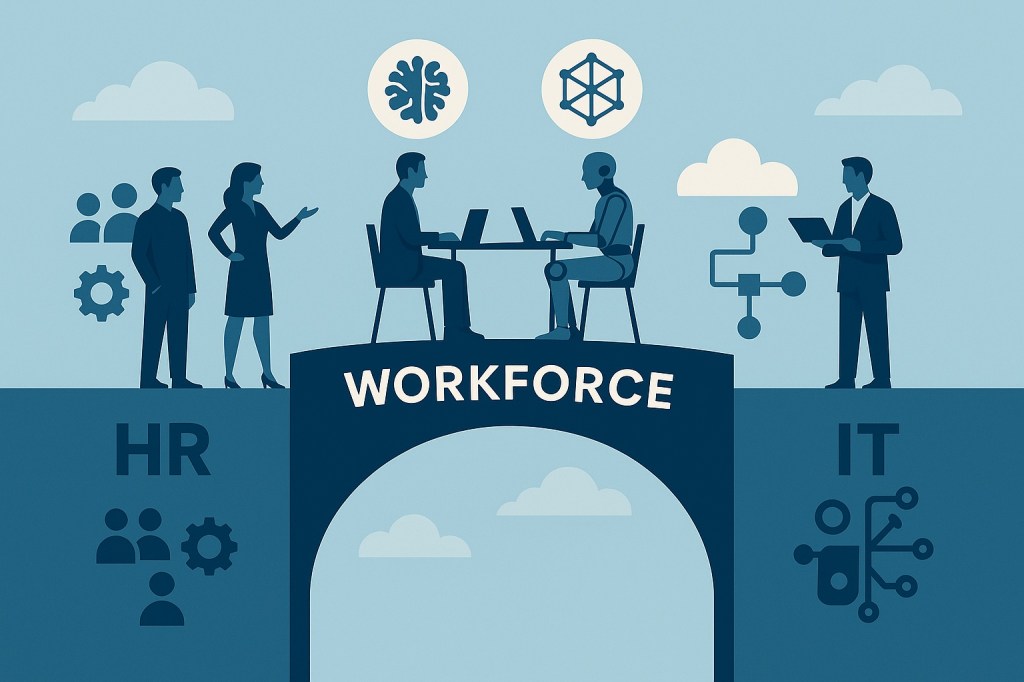
AI is already changing how teams operate, how leaders make decisions, and how value is delivered to customers. For organizations, this means rethinking not just what work gets done, but how it’s done, and by whom. Therefor it is crucial to think about how we bring Human and AI resource management together.
The 2023 MIT Sloan / BCG study, The Rise of AI-Powered Organizations, found that the most successful companies with AI are those where HR and IT work closely together to redesign processes and roles. That collaboration is critical. If AI is deployed without rethinking how humans and machines collaborate, companies risk missed value, employee resistance, and ethical missteps.
Designing the Hybrid Workforce: Teams, Tasks, and Talent
AI doesn’t eliminate jobs—it changes them. To prepare, organizations need to break down roles into specific tasks:
- What can be automated?
- What can be enhanced by AI?
- What should remain Human-led?
From there, teams can be redesigned around how people and AI tools work together. In practice, this might mean:
- A customer service team using AI to summarize queries while humans resolve complex issues
- A product development team using AI to generate design options that humans refine
The HBR article Collaborative Intelligence: Humans and AI Are Joining Forces (Wilson & Daugherty, 2018) highlights five human roles in human-AI collaboration, such as AI trainers, explainers, sustainers, amplifiers and translators. These roles are already emerging in forward-looking teams and should be reflected in new job descriptions and team capabilities.
Organizational Change: Leading Through Disruption
Adding AI isn’t just a tech upgrade—it changes how decisions are made, who makes them, and what leadership looks like. For example:
- Middle managers might now focus more on coaching and less on reporting, as AI handles data consolidation.
- Teams may need to consult AI before acting, introducing a new rhythm to collaboration.
Gartner’s 2023 report How to Measure AI-Augmented Employee Productivity stresses that success in AI transformation isn’t just about productivity—it’s about how well teams adapt, collaborate, and trust AI tools. That requires strong change management, hands-on leadership, and clear guidance on when to trust AI versus when to override it.
Performance and Culture in an AI-Augmented Workplace
With AI in the mix, traditional performance reviews fall short. Leaders need to ask:
- How are employees using AI tools to improve their work?
- Are decisions more consistent, inclusive, and data-informed?
- Is the AI system fair and explainable?
The Stanford HAI Annual AI Index Report 2024 shows that AI systems are improving technically, but companies often lack the tools to measure human impact—such as employee trust or the inclusiveness of AI-driven decisions. Stanford HAI provides several frameworks that can be leveraged to measure Human + AI teams performance.
HR + IT: From Functional Silos to Strategic Workforce Partners
To make AI work, HR and IT must be in lockstep. Here’s what that looks like:
- Shared strategy: Joint planning on where AI will impact jobs and what new skills are needed
- Reskilling programs: Co-owned initiatives to help employees build digital and AI literacy
- Data and governance: Shared ownership of tools that measure workforce readiness and ensure responsible AI use
IBM’s 2023 Enterprise Guide to Closing the Skills Gap highlights that companies closing the skills gap at scale have strong HR–IT alignment. It’s not about HR specifying training needs and IT buying tools. It’s about building workforce capabilities together, with shared accountability.
Practical Implementation Guide
Step-by-Step
- Start with a vision: What does AI mean for how your people work?
- Create joint ownership: HR and IT should lead together from day one
- Map current tasks and roles: Where can AI add value or remove friction?
- Pilot hybrid teams: Run experiments in one area (e.g., marketing, finance) and scale what works
- Define ethical rules: Decide where AI should assist, and where humans must retain control
- Track impact: Use KPIs that include both productivity and human experience
Avoid These Pitfalls
- Launching AI without involving HR
- Treating AI as an isolated IT solution
- Ignoring cultural resistance or trust issues
- Failing to update roles, reviews, or incentives
Patterns That Work
- Embedding AI in learning programs led by both HR and IT
- Using AI to support—not replace—human decision-making in recruiting
- Creating workforce councils to oversee AI ethics and inclusion
Conclusion: Time to Rewire
AI is a shift in how people, teams, and organizations operate. Making that shift successful requires deep collaboration between HR and IT, clear direction from leadership, and a willingness to rethink everything from team design to performance reviews.
Organizations that embrace this challenge with practical steps and shared ownership will not only manage AI’s impact—they’ll harness its full potential to build a smarter, more adaptive workforce.
 Best of Digital Transformation