The Secret Sauce Behind Successful Transformation: Learning Journeys

In the execution-to-integration phase of any transformation, the greatest challenge is rarely the strategy — it’s the sustainability of new ways of working. Systems are deployed, structures reconfigured, and operating models redesigned. Yet months later, familiar patterns resurface, and old behaviors creep back in.

Why? Because true change doesn’t happen in workshops or at go-live milestones. It happens in the daily decisions, habits, and interactions of people across the organization.

This is where learning journeys come in.

Unlike traditional training events — often one-off, content-heavy, and disconnected from real work — learning journeys are spaced, orchestrated experiences designed to embed new skills, mindsets, and behaviors over time. They are:

  • Sequenced over weeks or months to allow for reflection, practice, and reinforcement.
  • Multi-modal, blending digital modules, live sessions, coaching, peer learning, and on-the-job application.
  • Contextualized to individual roles, workflows, and transformation objectives.
  • Integrated into governance and feedback loops to drive ongoing alignment and improvement.

Well-designed learning journeys do more than teach — they transform. They make change tangible, repeatable, and sticky by equipping people to not only understand the new way, but live it every day.


1. Adult Learning Theory: How Adults Learn Best

Research by Malcolm Knowles and successors highlights that adults:

  • Are self-directed.
  • Bring prior experience into the learning process.
  • Want immediate relevance and application.
  • Learn best through problem-solving.

Implication for transformation:
Traditional training sessions or slide decks won’t embed new behaviors. Instead, adults need learning that:

  • Is contextual (tied to their specific role).
  • Offers autonomy (flexibility to explore and apply).
  • Encourages reflection (linking new knowledge with real experiences).

This supports transformation by turning employees into co-creators of change, not just recipients of it.


2. Learning Experience Design : Make It Stick Through Design

Learning Experience Design blends cognitive science, user-centered design, and storytelling to create memorable and effective learning environments. Drawing from design thinking, it emphasizes:

  • Empathizing with learners’ day-to-day.
  • Designing around “moments that matter.”
  • Prototyping and iterating based on feedback.

Implication for transformation:
Learning Experience Design ensures that learning is not generic. For example:

  • Frontline employees might need immersive, task-based simulations.
  • Managers may benefit more from leadership labs and decision-making scenarios.
  • Learning pathways can be designed to mirror the actual rollout of new processes or systems.

This design-first approach increases relevance, reduces friction, and drives higher engagement—key enablers for sustainable transformation.


3. Behavioral Science & Habit Formation: Anchor New Norms

Transformation success is often about small, repeatable behavior changes. Behavioral science — especially the work of James Clear (Atomic Habits) and Charles Duhigg (The Power of Habit) — shows that habits are formed when:

  • Behaviors are simple and easy to start.
  • Triggers and cues are present in the environment.
  • There is immediate reward or reinforcement.

Implication for transformation:
Learning journeys that incorporate behavior design principles:

  • Use nudges to prompt the right actions.
  • Reinforce micro-successes (e.g., feedback after using a new system).
  • Encourage habit stacking (e.g., “after daily team huddle, review dashboard insights”).

Embedding these principles turns learning from a one-off event into an ongoing cycle of behavior reinforcement, helping transformation stick at the individual and team levels.


4. Integration Best Practices: Close the Loop Between Learning and Doing

Many transformations fail in the post-implementation phase because of a disconnect between system rollout, new processes, and human capability. Integration-focused learning journeys:

  • Align with change governance (e.g., steerco and sponsor feedback loops).
  • Include just-in-time learning embedded into the workflow (performance support tools, coaching, etc.).
  • Monitor learning adoption KPIs (e.g., skill application, confidence, usage rates).

Three critical integration elements:

a) Learning must be embedded in the work, not adjacent to it

  • Learning and performance support tools within workflows.
  • Just-in-time content linked to system/process steps.

b) Learning should be part of governance and leadership rituals

  • Incorporating learning metrics into program dashboards.
  • Leaders modelling and discussing learning progress in townhalls and reviews.

c) Learning journeys need to be tracked and adapted over time

  • Use of learning analytics, feedback loops, and continuous improvement.
  • Mechanisms to sunset legacy habits and reinforce new ones.

Together, these principles ensure learning is not a support function but a core engine of transformation delivery.


5. Real-World Examples of Learning Journeys in Action

Microsoft – From Culture Reset to Growth Mindset

  • Journey led by Satya Nadella blending storytelling, role-modeling, and digital learning platforms.
  • Emphasis on curiosity, collaboration, and continuous learning.

Unilever – Scaling Digital Fluency Globally

  • Created a Digital Learning Framework aligned to business capabilities.
  • Personalized learning portals, regional academies, and gamification.

Siemens – MyLearning World as a Platform for Change

  • Centralized platform delivering self-paced, role-based learning.
  • Integration into performance management and project onboarding.

Each example reinforces a core principle: learning drives transformation when it is lived, not just launched.


6. Implementation Blueprint: How to Design and Launch a Learning Journey

Step 1: Define the learning objectives linked to transformation goals

  • What behaviors must change? In which roles?

Step 2: Map the journey — sequence, format, duration

  • Consider phases: Awareness → Enablement → Practice → Reinforcement
  • Blend formats: eLearning, workshops, peer sessions, toolkits, coaching

Step 3: Integrate with business cadence and systems

  • Embed in onboarding, performance reviews, and tool workflows.

Step 4: Mobilize champions and leadership sponsors

  • Leaders should learn with their teams — visibly and vocally.

Step 5: Monitor progress and adapt in real time

  • Use learning analytics, pulse surveys, feedback loops.

Tip: Treat learning like a product — continuously evolving with new features and feedback.


Conclusion: From Learning to Lasting Change

“Transformation sticks when people change how they work — and that only happens through intentional, immersive learning journeys.”

If your transformation includes a plan, a system, and a steering committee — it should also include a learning journey.
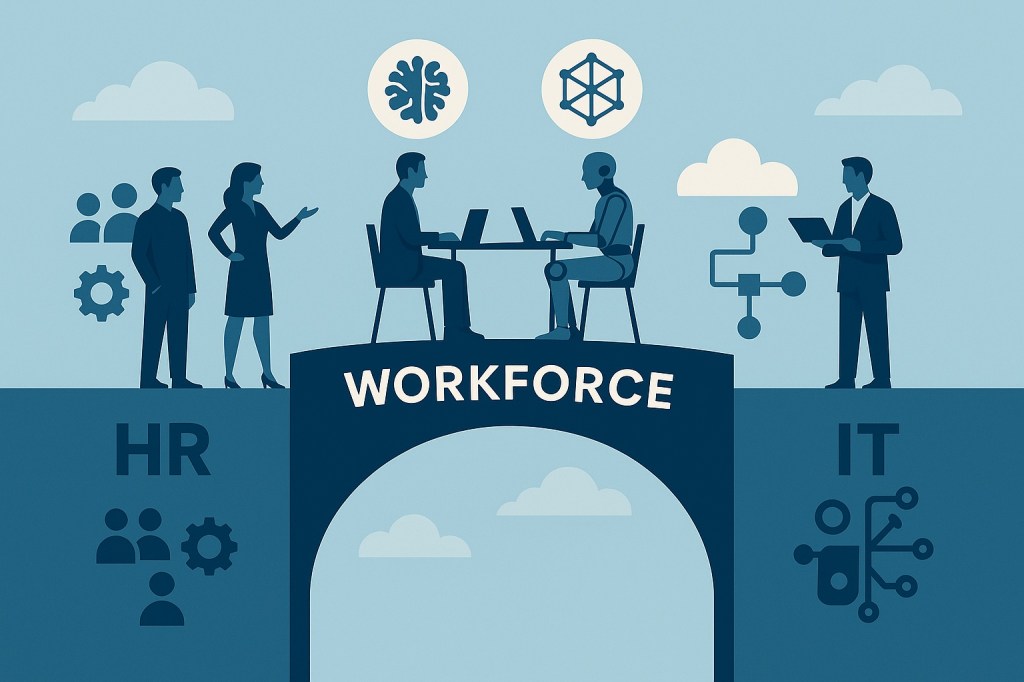
Rewiring the Workforce: Aligning HR and IT in the Age of AI

AI is already changing how teams operate, how leaders make decisions, and how value is delivered to customers. For organizations, this means rethinking not just what work gets done, but how it’s done, and by whom. Therefor it is crucial to think about how we bring Human and AI resource management together.

The 2023 MIT Sloan / BCG study, The Rise of AI-Powered Organizations, found that the most successful companies with AI are those where HR and IT work closely together to redesign processes and roles. That collaboration is critical. If AI is deployed without rethinking how humans and machines collaborate, companies risk missed value, employee resistance, and ethical missteps.


Designing the Hybrid Workforce: Teams, Tasks, and Talent

AI doesn’t eliminate jobs—it changes them. To prepare, organizations need to break down roles into specific tasks:

  • What can be automated?
  • What can be enhanced by AI?
  • What should remain Human-led?

From there, teams can be redesigned around how people and AI tools work together. In practice, this might mean:

  • A customer service team using AI to summarize queries while humans resolve complex issues
  • A product development team using AI to generate design options that humans refine

The HBR article Collaborative Intelligence: Humans and AI Are Joining Forces (Wilson & Daugherty, 2018) highlights five human roles in human-AI collaboration, such as AI trainers, explainers, sustainers, amplifiers and translators. These roles are already emerging in forward-looking teams and should be reflected in new job descriptions and team capabilities.


Organizational Change: Leading Through Disruption

Adding AI isn’t just a tech upgrade—it changes how decisions are made, who makes them, and what leadership looks like. For example:

  • Middle managers might now focus more on coaching and less on reporting, as AI handles data consolidation.
  • Teams may need to consult AI before acting, introducing a new rhythm to collaboration.

Gartner’s 2023 report How to Measure AI-Augmented Employee Productivity stresses that success in AI transformation isn’t just about productivity—it’s about how well teams adapt, collaborate, and trust AI tools. That requires strong change management, hands-on leadership, and clear guidance on when to trust AI versus when to override it.


Performance and Culture in an AI-Augmented Workplace

With AI in the mix, traditional performance reviews fall short. Leaders need to ask:

  • How are employees using AI tools to improve their work?
  • Are decisions more consistent, inclusive, and data-informed?
  • Is the AI system fair and explainable?

The Stanford HAI Annual AI Index Report 2024 shows that AI systems are improving technically, but companies often lack the tools to measure human impact—such as employee trust or the inclusiveness of AI-driven decisions. Stanford HAI provides several frameworks that can be leveraged to measure Human + AI teams performance.


HR + IT: From Functional Silos to Strategic Workforce Partners

To make AI work, HR and IT must be in lockstep. Here’s what that looks like:

  • Shared strategy: Joint planning on where AI will impact jobs and what new skills are needed
  • Reskilling programs: Co-owned initiatives to help employees build digital and AI literacy
  • Data and governance: Shared ownership of tools that measure workforce readiness and ensure responsible AI use

IBM’s 2023 Enterprise Guide to Closing the Skills Gap highlights that companies closing the skills gap at scale have strong HR–IT alignment. It’s not about HR specifying training needs and IT buying tools. It’s about building workforce capabilities together, with shared accountability.


Practical Implementation Guide

Step-by-Step

  1. Start with a vision: What does AI mean for how your people work?
  2. Create joint ownership: HR and IT should lead together from day one
  3. Map current tasks and roles: Where can AI add value or remove friction?
  4. Pilot hybrid teams: Run experiments in one area (e.g., marketing, finance) and scale what works
  5. Define ethical rules: Decide where AI should assist, and where humans must retain control
  6. Track impact: Use KPIs that include both productivity and human experience

Avoid These Pitfalls

  • Launching AI without involving HR
  • Treating AI as an isolated IT solution
  • Ignoring cultural resistance or trust issues
  • Failing to update roles, reviews, or incentives

Patterns That Work

  • Embedding AI in learning programs led by both HR and IT
  • Using AI to support—not replace—human decision-making in recruiting
  • Creating workforce councils to oversee AI ethics and inclusion

Conclusion: Time to Rewire

AI is a shift in how people, teams, and organizations operate. Making that shift successful requires deep collaboration between HR and IT, clear direction from leadership, and a willingness to rethink everything from team design to performance reviews.

Organizations that embrace this challenge with practical steps and shared ownership will not only manage AI’s impact—they’ll harness its full potential to build a smarter, more adaptive workforce.

My Takeaways from: Welcome to AI – A Human Guide to Artificial Intelligence

Since I am still in the early stages of my AI journey, the title Welcome to AI immediately caught my attention, particularly because I am interested in how we as humans need to adapt driven by the rapid proliferation of AI.

David Shrier offers thought-provoking insights into the transformative impact of AI on society, emphasizing its implications for businesses and leadership.

My Key Insights from the Book:

  1. Democratization of AI
    The release of new platforms, like TensorFlow, has made advanced machine learning easy accessible, enabling widespread AI adoption. This democratization lowers entry barriers and drives innovation and competition across industries. For businesses, this directly impacts their strategic planning, including where to allocate resources effectively to stay competitive.
  2. Workforce Evolution and Job Displacement
    AI is automating tasks across various sectors, leading to the displacement of traditional roles. Entire professions, including, design, copywriting, and even engineering are evolving or becoming obsolete. However, AI is also creating demand for new roles, particularly those requiring uniquely human skills such as problem-solving, adaptability, and interpersonal communication.
  3. The Future of Work: Hybrid Teams
    The workplace of the future will be defined by hybrid teams where humans and AI systems collaborate to enhance productivity and capabilities. AI excels in handling repetitive or data-intensive tasks, freeing humans to focus on strategic, creative, and relational aspects of work. To enable this synergy, leaders must prioritize user-friendly AI systems and equip their teams with the skills to integrate AI effectively.
  4. Ethical AI Integration
    The lack of global standards for ethical AI applications calls for proactive leadership. Establishing clear ethical frameworks for AI use, centered on transparency, fairness, and accountability, is essential for maintaining trust among customers, employees, and other stakeholders.

Recommended Actions for Leaders:

  • Invest in AI Literacy: Develop a robust understanding of AI technologies to make informed and strategic decisions.
  • Foster a Culture of Continuous Learning: Promote reskilling and upskilling initiatives that emphasize soft skills and adaptability, preparing the workforce to thrive alongside AI.
  • Promote Human-AI Synergy: Implement AI tools that enhance human strengths, building teams that combine AI efficiency with human creativity and insight.
  • Establish Ethical Guidelines: Create and adhere to ethical standards for AI usage to ensure responsible implementation and long-term trust.

I am convinced that these insights and actions will empower us to navigate the AI revolution effectively, positioning our organizations for sustainable success in an increasingly AI-enhanced and automated world.