Learning with AI – Unlocking Capability at Every Level

AI is Changing How We Learn! We’re entering a new era where learning and AI are deeply intertwined. Whether it’s a university classroom, a manufacturing site, or your own weekend learning project, AI is now part of how we access knowledge, gain new skills, and apply them faster.

The impact is real. In formal education, AI supported tutors are already showing measurable learning gains. In the workplace, embedded copilots help teams learn in the flow of work. And at the organizational level, smart knowledge systems can reduce onboarding time and improve consistency.

But like any tool, AI’s value depends on how we use it. In this article, I’ll explore four areas where AI is transforming learning — and share some insights from my own recent experiences along the way.


1. Formal Education — From Study Assistant to Writing Coach

AI is showing clear value in helping students and professionals deepen understanding, organize ideas, and communicate more effectively.

In my recent Supervisory Board program, I used NotebookLM to upload course materials and interact with them — asking clarifying questions and summarizing key insights. For my final paper, I turned to ChatGPT and Claude for review and editing — helping me sharpen my arguments and improve readability without losing my voice.

The benefit? More focused learning time, better written output, and higher engagement with the material.

How to get the most from AI in education:

  • Use AI to test understanding, not just provide answers
  • Let it structure thoughts and give feedback — like a sounding board
  • Ensure use remains aligned with academic integrity standards

Recent research supports this approach: Harvard studies show students using structured AI tutors learn more in less time when guardrails guide the interaction toward reasoning — not shortcuts.


2. Learning on the Job — From Static Training to Smart Assistance

In many workplaces, AI is no longer something you log into — it’s embedded directly into your tools, helping you solve problems, write faster, or learn new procedures while working.

Take Siemens, for example. Their industrial engineers now use an AI copilot integrated into their software tools to generate, troubleshoot, and optimize code for production machinery. Instead of searching manuals or waiting for expert support, engineers are guided step-by-step by an assistant that understands both the code and the task.

The benefit? People learn while doing — and become more capable with every task.

How to get the most from AI on the job:

  • Start with tasks that benefit from examples (e.g. writing, code, cases)
  • Let the AI model good practice, then ask the user to adapt or explain
  • Use real-time feedback to reinforce learning and reduce rework

Well-implemented, AI tools don’t replace training — they become the cornerstone of the training.


3. Organizational Learning — Turning Knowledge into an Exchange

As organizations accumulate more policies, procedures, and playbooks, the challenge isn’t just creating knowledge — it’s making it accessible. This is where AI can fundamentally change the game.

PwC is a leading example. They’ve deployed ChatGPT Enterprise to 100,000 employees, combined with internal GPTs trained on company-specific content. This transforms how people access information: instead of digging through files, they ask a question and get a consistent, governed answer — instantly.

The benefit? Faster onboarding, fewer escalations, and more confident decision-making across the board.

How to build this in your organization:

  • Start with high-value content (e.g., SOPs, onboarding, policies)
  • Assign content owners to keep AI knowledge up to date
  • Monitor questions and feedback to identify knowledge gaps

Done right, this turns your organization into a living learning system.


4. Personal Learning — Exploring New Skills with AI as a Guide

Outside of work and formal learning, many people are using AI to explore entirely new topics. Whether it’s a new technology, management concept, or even a language, tools like ChatGPT, Gemini and Claude make it easy to start — and to go deep.

Let’s say you want to learn about cloud architecture. You can ask AI to:

  • Create a 4-week plan tailored to your experience level
  • Suggest reading material and create quick explainers
  • Generate test questions or even simulate an interview

The benefit? Structured, personalized, and frictionless learning — anytime, anywhere.

To make it effective:

  • Be specific: define your goals and time frame
  • Ask for exercises or cases to apply what you learn
  • Use reflection prompts and feedback to deepen understanding

The key is to treat AI as a learning coach, not just a search engine.


Looking Ahead — Opportunities, Risks, and What Leaders Can Do

AI can make learning faster, broader, and more accessible. But like any capability shift, it introduces both upside and new risks:

Opportunities

  • Faster time to skill through real-time, contextual learning
  • Scaling of expert knowledge across global teams
  • Better engagement and confidence among learners at all levels

Risks

  • Over-reliance on AI can lead to shallow understanding
  • Inaccurate or outdated responses risk reinforcing errors
  • Uneven adoption can widen capability gaps inside teams

How to mitigate the risks

  • Introduce guardrails that promote reasoning and reduce blind copying
  • Keep AI tools connected to curated, up-to-date knowledge
  • Build adoption playbooks tailored to roles, not just tools

Final Thought — Treat AI as Part of Your Learning System

The most successful organizations aren’t just giving people access to AI — they’re designing learning systems around it.

That means using AI to model best practice, challenge thinking, and reduce time-to-competence. AI is not just a productivity tool — it’s a capability accelerator.

Those who treat it that way will upskill faster, build smarter teams, and stay more adaptable in the face of constant change.
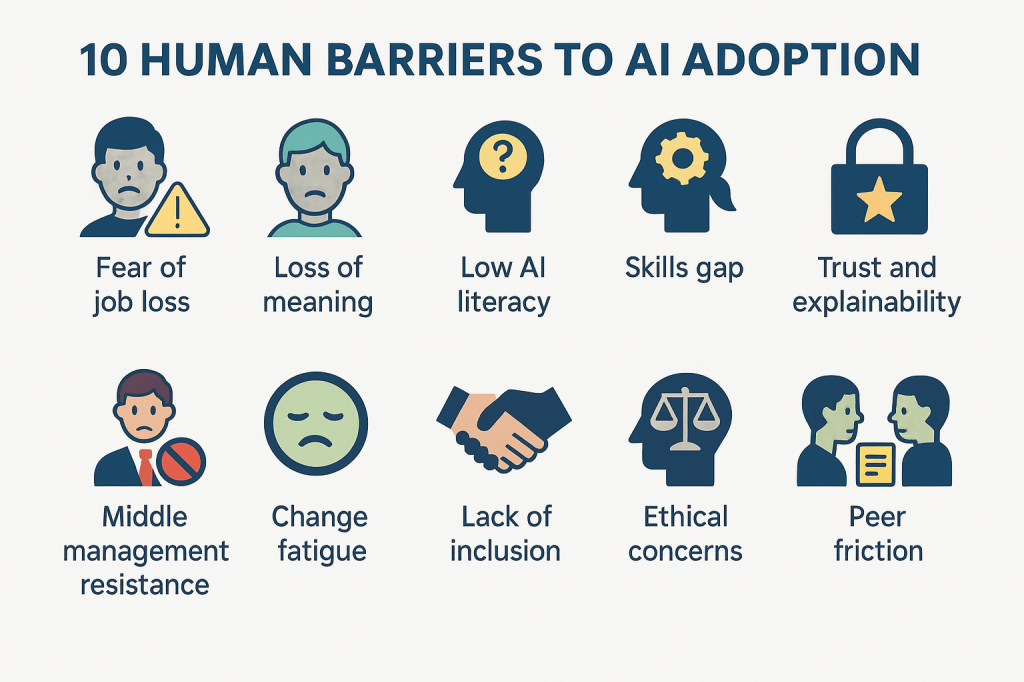

If AI Is So Smart, Why Are We Struggling to Use It?

The human-side barriers to AI adoption — and how to overcome them

In my previous newsletter, “Where AI is Already Making a Significant Impact on Business Process Execution – 15 Areas Explained,” we explored how AI is streamlining tasks from claims processing to customer segmentation. But despite these breakthroughs, one question keeps surfacing:

If AI is delivering so much value… why are so many organizations struggling to actually adopt it?

The answer isn’t technical — it’s human.

In this edition, I explore ten people-related reasons AI initiatives stall or underdeliver. Each barrier is followed by a practical example and suggestions for how to overcome it.


1. Fear of Job Loss and Role Redundancy

Employees fear AI will replace them, leading to resistance or disengagement. This is especially prevalent in operational roles and shared services.

Example: An EY survey found 75% of US workers worry about AI replacing their jobs. In several large organizations, process experts quietly slow-roll automation to protect their roles.

How to mitigate: Communicate early and often. Frame AI as augmentation, not replacement. Highlight opportunities for upskilling and create pathways for digitally enabled roles.


2. Loss of Meaning and Professional Identity

Even if employees accept AI won’t replace them, they may fear it will erode the craftsmanship and meaning of their work.

Example: In legal and editorial teams, professionals report reluctance to use generative AI tools because they feel it “cheapens” their contribution or downplays their expertise.

How to mitigate: Position AI as a creative partner, not a substitute. Focus on use cases that enhance quality and amplify human strengths.


3. Low AI Literacy and Confidence

Many knowledge workers don’t feel equipped to understand or apply AI tools. This leads to underutilization or misuse.

Example: I’ve seen this firsthand: employees hesitate to rely on AI tools and default to old ways of working out of discomfort or lack of clarity.

How to mitigate: Launch AI literacy programs tailored to roles. Give people space to experiment, and build a shared language for AI in the organization.


4. Skills Gap: Applying AI to Domain Work

Beyond literacy, many employees lack the applied skills needed to integrate AI into their actual workflows. They may know what AI can do — but not how to adapt it to their role.

Example: In a global supply chain function, team members were aware of AI’s capabilities but struggled to translate models into usable scenarios like demand sensing or inventory risk prediction.

How to mitigate: Invest in practical upskilling: scenario-based training, role-specific accelerators, and coaching. Empower cross-functional “AI translators” to bridge tech and business.


5. Trust and Explainability Concerns

Employees and managers hesitate to rely on AI if they don’t understand “how” it reached its output — especially in decision-making contexts.

Example: A global logistics firm paused the rollout of AI-based demand forecasting after regional leaders questioned unexplained fluctuations in output.

How to mitigate: Prioritize transparency for critical use cases. Use interpretable models where possible, and combine AI output with human judgment.


6. Middle Management Resistance

Mid-level managers may perceive AI as a threat to their control or relevance. They can become blockers, slowing momentum.

Example: In a consumer goods company, digital leaders struggled to scale AI pilots because local managers didn’t support or prioritize the initiatives.

How to mitigate: Involve middle managers in co-creation. Tie their success metrics to AI-enabled outcomes and make them champions of transformation.


7. Change Fatigue and Initiative Overload

Teams already dealing with hybrid work, restructurings, or system rollouts may see AI as just another corporate initiative on top of their daily work.

Example: A pharmaceutical company with multiple digital programs saw frontline disengagement with AI pilots due to burnout and lack of clear value.

How to mitigate: Embed AI within existing transformation goals. Focus on a few high-impact use cases, and consistently communicate their benefit to teams.


8. Lack of Inclusion in Design and Rollout

When AI tools are developed in technical silos, end users often feel the solutions don’t reflect their workflows or needs.

Example: A banking chatbot failed in deployment because call center staff hadn’t been involved in the design phase — leading to confusion and distrust.

How to mitigate: Involve users early and often. Use participatory design approaches and validate tools in real working environments.


9. Ethical Concerns and Mistrust

Some employees worry AI may reinforce bias, lack fairness, or be used inappropriately — especially in sensitive areas like HR, compliance, or performance assessment.

Example: An AI-based resume screener was withdrawn by a tech firm after internal concerns about gender and ethnicity bias, even before public rollout.

How to mitigate: Establish clear ethical guidelines for AI. Be transparent about data usage, and create safe channels for feedback and concerns.


10. Peer Friction: “They Let the AI Do Their Job”

Even when AI is used effectively, friction can arise when colleagues feel others are “outsourcing their thinking” or bypassing effort by relying on AI tools.

Example: In a shared services team, tension grew when some employees drafted client reports with AI in minutes — while others insisted on traditional methods, feeling their contributions were undervalued.

How to mitigate: Create shared norms around responsible AI use. Recognize outcomes, not effort alone, and encourage knowledge sharing across teams.


Final Thought: It’s Not the Tech — It’s the Trust

Successful AI adoption isn’t about algorithms or infrastructure — it’s about mindsets, motivation, and meaning.

If we want people to embrace AI, we must:

  • Empower them with knowledge, skills, and confidence
  • Engage them as co-creators in the journey
  • Ensure they see personal and professional value in change

Human-centered adoption isn’t the soft side of transformation — it’s the hard edge of success. Let’s create our transformation plans with that in mind.

Harnessing Curiosity for Digital Transformation Success

In a world shaped by accelerating change, new technologies, and shifting customer expectations, digital transformation is no longer optional—it’s a strategic imperative. But technology alone doesn’t drive transformation. The real differentiator lies in human capabilities—and among these, curiosity stands out as a key enabler of successful change.

Curiosity: The Human Advantage in a Digital World

Curiosity isn’t just about asking questions. It’s the active pursuit of new knowledge, perspectives, and possibilities. It fuels learning, drives innovation, and enables people to adapt quickly in fast-moving environments.

As Deloitte puts it in their research on digital fluency, “Curiosity is the catalyst that allows people to keep pace with technology—and lead with it.”

For transformation leaders, this has direct implications:

  • Curious individuals are more likely to experiment, learn, and improve.
  • Curious teams are better at breaking silos, seeking input, and iterating solutions.
  • Curious cultures are more resilient, adaptive, and open to what’s next.

Research That Connects Curiosity to Transformation Success

The Business Case for Curiosity – Harvard Business Review (Francesca Gino, 2018)

  • Curious employees are more engaged, collaborative, and better at decision-making.
  • Organizations that foster curiosity experience higher innovation and reduced groupthink.
  • Read the article →

The Mindsets of Transformation Leaders – McKinsey & Company

  • Highlights intellectual curiosity as a hallmark of successful transformation leaders.
  • Curious leaders are more willing to challenge assumptions, adapt strategy, and engage stakeholders.
  • Read the article →

Human + Machine: Reimagining Work in the Age of AI – IBM Institute for Business Value

  • Emphasizes that in the AI era, human skills like curiosity are vital complements to automation.
  • Curious individuals are better at interpreting data, asking better questions, and guiding AI to impactful outcomes.
  • Explore Human + Machine →

The Curiosity Gap: What Holds Teams Back

Despite its value, many organisations unintentionally stifle curiosity:

  • Rigid hierarchies discourage questioning.
  • Execution pressure leaves no room for reflection.
  • Fear of failure shuts down experimentation.
  • Overreliance on expertise limits fresh thinking.

These are culture issues, not people issues. Leaders play a pivotal role in changing this dynamic.

How Leaders Can Foster Curiosity

Transformation leaders can amplify curiosity in practical, powerful ways:

  • Ask more than tell: Use open-ended questions to spark exploration.
  • Normalize experimentation: Frame pilots and prototypes as learning opportunities.
  • Listen actively: Signal that new ideas and diverse perspectives are valued.
  • Reward growth: Recognize not just performance, but how people learn and adapt.
  • Lead with humility: Show you’re learning too—and invite others on the journey.

Final Word

Digital transformation is ultimately a human transformation. And curiosity is the mindset that keeps humans relevant, engaged, and future-ready.

It’s what helps a data analyst spot an emerging trend, a product manager test a radical new idea, and a CEO rethink a decades-old business model. It’s also what allows us to partner more effectively with AI—asking the right questions, interpreting signals, and imagining better solutions.

As you lead your organisation through transformation, don’t just invest in platforms and capabilities. Invest in curiosity. It’s the spark that turns potential into progress.

Harnessing Lessons Learned for Digital Transformation Success

Introduction

Digital transformation is a complex, multi-phase journey that requires continuous learning and adaptation. Organizations that systematically capture and apply lessons learned improve their chances of success, avoid recurring mistakes, and optimize future initiatives. However, many businesses either fail to document insights effectively or struggle to integrate them into future projects. This article explores the importance of lessons learned, effective approaches, implementation strategies, key challenges, and a step-by-step framework to ensure digital transformation efforts benefit from past experiences.

1. Why Lessons Learned Matter in Digital Transformation

Lessons learned play a crucial role in refining digital transformation efforts. Key benefits include:

  • Preventing Repeated Mistakes – Avoiding common pitfalls saves time, money, and resources.
  • Enhancing Decision-Making – Informed decisions based on past experiences lead to better outcomes.
  • Optimizing Processes – Continuous improvement ensures that digital initiatives become more efficient over time.
  • Strengthening Governance – Ensuring that digital transformation governance evolves based on real-world insights.
  • Fostering a Learning Culture – Encouraging teams to reflect on successes and failures promotes organizational agility.

By embedding a structured approach to lessons learned, companies can accelerate their digital transformation efforts and increase long-term success.

2. Approaches to Capturing Lessons Learned

Various methodologies exist for systematically gathering insights from digital transformation initiatives. Some of the most effective approaches include:

A. After-Action Review (AAR)

Originally developed by the U.S. Army, the AAR method uses a structured reflection process:

  1. What was supposed to happen?
  2. What actually happened?
  3. What went well and why?
  4. What can be improved and how?

B. Agile Retrospectives

Agile methodologies integrate lessons learned through retrospectives at the end of each sprint. Common questions include:

  • What worked well?
  • What didn’t go well?
  • What can we improve?
  • What are the action items for the next sprint?

C. Post-Implementation Review (PIR)

A PIR is conducted after a major project phase or the entire transformation effort. It assesses:

  • Whether objectives were met.
  • What worked and what didn’t.
  • How to apply insights to future transformations.

D. Lessons Learned Workshops

Interactive sessions where key stakeholders share insights using structured formats like:

  • Start, Stop, Continue review.
  • Root Cause Analysis (Fishbone Diagrams).
  • Timeline Review with Thematic Grouping of Issues.

E. Knowledge Repositories for Continuous Learning

Organizations can store and share lessons learned using:

  • Digital transformation playbooks.
  • Internal knowledge management systems (e.g., Confluence, SharePoint).
  • AI-driven repositories for searchability.

3. Applying Lessons Learned in Digital Transformation

Capturing lessons is only valuable if they are applied effectively. Here’s how organizations can ensure insights drive real change:

A. Integrate Lessons into Governance Structures

  • Assign a Lessons Learned Owner or a Transformation Office to track insights.
  • Make lessons learned a standard agenda item in executive steering committees.
  • Embed lessons into organizational decision-making and process improvements.

B. Apply Lessons at Different Levels

  1. Sprint/Phase Level – Immediate adjustments based on sprint retrospectives.
  2. Program/Portfolio Level – Aggregate insights to refine digital strategies.
  3. Enterprise Level – Consolidate transformation-wide lessons into strategic planning.

C. Communicate Lessons Effectively

Lessons must reach the right audience to be impactful:

AudienceCommunication Approach
ExecutivesSummary reports, dashboard insights
Project TeamsWorkshops, sprint reviews, playbooks
Entire OrganizationNewsletters, town halls, digital knowledge hubs

D. Overcoming Common Challenges

ChallengeSolution
Teams don’t document lessonsUse structured templates and automated tools
Lessons aren’t appliedAssign accountability and track implementation
Resistance to discussing failuresFoster a blame-free culture focused on improvement
Insights are scattered across silosCentralize in a knowledge management system

4. Step-by-Step Framework for Implementing Lessons Learned

Step 1: Capture Lessons at Key Milestones

  • Conduct lessons learned sessions at the end of sprints, phases, and projects.
  • Use structured templates and tools to document insights.

Step 2: Analyze and Prioritize Insights

  • Categorize lessons into successes, challenges, opportunities, and recommendations.
  • Use analytical tools like Root Cause Analysis to extract meaningful trends.
  • Prioritize lessons based on strategic impact.

Step 3: Integrate Lessons into Future Projects

  • Update digital transformation playbooks and methodologies.
  • Include lessons learned in risk management frameworks.
  • Modify Standard Operating Procedures (SOPs) based on past experiences.

Step 4: Communicate Lessons Across the Organization

  • Tailor communication methods for different audiences (executives, teams, entire organization).
  • Use multiple channels: internal portals, newsletters, videos, and town halls.
  • Establish a continuous feedback loop for ongoing knowledge sharing.

Step 5: Institutionalize Lessons for Long-Term Impact

  • Develop a centralized knowledge repository for easy retrieval of past lessons.
  • Create a Lessons Learned Playbook to guide future teams, e.g. with Do’s and Don’ts
  • Measure impact through KPIs such as reduced project failures, increased efficiency, and improved adoption rates.

5. Final Thoughts

Applying lessons learned in digital transformation is essential for continuous improvement and long-term success. By embedding a structured process into governance, decision-making, and cultural practices, organizations can avoid repeating mistakes, optimize their digital initiatives, and drive better outcomes.

Successful digital transformations are not just about implementing new technologies—they are about learning, adapting, and evolving. Organizations that prioritize lessons learned as a strategic capability will lead the way in digital excellence.