The Secret Sauce Behind Successful Transformation: Learning Journeys

In the execution-to-integration phase of any transformation, the greatest challenge is rarely the strategy — it’s the sustainability of new ways of working. Systems are deployed, structures reconfigured, and operating models redesigned. Yet months later, familiar patterns resurface, and old behaviors creep back in.

Why? Because true change doesn’t happen in workshops or at go-live milestones. It happens in the daily decisions, habits, and interactions of people across the organization.

This is where learning journeys come in.

Unlike traditional training events — often one-off, content-heavy, and disconnected from real work — learning journeys are spaced, orchestrated experiences designed to embed new skills, mindsets, and behaviors over time. They are:

  • Sequenced over weeks or months to allow for reflection, practice, and reinforcement.
  • Multi-modal, blending digital modules, live sessions, coaching, peer learning, and on-the-job application.
  • Contextualized to individual roles, workflows, and transformation objectives.
  • Integrated into governance and feedback loops to drive ongoing alignment and improvement.

Well-designed learning journeys do more than teach — they transform. They make change tangible, repeatable, and sticky by equipping people to not only understand the new way, but live it every day.


1. Adult Learning Theory: How Adults Learn Best

Research by Malcolm Knowles and successors highlights that adults:

  • Are self-directed.
  • Bring prior experience into the learning process.
  • Want immediate relevance and application.
  • Learn best through problem-solving.

Implication for transformation:
Traditional training sessions or slide decks won’t embed new behaviors. Instead, adults need learning that:

  • Is contextual (tied to their specific role).
  • Offers autonomy (flexibility to explore and apply).
  • Encourages reflection (linking new knowledge with real experiences).

This supports transformation by turning employees into co-creators of change, not just recipients of it.


2. Learning Experience Design : Make It Stick Through Design

Learning Experience Design blends cognitive science, user-centered design, and storytelling to create memorable and effective learning environments. Drawing from design thinking, it emphasizes:

  • Empathizing with learners’ day-to-day.
  • Designing around “moments that matter.”
  • Prototyping and iterating based on feedback.

Implication for transformation:
Learning Experience Design ensures that learning is not generic. For example:

  • Frontline employees might need immersive, task-based simulations.
  • Managers may benefit more from leadership labs and decision-making scenarios.
  • Learning pathways can be designed to mirror the actual rollout of new processes or systems.

This design-first approach increases relevance, reduces friction, and drives higher engagement—key enablers for sustainable transformation.


3. Behavioral Science & Habit Formation: Anchor New Norms

Transformation success is often about small, repeatable behavior changes. Behavioral science — especially the work of James Clear (Atomic Habits) and Charles Duhigg (The Power of Habit) — shows that habits are formed when:

  • Behaviors are simple and easy to start.
  • Triggers and cues are present in the environment.
  • There is immediate reward or reinforcement.

Implication for transformation:
Learning journeys that incorporate behavior design principles:

  • Use nudges to prompt the right actions.
  • Reinforce micro-successes (e.g., feedback after using a new system).
  • Encourage habit stacking (e.g., “after daily team huddle, review dashboard insights”).

Embedding these principles turns learning from a one-off event into an ongoing cycle of behavior reinforcement, helping transformation stick at the individual and team levels.


4. Integration Best Practices: Close the Loop Between Learning and Doing

Many transformations fail in the post-implementation phase because of a disconnect between system rollout, new processes, and human capability. Integration-focused learning journeys:

  • Align with change governance (e.g., steerco and sponsor feedback loops).
  • Include just-in-time learning embedded into the workflow (performance support tools, coaching, etc.).
  • Monitor learning adoption KPIs (e.g., skill application, confidence, usage rates).

Three critical integration elements:

a) Learning must be embedded in the work, not adjacent to it

  • Learning and performance support tools within workflows.
  • Just-in-time content linked to system/process steps.

b) Learning should be part of governance and leadership rituals

  • Incorporating learning metrics into program dashboards.
  • Leaders modelling and discussing learning progress in townhalls and reviews.

c) Learning journeys need to be tracked and adapted over time

  • Use of learning analytics, feedback loops, and continuous improvement.
  • Mechanisms to sunset legacy habits and reinforce new ones.

Together, these principles ensure learning is not a support function but a core engine of transformation delivery.


5. Real-World Examples of Learning Journeys in Action

Microsoft – From Culture Reset to Growth Mindset

  • Journey led by Satya Nadella blending storytelling, role-modeling, and digital learning platforms.
  • Emphasis on curiosity, collaboration, and continuous learning.

Unilever – Scaling Digital Fluency Globally

  • Created a Digital Learning Framework aligned to business capabilities.
  • Personalized learning portals, regional academies, and gamification.

Siemens – MyLearning World as a Platform for Change

  • Centralized platform delivering self-paced, role-based learning.
  • Integration into performance management and project onboarding.

Each example reinforces a core principle: learning drives transformation when it is lived, not just launched.


6. Implementation Blueprint: How to Design and Launch a Learning Journey

Step 1: Define the learning objectives linked to transformation goals

  • What behaviors must change? In which roles?

Step 2: Map the journey — sequence, format, duration

  • Consider phases: Awareness → Enablement → Practice → Reinforcement
  • Blend formats: eLearning, workshops, peer sessions, toolkits, coaching

Step 3: Integrate with business cadence and systems

  • Embed in onboarding, performance reviews, and tool workflows.

Step 4: Mobilize champions and leadership sponsors

  • Leaders should learn with their teams — visibly and vocally.

Step 5: Monitor progress and adapt in real time

  • Use learning analytics, pulse surveys, feedback loops.

Tip: Treat learning like a product — continuously evolving with new features and feedback.


Conclusion: From Learning to Lasting Change

“Transformation sticks when people change how they work — and that only happens through intentional, immersive learning journeys.”

If your transformation includes a plan, a system, and a steering committee — it should also include a learning journey.
Rewiring the Workforce: Aligning HR and IT in the Age of AI

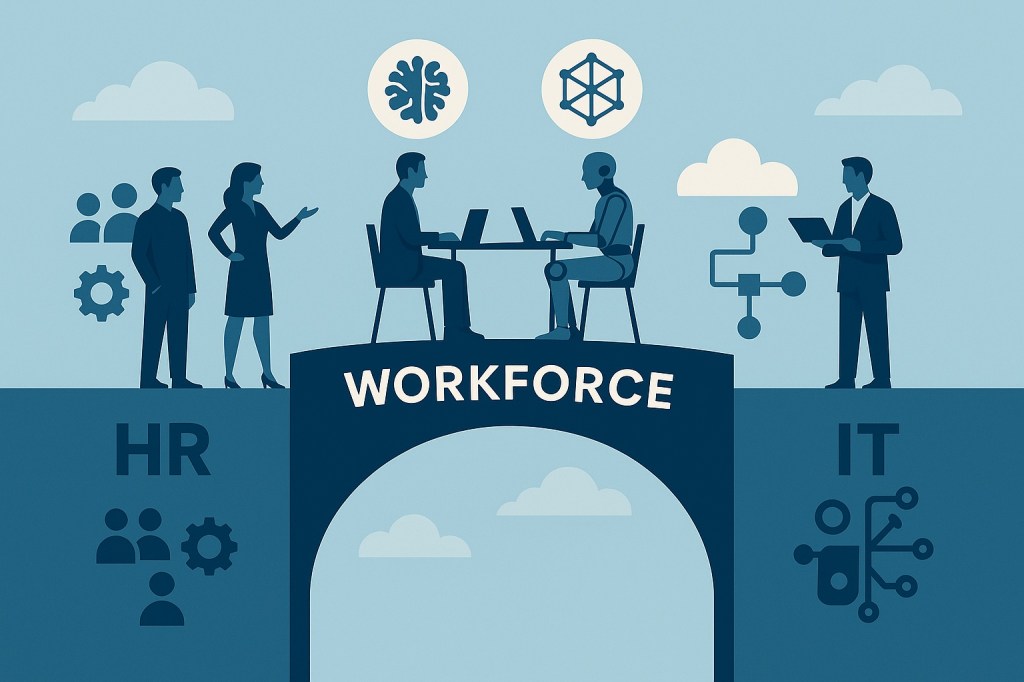
AI is already changing how teams operate, how leaders make decisions, and how value is delivered to customers. For organizations, this means rethinking not just what work gets done, but how it’s done, and by whom. Therefor it is crucial to think about how we bring Human and AI resource management together.

The 2023 MIT Sloan / BCG study, The Rise of AI-Powered Organizations, found that the most successful companies with AI are those where HR and IT work closely together to redesign processes and roles. That collaboration is critical. If AI is deployed without rethinking how humans and machines collaborate, companies risk missed value, employee resistance, and ethical missteps.


Designing the Hybrid Workforce: Teams, Tasks, and Talent

AI doesn’t eliminate jobs—it changes them. To prepare, organizations need to break down roles into specific tasks:

  • What can be automated?
  • What can be enhanced by AI?
  • What should remain Human-led?

From there, teams can be redesigned around how people and AI tools work together. In practice, this might mean:

  • A customer service team using AI to summarize queries while humans resolve complex issues
  • A product development team using AI to generate design options that humans refine

The HBR article Collaborative Intelligence: Humans and AI Are Joining Forces (Wilson & Daugherty, 2018) highlights five human roles in human-AI collaboration, such as AI trainers, explainers, sustainers, amplifiers and translators. These roles are already emerging in forward-looking teams and should be reflected in new job descriptions and team capabilities.


Organizational Change: Leading Through Disruption

Adding AI isn’t just a tech upgrade—it changes how decisions are made, who makes them, and what leadership looks like. For example:

  • Middle managers might now focus more on coaching and less on reporting, as AI handles data consolidation.
  • Teams may need to consult AI before acting, introducing a new rhythm to collaboration.

Gartner’s 2023 report How to Measure AI-Augmented Employee Productivity stresses that success in AI transformation isn’t just about productivity—it’s about how well teams adapt, collaborate, and trust AI tools. That requires strong change management, hands-on leadership, and clear guidance on when to trust AI versus when to override it.


Performance and Culture in an AI-Augmented Workplace

With AI in the mix, traditional performance reviews fall short. Leaders need to ask:

  • How are employees using AI tools to improve their work?
  • Are decisions more consistent, inclusive, and data-informed?
  • Is the AI system fair and explainable?

The Stanford HAI Annual AI Index Report 2024 shows that AI systems are improving technically, but companies often lack the tools to measure human impact—such as employee trust or the inclusiveness of AI-driven decisions. Stanford HAI provides several frameworks that can be leveraged to measure Human + AI teams performance.


HR + IT: From Functional Silos to Strategic Workforce Partners

To make AI work, HR and IT must be in lockstep. Here’s what that looks like:

  • Shared strategy: Joint planning on where AI will impact jobs and what new skills are needed
  • Reskilling programs: Co-owned initiatives to help employees build digital and AI literacy
  • Data and governance: Shared ownership of tools that measure workforce readiness and ensure responsible AI use

IBM’s 2023 Enterprise Guide to Closing the Skills Gap highlights that companies closing the skills gap at scale have strong HR–IT alignment. It’s not about HR specifying training needs and IT buying tools. It’s about building workforce capabilities together, with shared accountability.


Practical Implementation Guide

Step-by-Step

  1. Start with a vision: What does AI mean for how your people work?
  2. Create joint ownership: HR and IT should lead together from day one
  3. Map current tasks and roles: Where can AI add value or remove friction?
  4. Pilot hybrid teams: Run experiments in one area (e.g., marketing, finance) and scale what works
  5. Define ethical rules: Decide where AI should assist, and where humans must retain control
  6. Track impact: Use KPIs that include both productivity and human experience

Avoid These Pitfalls

  • Launching AI without involving HR
  • Treating AI as an isolated IT solution
  • Ignoring cultural resistance or trust issues
  • Failing to update roles, reviews, or incentives

Patterns That Work

  • Embedding AI in learning programs led by both HR and IT
  • Using AI to support—not replace—human decision-making in recruiting
  • Creating workforce councils to oversee AI ethics and inclusion

Conclusion: Time to Rewire

AI is a shift in how people, teams, and organizations operate. Making that shift successful requires deep collaboration between HR and IT, clear direction from leadership, and a willingness to rethink everything from team design to performance reviews.

Organizations that embrace this challenge with practical steps and shared ownership will not only manage AI’s impact—they’ll harness its full potential to build a smarter, more adaptive workforce.

Embed Design Thinking in Digital Transformation

What is Design Thinking?

Design Thinking is a human-centered, iterative problem-solving methodology that blends what is desirable from a human point of view with what is technologically feasible and economically viable. It emphasizes empathy, creativity, and experimentation — especially in the face of complex, ambiguous challenges.

This approach has been championed by several leading institutions:

  • IDEO, the design and innovation consultancy that helped formalize and popularize the methodology in the 1990s, defines Design Thinking as “a way to solve problems creatively and put the user at the heart of the process.”
  • Stanford d.school (Hasso Plattner Institute of Design) provides a widely adopted framework for teaching Design Thinking, focusing on empathy, rapid prototyping, and iteration.
  • Harvard Business Review and MIT Sloan Management Review have featured numerous case studies and research articles on the strategic value of Design Thinking in driving innovation and transformation.

Design Thinking is not just about aesthetics or UX — it’s about rethinking the business problem from the outside in. It works particularly well when the problems are not well defined, solutions are not obvious, and buy-in is essential.


When to Apply Design Thinking in a Transformation Journey

Design Thinking is particularly valuable in the following scenarios:

  1. Tackling Complex, Ill-Defined Problems
    Helps navigate ambiguity and uncover the real issues when the challenge is unclear or evolving.
  2. Creating User-Centric Solutions
    Ensures that products, services, or experiences truly meet user needs, boosting adoption and satisfaction.
  3. Driving Innovation
    Encourages breakthrough thinking and novel solutions beyond incremental improvements.
  4. Organizational Transformation
    Reframes complex change challenges and engages stakeholders in co-creating future ways of working.
  5. Cross-Functional Alignment
    Provides a shared process and language for collaboration across diverse teams and disciplines.

How to Apply Design Thinking: The 5 Key Steps

The five-step model used by the Stanford d.school and adopted globally is:

1. Empathize

The foundation of Design Thinking is developing a deep understanding of the users and stakeholders involved.

Key Activities:

  • Conduct user interviews and observations
  • Create empathy maps
  • Shadow users in their natural environment
  • Gather stories and experiences
  • Identify pain points and unmet needs

Tips for Success:

  • Suspend judgment and listen deeply
  • Look for contradictions between what people say and what they do
  • Pay attention to emotional responses and non-verbal cues
  • Seek diverse perspectives across your user base

2. Define

This phase involves synthesizing research insights to clearly articulate the problem you’re trying to solve.

Key Activities:

  • Analyze patterns in your research data
  • Create user personas
  • Develop problem statements or “How Might We” questions
  • Map user journeys to identify opportunities
  • Prioritize which challenges to address

Tips for Success:

  • Frame problems as opportunities
  • Ensure your problem statement is neither too broad nor too narrow
  • Focus on user needs rather than organizational constraints
  • Use the format: “[User] needs a way to [user’s need] because [insight]”

3. Ideate

With a clear problem definition, teams generate a wide range of potential solutions.

Key Activities:

  • Brainstorming sessions
  • Mind mapping
  • Sketch sessions (like Crazy 8s)
  • Analogical thinking exercises
  • Creative provocations and constraints

Tips for Success:

  • Defer judgment—aim for quantity over quality initially
  • Build on others’ ideas
  • Encourage wild ideas to stretch thinking
  • Stay focused on the problem statement
  • Combine and refine ideas before moving to prototyping

4. Prototype

This phase transforms ideas into tangible forms that can be experienced and tested.

Key Activities:

  • Create low-fidelity prototypes (paper, cardboard)
  • Develop digital mockups or wireframes
  • Role-play service experiences
  • Storyboard user journeys
  • Build functional models

Tips for Success:

  • Start simple and rough—prototypes should be quick and inexpensive
  • Focus on the critical aspects you need to test
  • Create just enough detail to get meaningful feedback
  • Remember that prototypes are disposable learning tools, not final products
  • Consider multiple prototype variations when possible

5. Test

The testing phase involves gathering feedback from users interacting with your prototypes.

Key Activities:

  • User testing sessions
  • A/B testing
  • Feedback collection and analysis
  • Observation of prototype interactions
  • Iteration based on learnings

Tips for Success:

  • Test with real users, not just team members
  • Ask open-ended questions
  • Watch what users do, not just what they say
  • Be prepared to return to earlier phases based on feedback
  • Document both successes and failures

Positioning Design Thinking Within the Transformation Toolkit

Design Thinking plays a distinct role within the broader transformation toolkit. It complements analytical, strategic, and operational tools by introducing human-centered exploration.

Phase of TransformationKey ObjectiveRelevant ToolsDesign Thinking’s Role
Direction SettingDefine purpose and ambitionVision Canvas, Portfolio AssessmentReframe strategic challenges through user lenses
Problem FramingUnderstand root causesRoot Cause Tree, Current State MappingUncover unmet needs, redefine the real problem
Solution DesignDevelop future-state solutionsJourney Mapping, Value Stream DesignGenerate, test, and refine ideas based on user feedback
ImplementationDeliver and scale changeAgile Delivery, Roadmap PlanningAlign design with adoption and feedback
Continuous ImprovementOptimize and evolvePDCA Cycle, VOC, KPIsRapidly test and iterate small changes that matter to users

Connections to Other Tools:

  • Agile: Design Thinking fuels the Agile backlog with user-validated insights.
  • Journey Mapping: Design Thinking is the mindset powering journey development.
  • Root Cause Analysis: Ensures you’re solving the right problem, not just the obvious one.
  • Business Case Development: Early prototypes validate assumptions before large investments.

Conclusion

Design Thinking brings the voice of the user into the heart of digital transformation. In a landscape driven by technology, data, and speed, it serves as a vital reminder that people are at the core of every transformation.

For transformation leaders, it offers a structured yet creative way to navigate ambiguity, build stakeholder alignment, and reduce the risk of building solutions no one wants. Combined with complementary tools, it can shift the trajectory of change programs from compliance-driven to truly innovation-led.

“Design Thinking is not a process for designers, it’s a process for creators, innovators, and leaders.” — Tim Brown, IDEO

Revolutionizing Finance with AI Automation

Finance is one of the business functions most primed for disruption through AI. With its high volume of repetitive transactions, rich data environments, and structured processes, the finance and controlling function is uniquely positioned to benefit from automation and intelligent analytics. As AI technologies mature, they are enabling a shift from transactional finance to strategic finance, unlocking new efficiencies, predictive capabilities, and business insights.

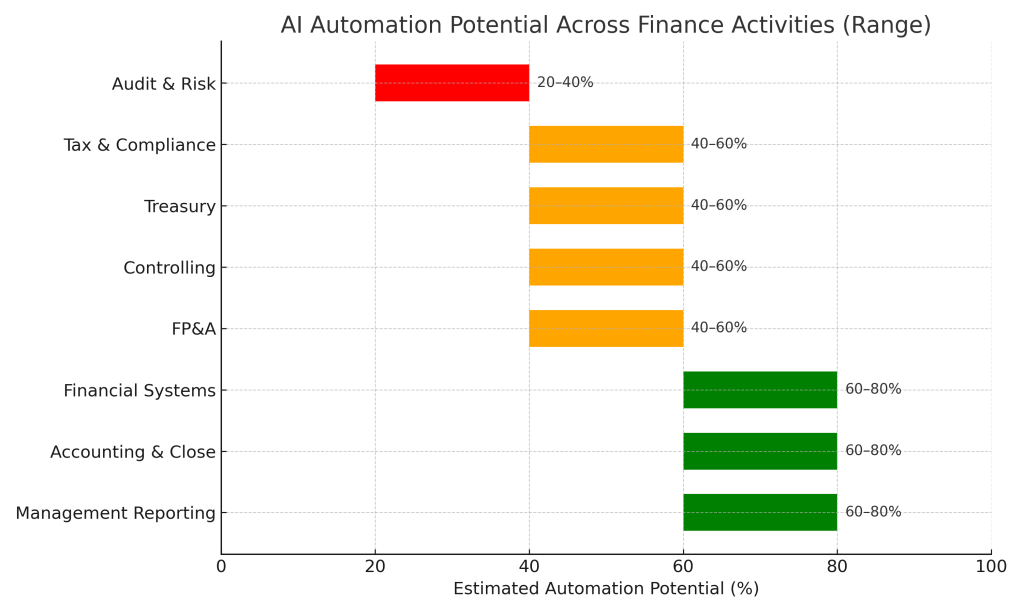
The implications are not just technological but organizational. With automation potential ranging from 30% to over 80% across various activities, it is likely that finance teams of the future will require less than 50% of the current workforce for traditional roles. The roles that remain will be more analytical, advisory, and technology-driven.

This article explores the key activities of the Finance function, how AI is transforming each area, and what the finance function could look like in 5–10 years. We also outline two distinct transformation scenarios—one focused on rapid implementation and another on sustainable foundations—to help finance leaders chart their course.

Key Activities of the Finance & Controlling Function and AI’s Impact

  1. Financial Planning & Analysis (FP&A)
    • Activities: Budgeting, forecasting, scenario modeling, variance analysis.
    • AI Impact: Predictive forecasting, automated scenario generation, and anomaly detection increase speed and accuracy.
  2. Management Reporting
    • Activities: Internal performance reports, dashboards, KPI tracking.
    • AI Impact: Natural language generation and self-service analytics personalize insights and automate commentary.
  3. Controlling
    • Activities: Cost control, investment analysis, policy compliance.
    • AI Impact: AI uncovers cost drivers, monitors ROI, and enforces compliance rules automatically.
  4. Accounting & Financial Close
    • Activities: AP/AR, reconciliations, journal entries, intercompany close.
    • AI Impact: OCR, bots, and smart matching drastically reduce manual work and cycle times.
  5. Treasury & Cash Management
    • Activities: Cash forecasting, liquidity management, FX risk, banking.
    • AI Impact: Predictive models optimize cash positions and detect fraud in real time.
  6. Tax & Compliance
    • Activities: Tax classification, filings, regulatory adherence.
    • AI Impact: Automated tax coding, real-time compliance monitoring, and AI-driven audit trails.
  7. Audit & Risk Management
    • Activities: Internal/external audit support, control testing, risk management.
    • AI Impact: Continuous audit monitoring, real-time risk scoring, and policy breach alerts.
  8. Financial Systems & Data Management
    • Activities: ERP management, data quality, automation enablement.
    • AI Impact: Data cleansing, process mining, and AI copilots transform finance operations.

AI Automation Potential Across Finance

AreaAutomation PotentialComments
FP&AModerateForecasting and analysis are automatable, but strategic planning remains human-led.
Management ReportingHighReport generation and commentary can be mostly automated.
ControllingModerateRoutine cost analysis is automatable; investment decisions are not.
Accounting & CloseHighReconciliations and entries are ideal for automation.
TreasuryModerateForecasting and fraud detection can be automated; decisions require oversight.
Tax & ComplianceModerateClassification and monitoring are automatable; legal interpretation is not.
Audit & RiskLow to ModerateMonitoring can be automated; assessments need human judgment.
Financial SystemsHighData tasks and support functions are highly automatable.

The Finance Function in 5–10 Years: AI-Augmented and Insight-Driven
Finance in the future will be lean, real-time, and forward-looking. The traditional role of finance as a scorekeeper will evolve into that of a strategic partner. Key shifts will include:

  • Near real-time closing and continuous forecasting
  • Proactive risk management through AI-driven monitoring
  • AI copilots supporting analysts with real-time insights
  • Self-optimizing processes and embedded business advisory

This transformation also entails a significant redefinition of workforce composition. Many routine roles will be phased out or reshaped, with the remaining talent focused on analytics, business partnering, and data stewardship. Finance teams may operate with less than half the current headcount, but with higher impact and strategic relevance.

Two Roadmap Scenarios for AI Transformation

1. Go Fast: Rapid AI Deployment in High-Impact Areas

  • Focus on automating high-volume, repetitive tasks for fast ROI.
  • Prioritize areas like reporting, financial close, and forecasting.
  • Launch an AI Center of Excellence to scale use cases.
  • Upskill teams in AI tools and data literacy.
  • Risks: Process fragmentation, change fatigue.

2. Build to Last: Strengthen Foundations Before Scaling AI

  • Begin with standardizing processes and modernizing ERP/data.
  • Use process mining to identify where AI fits best.
  • Pilot AI while building trust in systems and data.
  • Drive long-term scalability through structured change management.
  • Risks: Slower benefits realization, loss of momentum.

Conclusion: Finance Leaders Must Shape the AI Journey
AI offers unprecedented potential to elevate finance from an operational function to a strategic powerhouse. Whether choosing to go fast or build to last, success will require clear vision, strong governance, and continuous upskilling.

But leaders must also prepare for the workforce transformation ahead. With many transactional roles set to disappear, reskilling, talent planning, and organizational redesign must become part of the AI roadmap. Finance leaders who act now—balancing ambition with structure—will define the future of the profession and unlock new value for their organizations.

How to Assess and Advance Your Data Maturity for Transformation

Why Frameworks Matter for Digital Transformation

In today’s business environment, data is the foundation for innovation, agility, and competitive advantage. It is a key area for your transformation. However, the ability to use data effectively depends not just on having data, but on how mature an organization’s data management practices are. Therefor herewith a deep dive into a number of frameworks and tools to help you mature your data.

Data Maturity Frameworks provide a structured lens to:

  • Evaluate the organization’s current capabilities across governance, quality, integration, and usage.
  • Identify critical gaps that could slow down digital, data, and AI initiatives.
  • Prioritize investments that align data management with strategic business goals.

By anchoring digital transformation programs in recognized data maturity frameworks, leaders ensure they are building on a solid, scalable, and business-aligned data foundation — rather than risking value loss from fragmented, low-quality data landscapes.


Leading Data Maturity Frameworks

Measuring and improving data maturity begins with selecting the right guiding model.
Three leading frameworks stand out for their depth, business relevance, and proven industry adoption:

1. DAMA-DMBOK / Data Management Maturity (DMM) Model

The Data Management Maturity (DMM) Model, grounded in DAMA-DMBOK standards, offers a comprehensive evaluation across governance, quality, operations, architecture, and security. Organizations progress through five levels, from Ad Hoc to Optimized, providing a detailed improvement roadmap.

Best for: Organizations seeking deep, structured management of data as a strategic asset.

Link: DMBoK – Data Management Body of Knowledge


2. Gartner Enterprise Information Management (EIM) Maturity Model

Gartner’s model links data management directly to business value creation. It assesses governance, integration, metadata management, and security across five stages, from Aware to Transformational, focusing on enabling better decisions, agility, and growth.

Best for: Enterprises aligning data strategies tightly to digital transformation outcomes.

Link: Understand Data Governance Trends & Strategies | Gartner


3. McKinsey Data Maturity Framework

McKinsey’s approach positions data as a driver of innovation and business model evolution. It evaluates maturity across strategy, governance, culture, talent, and architecture, emphasizing how organizations can unlock tangible value and new revenue streams from data.

Best for: Companies positioning data as a growth engine rather than just a technical enabler.

Link: The data-driven enterprise of 2025 | McKinsey


Comparison: Leading Frameworks

FeatureDAMA-DMBOK / DMMGartner EIM MaturityMcKinsey Data Maturity
Primary FocusEnterprise data management excellenceInformation management for business valueData as a lever for innovation and performance
CoverageGovernance, quality, architecture, operations, securityGovernance, integration, quality, metadata, securityStrategy, culture, governance, monetization
Maturity Stages5 (Initial → Optimized)5 (Aware → Transformational)5 (Foundational → Transformational)
Best FitDetailed structure and controlStrategic business alignmentScaling for innovation and growth
Typical UsersCDOs, Data Management LeadersCIOs, CDOs, Digital OfficersCEOs, Business Transformation Leaders

From Frameworks to Action: Why Assessment Tools Matter

Selecting a maturity framework sets the strategic direction — but real progress begins with a clear-eyed, objective assessment of where you stand today.

Data Maturity Assessment Tools help organizations:

  • Map their current capabilities against best practice models.
  • Benchmark against industry standards.
  • Identify quick wins and critical gaps to address.

Choosing the right tool ensures that your transformation journey is grounded in reality — not assumptions.


Practical Tools to Assess Your Data Maturity

Here are five proven tools that align with leading frameworks and provide practical, actionable insights:

1. EDM Council’s DCAM Assessment

A standards-based evaluation covering governance, quality, operations, architecture, and ethics, offering detailed benchmarking and industry alignment.

Best for: Enterprises seeking comprehensive, validated assessments aligned to DAMA-DMBOK/DMM.


2. Gartner Data and Analytics Maturity Assessment Toolkit

A fast, executive-level self-assessment providing immediate insights across governance, integration, and information usage dimensions.

Best for: Organizations seeking quick, strategic diagnostics.


3. McKinsey Data Diagnostic Survey

A strategic assessment linking data maturity directly to business value creation, uncovering growth, efficiency, and innovation opportunities.

Best for: Companies aiming to scale data-driven growth and innovation.


4. Informatica Data Maturity Assessment Tool

A practical, operations-focused online survey that delivers quick recommendations for improving data management capabilities.

Best for: Quick internal benchmarking and operational improvements.


5. Microsoft Data Maturity Assessment

An evaluation emphasizing cloud readiness, governance, and AI-enablement, ideal for organizations modernizing through Azure and advanced analytics.

Best for: Cloud modernization and AI scaling initiatives.


Comparison: Assessment Tools

ToolFramework AlignmentStrengthAccess TypeBest Fit
EDM Council DCAM™DAMA-DMBOK / DMMComprehensive, standards-basedMembership or consultancy-ledFormal enterprise assessments
Gartner D&A Maturity ToolkitGartner EIMExecutive-level, quick insightsSubscription / occasional free accessStrategic initial diagnostics
McKinsey Data DiagnosticMcKinsey MaturityStrategic, business value focusConsulting-led / some self-guidesLinking data to growth and innovation
Informatica Assessment ToolGeneral (Data Management)Quick, operationally actionableFree onlineInternal benchmarking
Microsoft Data Maturity AssessmentMicrosoft Data StrategyCloud and AI readiness focusFree via Azure partnershipsCloud data modernization

How to Apply Frameworks and Tools Effectively

  • Anchor your transformation in a recognized data maturity framework that matches your strategic goals.
  • Conduct an honest assessment using a structured tool to identify your true starting point — don’t rely on assumptions.
  • Prioritize actions that link data maturity gaps directly to business value opportunities, not just technical fixes.
  • Treat maturity as a journey, not a one-off exercise: integrate regular reassessments into your transformation governance.
  • Balance detail and speed: Use lighter diagnostics for initial framing and deeper assessments for large investment decisions.

By applying a framework thoughtfully and leveraging the right tools at the right stages, organizations can dramatically accelerate their journey from managing data to monetizing it, unlocking sustainable digital advantage.

Key Insights from Digital Forum Amsterdam: AI’s Global Impact

Last week, I had the opportunity to present at the Digital Forum in Amsterdam, where over 100 executives and transformation leaders gathered to explore the future of leadership in the digital era. My keynote, titled “AI Without Borders – Harnessing Artificial Intelligence for Global Impact”, was met with great engagement and sparked many thoughtful discussions afterward.

In this article, I’d like to share the highlights and insights from the session—with the slides embedded between paragraphs for context.


AI is Reshaping Work—Across All Roles and Industries

My opening message was simple: no matter where you work or what your role is, AI will impact your processes, job content, and organization over the next 5 to 10 years. The only uncertainty is the scale and speed of this change.

To reinforce this, I brought in research findings from the WEF, MIT, PwC, McKinsey, Gartner, IBM, and Goldman Sachs. These sources highlight both the immense economic potential of AI (up to $15.7 trillion by 2030) and its disruptive impact on the workforce—millions of jobs created, transformed, or displaced, and a pressing need for upskilling on a global scale.


Staying Ahead: Why AI Fluency Matters

One statement particularly resonated with the audience: “It’s not that your job will be replaced by AI—but it might be replaced by someone who uses AI better than you.”

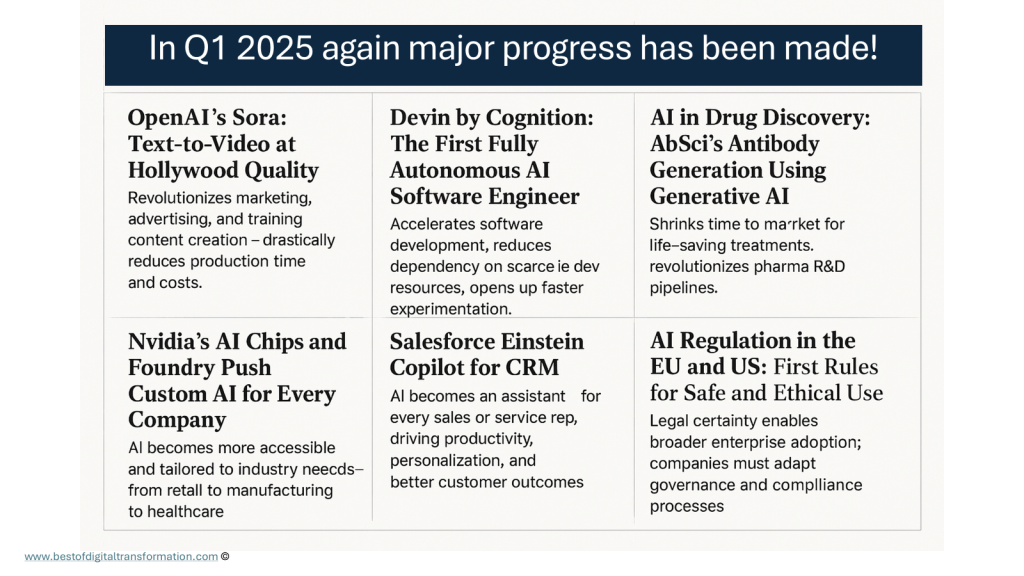
This is a wake-up call for continuous learning. The pace of development is breathtaking. I shared a snapshot of Q1 2025 breakthroughs and hinted at Google’s recent launch of AgentSpace, which I’ll cover in a future edition.


The Real Impact: AI in Marketing, Supply Chain, and Innovation

We then looked deeper into three core business areas—Marketing & Sales, Supply Chain, and Innovation—to see how AI is already creating tangible value.

In Marketing & Sales, AI is now embedded across the funnel—from awareness to retention. At Brenntag, for example, we successfully used AI to predict customer churn and recommend next-best actions, helping our commercial teams serve customers more effectively.

I also highlighted how large brands are already using AI to generate marketing content at scale. But the exciting shift is that these same capabilities are now accessible to smaller companies too—lowering the barriers to entry and leveling the playing field.


In Supply Chain, we see a dual reality: some companies still struggle with visibility and fragmented data, while others are unlocking efficiency gains with advanced AI tools. My message here: building end-to-end supply chain visibility is foundational. Only then can AI deliver its full potential.

As an example, I shared how, more than a decade ago at Philips, we began using IoT and early predictive maintenance for MRI machines. Today, this has evolved into a sophisticated system combining sensors, analytics, and AI—ensuring optimal equipment uptime and smooth patient flow in diagnostic imaging.


AI Accelerates the Innovation Cycle

AI is also supercharging innovation, reducing the time and cost of development across all phases—from identifying unmet needs to prototyping and testing.

I used the breakthrough example of AlphaFold by DeepMind, which dramatically accelerates drug discovery and the design of new materials. And at Brenntag, we’ve experimented with AI to accelerate lab innovation in the chemical sector—demonstrating that even smaller-scale applications can yield significant gains.


Data: The Essential Fuel for AI

Of course, none of this works without data. But many organizations face persistent challenges: fragmented systems, inconsistent standards, unclear data ownership, and poor governance.

I emphasized that improving data quality, accessibility, and trust is a prerequisite for AI success. Only when teams believe in the data and the systems built on top of it will adoption and results follow.


People and Culture Make the Difference

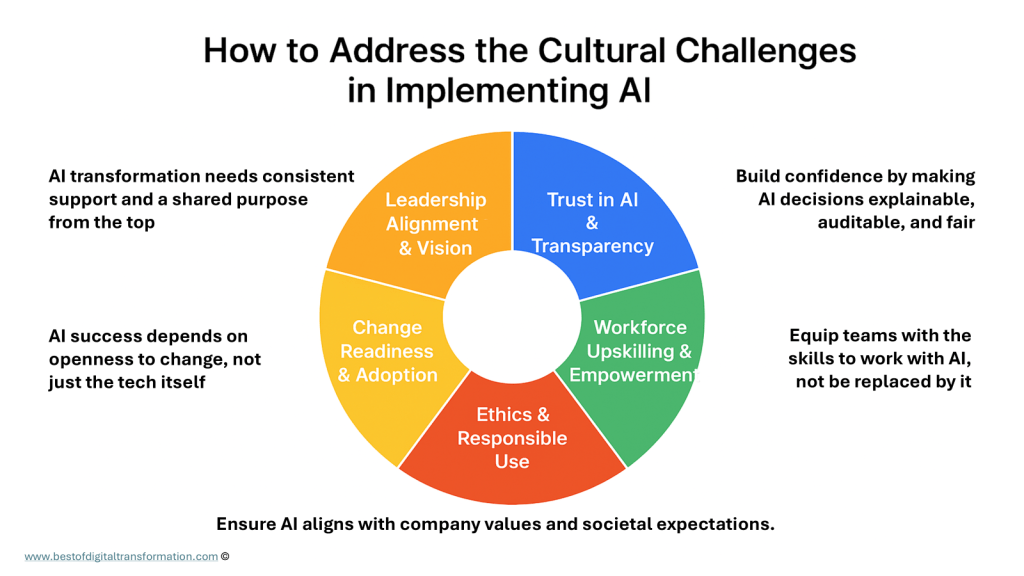
Finally, I addressed the cultural and organizational shifts required for AI to succeed. This includes:

  • Building trust and transparency into AI solutions
  • Empowering people to work ethically and responsibly with AI
  • Driving change management and adoption
  • And most importantly: ensuring consistent leadership support, with a clear vision and shared purpose

My Closing Message

I wrapped up with four key takeaways for leaders steering AI transformations:

  • AI will change processes, jobs, and businesses – only the speed is unknown
  • Data is the fuel for AI – make it fit for purpose and ready to use
  • The future is Human + AI – a cultural transformation is essential
  • Embed AI in your Operating Model – start small, scale fast, and learn continuously

AI powers Accelerated Innovation

Innovation has always been a critical driver of competitive advantage, but the demands on innovation today are more intense than ever. Companies need to not only generate breakthrough ideas but also bring them to market rapidly and tailor them to increasingly diverse customer needs.

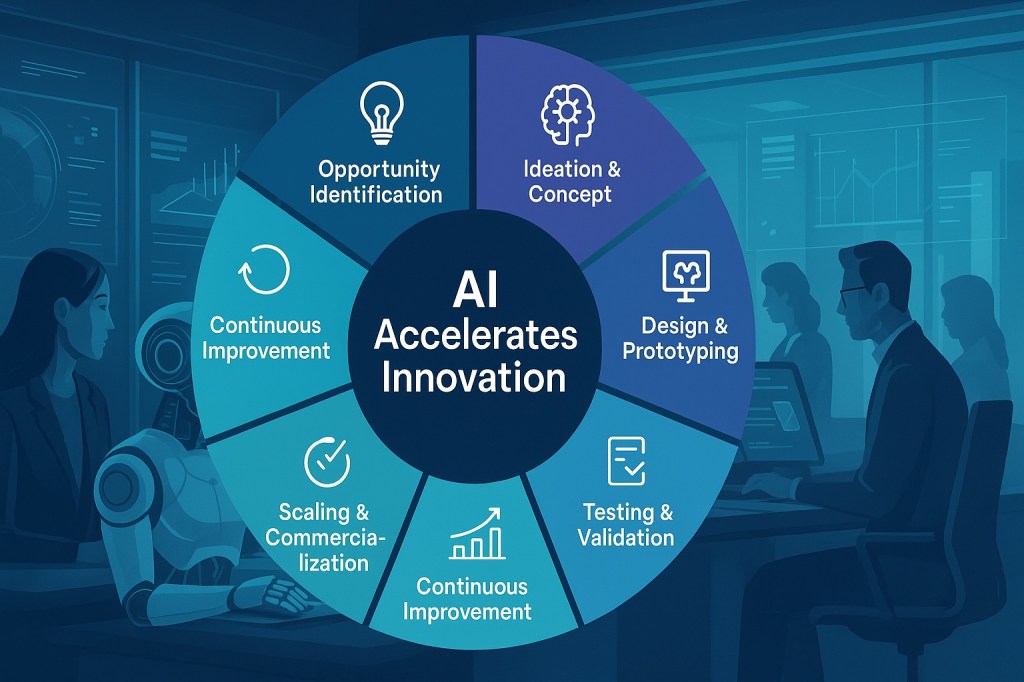
Artificial Intelligence (AI) is emerging as a transformative force in this landscape. It accelerates every stage of the innovation process—from identifying opportunities and generating concepts to prototyping, testing, and scaling. Just as importantly, AI enables a new level of real-time customisation, empowering businesses to design and refine products and services that are more precisely aligned with individual customer preferences.

In this newsletter, I explore how AI is transforming each phase of the product and service innovation lifecycle, supported by research evidence and real-world applications.


1. Research & Opportunity Identification AI enhances the discovery of new product and service opportunities by analyzing vast volumes of structured and unstructured data—from customer sentiment and social chatter to competitive intelligence and emerging macro trends. Machine learning and natural language processing enable companies to identify unmet needs and whitespace opportunities with speed and precision that traditional market research can’t match.

Research Evidence

  • McKinsey (2023): AI accelerates opportunity identification by 37%.
  • MIT (2023): Trend analysis with AI improves opportunity detection by 42%.

Examples

  • Procter & Gamble uses NLP to mine social media and reviews for unmet customer needs.
  • Netflix identifies content gaps via recommendation engine data, informing production.

2. Ideation & Concept Development AI acts as a co-pilot for creativity, expanding the range of ideas and increasing the novelty of concepts generated. Generative AI and collaborative platforms help teams break cognitive biases, synthesize divergent thinking, and visualize concepts early in the process.

Research Evidence

  • Stanford Innovation Lab (2022): AI-enhanced brainstorming boosts novel ideas by 56%.
  • IBM: Cross-functional ideation quality rises by 31% with AI tools.

Examples

  • Airbus generated over 60,000 aircraft partition designs, discovering a solution 45% lighter than legacy models.
  • Designers leverage DALL·E to visualize product concepts rapidly.

3. Design & Prototyping AI accelerates prototyping by running simulations, optimizing form factors, and suggesting alternatives based on performance or customer preferences. It reduces development time while improving the diversity and feasibility of design iterations.

Research Evidence

  • MIT Media Lab: Iteration time reduced by 47%; 215% more design variations explored.
  • Harvard Business Review: AI simulation reduces physical prototype needs by 39%.

Examples

  • Volkswagen runs thousands of virtual car tests before building physical versions.
  • IKEA uses generative AI for furniture design and visualization.

4. Testing & Validation AI transforms validation by simulating real-world use, forecasting product success, and optimizing features through automated A/B testing. It helps teams reduce risk while aligning products more closely with customer expectations.

Research Evidence

  • Forrester (2024): AI improves A/B testing effectiveness by 28%.
  • Cambridge University: Product-market fit predictions enhanced by 41% with AI.

Examples

  • Amazon simulates user responses to product iterations.
  • Unilever uses digital twins to test product performance across different markets.

5. Scaling & Commercialization AI optimizes go-to-market strategies by refining product rollouts, forecasting demand, and personalizing marketing campaigns. It enables faster scaling while controlling costs and maximizing uptake.

Research Evidence

  • Accenture: Scale-up time reduced by 31%, costs by 26% through AI.
  • MIT Sloan: AI-guided marketing improves product adoption by 23%.

Examples

  • Starbucks uses AI to fine-tune new product rollouts globally.
  • Toyota leverages AI in supply chain modelling, improving scale efficiency by 18%.

6. Continuous Improvement AI closes the loop in innovation by turning customer usage and feedback into actionable insights. From predictive maintenance to feature enhancement prioritization, AI ensures products remain relevant and valuable over time.

Research Evidence

  • Deloitte: AI feedback analysis speeds product improvement cycles by 43%.
  • Harvard Business School: Predictive maintenance extends product lifecycles by 27%.

Examples

  • Tesla continuously improves vehicles via AI-analyzed driving data with over-the-air updates.
  • Microsoft uses AI to prioritize software feature improvements based on user behaviour.

Conclusion AI is more than a technological enabler—it is a strategic accelerator of innovation. By embedding AI across the full product and service lifecycle, companies gain the ability to move faster, personalize smarter, and innovate with greater confidence.

As generative and predictive technologies mature, organizations that embrace AI-driven innovation will shape the future.

What I Learned from Google & Kaggle’s Generative AI Intensive Course

Last week, I joined over 100,000 participants in a 5-day Generative AI Intensive Course hosted by Google and Kaggle—a free and fast-paced program designed to equip professionals with practical knowledge on how to harness the power of GenAI in real-world settings.

Why did I join? Because GenAI is no longer a concept—it’s here, and it’s evolving faster than most organizations can absorb. As leaders in digital transformation, we can’t afford to wait. We need to understand not just the what, but also the how of these technologies.

This course offered an excellent foundation of the current status of GenAI technologies, how they can be applied today, and even provided glimpses into where they are likely to evolve next.

Below is a summary of the course—structured for executives and transformation leaders seeking clarity on how GenAI will impact their businesses.


Day 1: Foundational Large Language Models & Text Generation

Why it matters: Understanding the fundamentals is critical before scaling GenAI use cases. Day one unpacked the Transformer architecture, the core engine behind tools like ChatGPT and Gemini.

Key Takeaways:

  • LLMs are the brains behind GenAI—they interpret and generate human-like language at scale.
  • Transformer models help these systems understand context and nuance.
  • Fine-tuning allows you to adapt general models to business-specific tasks, such as customer service or marketing.

Google whitepaper: “Foundational Large Language Models & Text Generation”


Day 2: Embeddings and Vector Stores

Why it matters: Without intelligent data structuring, GenAI becomes just another flashy tool. This session focused on how to make AI actually useful inside your organization.

Key Takeaways:

  • Embeddings turn complex data into searchable formats.
  • Vector stores make this information retrievable at speed and scale.
  • Retrieval-Augmented Generation (RAG) combines LLMs with your proprietary data for smarter, context-rich answers.

Google whitepaper: “Embeddings & Vector Stores”


Day 3: Generative AI Agents

Why it matters: GenAI is moving beyond chatbots—into agents that can autonomously perform tasks, interact with systems, and even make decisions.

Key Takeaways:

  • AI agents integrate tools, logic, and memory to act independently.
  • Platforms like LangChain and Vertex AI Agents provide orchestration layers for real-world applications.
  • Think of these as junior digital employees—capable of assisting operations, support, or analysis at scale.

Google whitepapers: “Agents” and “Agents Companion”


Day 4: Solving Domain-Specific Problems Using LLMs

Why it matters: Generic models only take you so far. Tailoring AI to your industry delivers far more strategic value.

Key Takeaways:

  • Domain-specific LLMs adapt to unique challenges in sectors like healthcare and cybersecurity.
  • SecLM enhances threat detection and response capabilities in cybersecurity.
  • MedLM supports clinical workflows and patient information retrieval in healthcare.

Google whitepaper: “Solving Domain-Specific Problems Using LLMs”


Day 5: Operationalizing GenAI on Vertex AI with MLOps

Why it matters: Scaling GenAI requires more than a good prompt—it demands structured deployment, governance, and monitoring.

Key Takeaways:

  • MLOps for GenAI adapts best practices from machine learning to this new frontier of GenAI applications.
  • Understanding the GenAI lifecycle—from experimentation to production—is key to long-term success.
  • Platforms like Vertex AI help organizations deploy and manage GenAI responsibly and at scale.

Google whitepaper: “Operationalizing Generative AI on Vertex AI using MLOps”


My Reflections

This course reinforced a simple truth: GenAI is becoming more capable rapidly. And like any capability, it needs strategy, structure, and experimentation to create real business value.

If you’re in a leadership role, here are three questions to reflect on:

  1. Where can GenAI complement or augment your current operations?
  2. Do you have the data foundation to make it effective?
  3. Are you equipping your teams to experiment safely and learn quickly?

What’s Next

I’ll be diving deeper into some of these topics in future articles —especially GenAI agents and domain-specific applications.

Let’s continue learning and leading—together


Genesis – Artificial Intelligence, Hope, and the Human Spirit

In Genesis, three titans from the worlds of diplomacy, technology, and innovation—Henry A. Kissinger, Eric Schmidt, and Craig Mundie—collaborate to offer a sweeping, contemplative exploration of artificial intelligence and its far-reaching implications.

What stands out immediately is how clearly the book captures this moment as a historic inflection point: a time when AI is poised to profoundly reshape society, governance, and what it means to be human. It balances an articulate exploration of opportunities—from accelerating innovation to solving global challenges—with a candid warning about the threats and disruptions AI could bring. Most powerfully, it forces us to reflect on the implications for humanity itself: our role, our agency, and our responsibility in shaping the trajectory of intelligent machines.

An Inflection Point in Human History

The central thesis of Genesis is that we stand at a defining juncture. Like the printing press or nuclear technology, AI introduces a new form of intelligence—one that challenges our existing institutions, ethical frameworks, and even our concept of reason.

AI’s ability to generate insights, patterns, and autonomous decisions has already begun to outpace human comprehension. The authors argue that this creates a new epistemology—an AI-driven way of “knowing” that may diverge significantly from human logic. And unlike past technologies, AI does not merely extend our abilities—it begins to redefine them.

Hope and Possibility

The authors make it clear that AI is not inherently a threat. In fact, they devote significant attention to its constructive potential. AI can enhance decision-making, speed up scientific discovery, optimize infrastructure, and help address systemic global issues like climate change and healthcare access.

At its best, AI can serve as a partner to human intelligence, extending the boundaries of creativity and solving problems that previously seemed intractable. The authors envision AI systems that support rather than replace human reasoning—providing tools to elevate, not diminish, the human spirit.

The Ethical and Existential Challenge

Yet, the transformative potential of AI brings existential questions into sharp focus:

  • What happens when AI makes decisions its creators cannot fully explain?
  • How do we preserve human values in systems that learn from data, not ethics?
  • Can AI uphold human dignity—or will it simply optimize for utility?

Kissinger, Schmidt, and Mundie stress the moral responsibility that comes with creating such powerful tools. The systems we build will increasingly influence not only productivity and security, but human identity and freedom. If not guided by clear ethics, AI could prioritize efficiency over empathy, precision over justice, and control over autonomy.

AI and the Transformation of Knowledge

One of the most insightful contributions of the book is its examination of how AI changes the nature of knowledge. Traditionally, knowledge has been built on human reasoning—observation, logic, debate, and reflection. AI, however, learns through statistical association, surfacing patterns and solutions that may be correct but unexplainable.

This shift has enormous implications. If humans increasingly accept AI-generated outputs without understanding them, we risk ceding authority to systems we cannot interrogate or hold accountable. Kissinger in particular warns of the long-term consequences for democratic governance, education, and scientific integrity.

Geopolitical Power and Global Governance

The geopolitical implications of AI are far-reaching. Schmidt and Mundie describe how AI development is currently concentrated in a small group of corporations and nations, creating a technological asymmetry that could rival or surpass those of the industrial and nuclear eras.

Without global cooperation and shared governance principles, AI could be weaponized—not just in military contexts, but through surveillance, manipulation, and digital authoritarianism. The authors urge policymakers to approach AI with the same strategic foresight that defined arms control during the Cold War.

Coexistence: Humans and AI as Partners

At the heart of Genesis is the idea of coexistence. The authors do not suggest halting AI development—but rather, ensuring that humans remain central to its evolution. We must design systems that align with human values and develop the emotional, ethical, and strategic capacities to work alongside them.

This also requires a transformation in education and leadership. Future leaders will need to pair technical literacy with philosophical depth—understanding not just how AI works, but how it fits within a broader human context.

A Call to Action for Leaders

For senior executives and transformation leaders, Genesis offers both insight and urgency. The authors call on decision-makers to:

  • Understand the transformational nature of AI and its long-term strategic implications.
  • Champion cross-disciplinary approaches, combining technology, ethics, and governance.
  • Cultivate AI literacy within their organizations to promote informed adoption and responsible innovation.
  • Advocate for global cooperation, recognizing that competitive advantage must be balanced with collective safety.

Conclusion

Genesis is not a technical manual—it’s a meditation on the choices that will shape our future. It challenges us to move beyond surface-level conversations about automation or productivity and to engage deeply with what AI means for human dignity, identity, and progress.

The authors leave us with a message that resonates long after the final page: the future of AI is not predetermined. It will be defined by the values, courage, and vision of those who lead today.

As we stand on the threshold of an AI-driven era, Genesis urges us not only to ask what AI can do—but to reflect on what we, as humans, ought to do.

Scenario Planning in Digital Transformation – Navigating Uncertainty with Strategic Foresight

In the many years I have been involved in strategic planning and roadmap formulation, scenario planning has been one of the most important tools. Especially in a digital landscape where the pace of change is exponential and unpredictable, scenario planning is extremely relevant. Transformation leaders must grapple with a range of unknowns: Which technologies will emerge as dominant? Will customers adopt faster or slower than anticipated? Will regulators accelerate or delay disruption?

Scenario planning offers a strategic approach to prepare for multiple plausible futures—enabling organizations to act with agility rather than react in crisis.


Why Scenario Planning is Crucial in Digital Transformation

Unlike traditional forecasting, scenario planning is not about predicting a single future—it’s about preparing for many. This becomes especially critical in digital transformation where:

  • Technology shifts are nonlinear and often abrupt (e.g. AI take off)
  • New competitors can emerge from adjacent industries
  • Adoption rates vary widely across geographies and customer segments
  • Cultural readiness and organizational agility are as important as tech choices

Scenario planning empowers transformation leaders to test strategies against uncertainty, align cross-functional teams, and invest with confidence, even amid ambiguity.


What Leading Research Tells Us

A cross-section of top-tier research provides a strong foundation for scenario planning in digital transformation:

🔹 IMD (Wade & Macaulay, 2018)

  • Advocates for shorter scenario horizons (2–3 years) to match digital transformation’s faster cycles.
  • Emphasizes the role of Digital Business Agility: hyperawareness, informed decision-making, and fast execution.
  • Recommends cross-functional scenario teams to ensure alignment across business, tech, and operations.

🔹 McKinsey: Next-Generation Operating Model

  • Positions scenario planning as a tool to test digital operating models built around customer journeys and integrated tech stacks.
  • Reinforces cross-silo collaboration and the sequencing of initiatives based on scenario readiness.

🔹 Deloitte: Digital Transformation 2.0

  • Introduces the Axes of Uncertainty approach to model digital-specific futures.
  • Brings in cultural transformation as a key variable in scenario evaluation.
  • Uses scenario planning to bridge divergent assumptions across business units.

🔹 Gartner: Scenario Planning for IT Leaders

  • Offers actionable frameworks for CIOs to translate digital strategy into adaptive execution.
  • Advocates modular, digital-first planning responsive to rapid tech shifts.

🔹 World Economic Forum: Digital Transformation Initiative (DTI)

  • Emphasizes ecosystem collaboration as essential to capturing digital value.
  • Provides value creation and capture frameworks to assess digital investments.
  • Highlights industry-specific scenarios and introduces the interactive “Scenario Game” tool for engaging, agile planning.

How Digital Scenario Planning Differs from Traditional Approaches

Traditional Scenario PlanningDigital Scenario Planning
5–10+ year horizons2–3 year horizons
Broad economic/political driversTech adoption, digital disruption
Siloed strategic teamsCross-functional collaboration
Linear review cyclesAgile, iterative refresh cycles
Culture often overlookedCulture is a central scenario lens

A Step-by-Step Guide to Scenario Planning in Digital Transformation

This guide synthesizes the most actionable elements from the research above:

Step 1: Define the Focus and Time Horizon

  • Choose a pivotal transformation question (e.g., platform strategy, AI deployment, customer engagement).
  • Set a 2–3 year horizon (per IMD) to match the pace of digital evolution.

Step 2: Identify Key Drivers and Critical Uncertainties

  • Form a cross-functional team (strategy, IT, ops, HR, marketing).
  • Identify external drivers and critical uncertainties (e.g., AI regulation, platform dominance, customer trust).
  • Prioritize variables by impact and uncertainty.

Step 3: Build the Scenario Matrix

  • Apply the Axes of Uncertainty method (Deloitte): Select two high-impact uncertainties to define four distinct scenarios.
  • Craft compelling names and short narratives (e.g., “Trust Deficit”, “AI Gold Rush”).
  • Incorporate culture, tech adoption, and ecosystem dynamics.

Step 4: Stress-Test Strategy and Culture

  • Evaluate each initiative across all scenarios:
    • What’s robust across all futures?
    • What’s conditional?
    • Where does culture enable or block execution?
  • Use WEF’s value creation and capture framework to refine prioritization.

Step 5: Define Early Warning Indicators

  • Develop a set of signals (regulatory shifts, competitor actions, adoption trends).
  • Assign accountability for scenario monitoring and review.

Step 6: Integrate into Governance and Portfolio Planning

  • Use scenarios to:
    • Guide steering committee strategy reviews
    • Align investment portfolios to scenario robustness
    • Shape adaptive transformation roadmaps

From Planning to Strategic Resilience

Scenario planning doesn’t eliminate uncertainty—it turns it into a strategic asset. In digital transformation, it enables bolder decisions, faster adaptation, and stronger cross-functional alignment.

By combining the frameworks from IMD, McKinsey, Deloitte, Gartner, and the World Economic Forum, organizations can embed scenario planning into their transformation governance and create a culture of preparedness and agility.

Ready to explore your digital future? Try the WEF Scenario Game to get started. Or you can also start exploring with your favourite LLM’s what relevant scenarios could be for your organisation.