Why 95% of AI Pilots Fail (MIT Study) – And How to Beat the Odds

Last week, a MIT study sent shockwaves through the AI and business community: 95% of AI pilots fail to deliver measurable business returns. Headlines spread fast, with investors and executives questioning whether enterprise AI is a bubble.

But behind the headlines lies a more nuanced story. The study doesn’t show that AI lacks potential—it shows that most organizations are not yet equipped to turn AI experiments into real business impact.


Myth vs. Reality: What Other Research Tells Us

While the MIT report highlights execution gaps, other studies paint a more balanced picture:

  • McKinsey (2025): AI adoption is rising fast, with value emerging where firms rewire processes and governance.
  • Stanford AI Index (2025): Investment and adoption continue to accelerate, signaling confidence in the long-term upside.
  • Field studies: Copilots in customer service and software engineering deliver double-digit productivity gains—but only when properly integrated.
  • MIT SMR–BCG: Companies that give individuals tangible benefits from AI—and track the right KPIs—are 6x more likely to see financial impact.

The picture is clear: AI works, but only under the right conditions.


Why AI Projects Fail (The 10 Traps)

1. No learning loop
Many AI pilots are clever demos that never improve once deployed. Without feedback mechanisms and continuous learning, the system remains static—and users quickly revert to old ways of working.

2. Integration gaps
AI may deliver great results in a sandbox, but in production it often fails to connect with core systems like CRM or ERP. Issues with identity management, permissions, and latency kill adoption.

3. Vanity pilots
Executives often prioritize flashy use cases—like marketing campaigns or customer-facing chatbots—while ignoring back-office automations. The result: excitement without measurable cash impact.

4. Build-first reflex
Organizations rush to build their own AI tools, underestimating the complexity of User eXperience (UX), guardrails, data pipelines, and monitoring. Specialist partners often outperform in speed and quality.

5. Six-month ROI traps
Leadership expects visible returns within half a year. But AI adoption follows a J-curve: disruption comes first, with benefits only materializing once processes and people adapt.

6. Weak KPIs
Too many pilots measure activity—such as number of prompts or usage time—rather than outcomes like error reduction, cycle time improvements, or cost savings. Without the right metrics, it’s impossible to prove value.

7. No product owner
AI projects often sit “between” IT, data, and the business, leaving no single accountable leader. Without an empowered product owner with a P&L target, projects stall in pilot mode.

8. Change ignored
Technology is deployed, but users aren’t engaged. Poor UX, lack of training, and trust concerns mean adoption lags. In response, employees turn to consumer AI tools instead of sanctioned ones.

9. Data & policy drag
Even when the AI works, poor data quality, fragmented sources, and unclear governance delay rollouts. Legal and compliance teams often block scaling because policies are not defined early enough.

10. Wrong first bets
Too many companies start with complex tasks. Early success is more likely in “thin-slice” repetitive processes—like call summarization or contract intake—that can prove value quickly.


How to Beat the Odds (10 Fixes That Work)

1. Design for learning
Build AI systems with memory, feedback capture, and regular improvement cycles. If a tool cannot learn and adapt in production, it should never progress beyond pilot stage.

2. Fix integration before inference
Prioritize robust connections into your CRM, ERP, and ticketing systems. AI without seamless workflow integration is just an isolated chatbot with no business impact.

3. Pick quick-win use cases
Target repetitive, document- and conversation-heavy flows—like claims processing, contract extraction, or helpdesk queries. These areas deliver ROI within 90–120 days and build momentum.

4. Appoint an AI Product Owner
Every use case should have a leader with budget, KPIs, and authority. This person is responsible for hitting targets and driving the project through pilot, limited production, and full scale-up.

5. Measure outcomes, not activity
Define 3–5 hard business KPIs (e.g., −25% contract cycle time, −20% cost per contact) and track adoption leading indicators. Publish a regular value scorecard to make progress visible.

6. Buy speed, build advantage
Use specialist vendors for modular, non-differentiating tasks. Save your in-house resources for proprietary applications where AI can become a true competitive edge.

7. Rebalance your portfolio
Shift investments away from glossy front-office showcases. Focus on back-office operations and service processes where AI can cut costs and generate visible ROI quickly.

8. Make change a deliverable
Adoption doesn’t happen automatically. Co-design solutions with frontline users, train them actively, and make fallback paths obvious. Manage trust as carefully as the technology itself.

9. Educate the board on the J-curve
Set realistic expectations that ROI takes more than six months. Pilot fast, but give production deployments time to stabilize, improve, and demonstrate sustained results.

10. Prove, then scale
Choose two or three use cases, set clear ROI targets up front, and scale only after success is proven. This disciplined sequencing builds credibility and prevents overreach.


The Broader Reflection

The 95% failure rate is not a verdict on AI’s future—it’s a warning about execution risk. Today’s picture is simple: adoption and investment are accelerating, productivity impacts are real, but enterprise-scale returns require a more professional approach.

We’ve seen this pattern before. Just as with earlier waves of digital transformation, leaders tend to overestimate short-term results and underestimate mid- to long-term impact.

How AI Changes the Digital Transformation Playbook

I recently revisited David L. Rogers’ 2016 book, The Digital Transformation Playbook. This work was foundational in how I approached digital strategy in the years that followed. It helped executives move beyond viewing digital as a technology problem and instead rethink strategy for a digital enabled business. As I now reflect on the accelerating impact of artificial intelligence—especially generative and adaptive AI—I found myself asking: how would this playbook evolve if it were written today? What shifts, additions, or reinterpretations does AI demand of us?

Rogers identified five strategic domains where digital forces reshaped the rules of business: customers, competition, data, innovation, and value. These domains remain as relevant as ever—but in the age of AI, each requires a fresh lens.

In this article, I revisit each domain, beginning with Rogers’ foundational insight and then exploring how AI transforms the picture. I also propose three new strategic domains that have become essential in the AI era: workforce, governance, and culture.


1. Customers → From Networks of Relationships to Intelligent Experiences

Rogers’ Insight (2016):
In the traditional business model, customers were treated as passive recipients of value. Rogers urged companies to reconceive customers as active participants in networks—communicating, sharing, and shaping brand perceptions in real-time. The shift was toward engaging these dynamic networks, understanding behavior through data, and co-creating value through dialogue, platforms, and personalization.

AI Shift (Now):
AI enables companies to move beyond personalized communication to truly intelligent experiences. By analyzing vast datasets in real-time, AI systems can predict needs, automate responses, and tailor interactions across channels. From recommendation engines to digital agents, AI transforms customer experience into something anticipatory and adaptive—redefining engagement, loyalty, and satisfaction.


2. Competition → From Industry Ecosystems to Model-Driven Advantage

Rogers’ Insight (2016):
Rogers challenged the notion of fixed industry boundaries, arguing that digital platforms enable competition across sectors. Businesses could no longer assume their competitors would come from within their own industry. Instead, value was increasingly co-created in fluid ecosystems involving customers, partners, and even competitors.

AI Shift (Now):
Today, the competitive battlefield is increasingly defined by AI capabilities. Winning organizations are those that can develop, fine-tune, and scale AI models faster than others. Competitive advantage comes from proprietary data, high-performing models, and AI-native organizational structures. In some cases, the model itself becomes the product—shifting power to those who own or control AI infrastructure.


3. Data → From Strategic Asset to Lifeblood of Intelligent Systems

Rogers’ Insight (2016):
Data, once a by-product of operations, was reimagined as a core strategic asset. Rogers emphasized using data to understand customers, inform decisions, and drive innovation. The shift was toward capturing more data and applying analytics to create actionable insights and competitive advantage.

AI Shift (Now):
AI transforms the role of data from decision-support to system training. Data doesn’t just inform—it powers intelligent behavior. The focus is now on quality, governance, and real-time flows of data that continuously refine AI systems. New challenges around data bias, provenance, and synthetic generation raise the stakes for ethical and secure data management.


4. Innovation → From Agile Prototyping to AI-Augmented Co-Creation

Rogers’ Insight (2016):
Rogers advocated for agile, iterative approaches to innovation. Instead of long development cycles, companies needed to embrace experimentation, MVPs, and customer feedback loops. Innovation was not just about new products—it was about learning fast and adapting to change.

AI Shift (Now):
AI amplifies every step of the innovation process. Generative tools accelerate ideation, design, and prototyping. Developers and designers can co-create with AI, testing multiple solutions instantly. The loop from idea to execution becomes compressed, with AI as a creative collaborator, not just a tool.


5. Value → From Digital Delivery to Adaptive Intelligence

Rogers’ Insight (2016):
Value creation, in Rogers’ view, moved from static supply chains to fluid, digital experiences. Companies needed to rethink how they delivered outcomes—shifting from products to services, from ownership to access, and from linear value chains to responsive platforms.

AI Shift (Now):
With AI, value is increasingly delivered through systems that learn and adapt. Intelligent services personalize in real time, optimize continuously, and evolve with user behavior. The value proposition becomes dynamic—embedded in a loop of sensing, reasoning, and responding.


Why We Must Expand the Playbook: The Rise of New Strategic Domains

The original five domains remain vital. Yet AI doesn’t just shift existing strategies—it introduces entirely new imperatives. As intelligent systems become embedded in workflows and decisions, organizations must rethink how they manage talent, ensure ethical oversight, and shape organizational culture. These aren’t adjacent topics—they are central to sustainable AI transformation.


6. Workforce → From Talent Strategy to Human–AI Teaming

AI is not replacing the workforce—it is changing it. Leaders must redesign roles, workflows, and capabilities to optimize human–AI collaboration. This means upskilling for adaptability, integrating AI into daily work, and ensuring people retain agency in AI-supported decisions. Human capital strategy must now include how teams and algorithms learn and perform together.


7. Governance → From Digital Risk to Responsible AI

AI introduces new dimensions of risk: bias, security, and regulatory complexity. Governance must now ensure not only compliance but also ethical development, explainability, and trust. Boards, executive teams, and product leaders need frameworks to evaluate and oversee AI initiatives—not just for effectiveness but for responsibility.


8. Culture → From Digital Fluency to AI Curiosity and Trust

The mindset shift required to scale AI is cultural as much as technological. Organizations must foster curiosity about what AI can do, confidence in its potential, and clarity about its limits. Trust becomes a cultural asset—built through transparency, education, and inclusive experimentation. Without it, AI adoption stalls.


Conclusion: A Playbook for the AI Era

Rogers’ original playbook gave us a framework to reimagine business strategy in a digital world. That foundation still holds. But as AI redefines how we compete, create, and lead, we need a new version—one that not only shifts the lens on customers, competition, data, innovation, and value, but also adds the critical dimensions of workforce, governance, and culture. These eight domains form the new playbook for transformation in the age of intelligence.

AI powers Accelerated Innovation

Innovation has always been a critical driver of competitive advantage, but the demands on innovation today are more intense than ever. Companies need to not only generate breakthrough ideas but also bring them to market rapidly and tailor them to increasingly diverse customer needs.

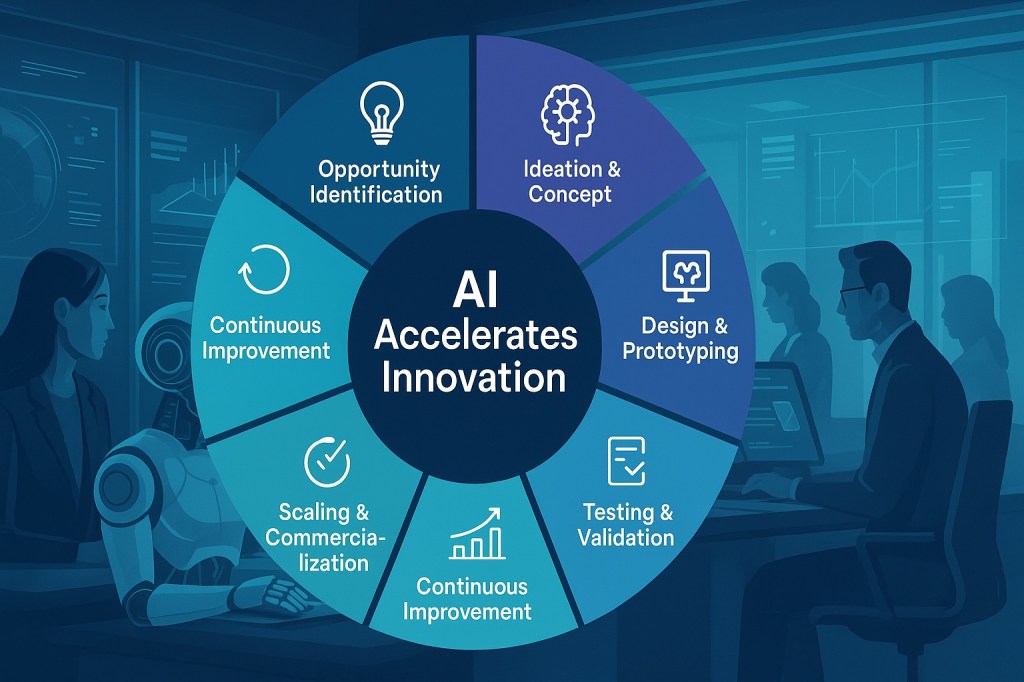
Artificial Intelligence (AI) is emerging as a transformative force in this landscape. It accelerates every stage of the innovation process—from identifying opportunities and generating concepts to prototyping, testing, and scaling. Just as importantly, AI enables a new level of real-time customisation, empowering businesses to design and refine products and services that are more precisely aligned with individual customer preferences.

In this newsletter, I explore how AI is transforming each phase of the product and service innovation lifecycle, supported by research evidence and real-world applications.


1. Research & Opportunity Identification AI enhances the discovery of new product and service opportunities by analyzing vast volumes of structured and unstructured data—from customer sentiment and social chatter to competitive intelligence and emerging macro trends. Machine learning and natural language processing enable companies to identify unmet needs and whitespace opportunities with speed and precision that traditional market research can’t match.

Research Evidence

  • McKinsey (2023): AI accelerates opportunity identification by 37%.
  • MIT (2023): Trend analysis with AI improves opportunity detection by 42%.

Examples

  • Procter & Gamble uses NLP to mine social media and reviews for unmet customer needs.
  • Netflix identifies content gaps via recommendation engine data, informing production.

2. Ideation & Concept Development AI acts as a co-pilot for creativity, expanding the range of ideas and increasing the novelty of concepts generated. Generative AI and collaborative platforms help teams break cognitive biases, synthesize divergent thinking, and visualize concepts early in the process.

Research Evidence

  • Stanford Innovation Lab (2022): AI-enhanced brainstorming boosts novel ideas by 56%.
  • IBM: Cross-functional ideation quality rises by 31% with AI tools.

Examples

  • Airbus generated over 60,000 aircraft partition designs, discovering a solution 45% lighter than legacy models.
  • Designers leverage DALL·E to visualize product concepts rapidly.

3. Design & Prototyping AI accelerates prototyping by running simulations, optimizing form factors, and suggesting alternatives based on performance or customer preferences. It reduces development time while improving the diversity and feasibility of design iterations.

Research Evidence

  • MIT Media Lab: Iteration time reduced by 47%; 215% more design variations explored.
  • Harvard Business Review: AI simulation reduces physical prototype needs by 39%.

Examples

  • Volkswagen runs thousands of virtual car tests before building physical versions.
  • IKEA uses generative AI for furniture design and visualization.

4. Testing & Validation AI transforms validation by simulating real-world use, forecasting product success, and optimizing features through automated A/B testing. It helps teams reduce risk while aligning products more closely with customer expectations.

Research Evidence

  • Forrester (2024): AI improves A/B testing effectiveness by 28%.
  • Cambridge University: Product-market fit predictions enhanced by 41% with AI.

Examples

  • Amazon simulates user responses to product iterations.
  • Unilever uses digital twins to test product performance across different markets.

5. Scaling & Commercialization AI optimizes go-to-market strategies by refining product rollouts, forecasting demand, and personalizing marketing campaigns. It enables faster scaling while controlling costs and maximizing uptake.

Research Evidence

  • Accenture: Scale-up time reduced by 31%, costs by 26% through AI.
  • MIT Sloan: AI-guided marketing improves product adoption by 23%.

Examples

  • Starbucks uses AI to fine-tune new product rollouts globally.
  • Toyota leverages AI in supply chain modelling, improving scale efficiency by 18%.

6. Continuous Improvement AI closes the loop in innovation by turning customer usage and feedback into actionable insights. From predictive maintenance to feature enhancement prioritization, AI ensures products remain relevant and valuable over time.

Research Evidence

  • Deloitte: AI feedback analysis speeds product improvement cycles by 43%.
  • Harvard Business School: Predictive maintenance extends product lifecycles by 27%.

Examples

  • Tesla continuously improves vehicles via AI-analyzed driving data with over-the-air updates.
  • Microsoft uses AI to prioritize software feature improvements based on user behaviour.

Conclusion AI is more than a technological enabler—it is a strategic accelerator of innovation. By embedding AI across the full product and service lifecycle, companies gain the ability to move faster, personalize smarter, and innovate with greater confidence.

As generative and predictive technologies mature, organizations that embrace AI-driven innovation will shape the future.

Scenario Planning in Digital Transformation – Navigating Uncertainty with Strategic Foresight

In the many years I have been involved in strategic planning and roadmap formulation, scenario planning has been one of the most important tools. Especially in a digital landscape where the pace of change is exponential and unpredictable, scenario planning is extremely relevant. Transformation leaders must grapple with a range of unknowns: Which technologies will emerge as dominant? Will customers adopt faster or slower than anticipated? Will regulators accelerate or delay disruption?

Scenario planning offers a strategic approach to prepare for multiple plausible futures—enabling organizations to act with agility rather than react in crisis.


Why Scenario Planning is Crucial in Digital Transformation

Unlike traditional forecasting, scenario planning is not about predicting a single future—it’s about preparing for many. This becomes especially critical in digital transformation where:

  • Technology shifts are nonlinear and often abrupt (e.g. AI take off)
  • New competitors can emerge from adjacent industries
  • Adoption rates vary widely across geographies and customer segments
  • Cultural readiness and organizational agility are as important as tech choices

Scenario planning empowers transformation leaders to test strategies against uncertainty, align cross-functional teams, and invest with confidence, even amid ambiguity.


What Leading Research Tells Us

A cross-section of top-tier research provides a strong foundation for scenario planning in digital transformation:

🔹 IMD (Wade & Macaulay, 2018)

  • Advocates for shorter scenario horizons (2–3 years) to match digital transformation’s faster cycles.
  • Emphasizes the role of Digital Business Agility: hyperawareness, informed decision-making, and fast execution.
  • Recommends cross-functional scenario teams to ensure alignment across business, tech, and operations.

🔹 McKinsey: Next-Generation Operating Model

  • Positions scenario planning as a tool to test digital operating models built around customer journeys and integrated tech stacks.
  • Reinforces cross-silo collaboration and the sequencing of initiatives based on scenario readiness.

🔹 Deloitte: Digital Transformation 2.0

  • Introduces the Axes of Uncertainty approach to model digital-specific futures.
  • Brings in cultural transformation as a key variable in scenario evaluation.
  • Uses scenario planning to bridge divergent assumptions across business units.

🔹 Gartner: Scenario Planning for IT Leaders

  • Offers actionable frameworks for CIOs to translate digital strategy into adaptive execution.
  • Advocates modular, digital-first planning responsive to rapid tech shifts.

🔹 World Economic Forum: Digital Transformation Initiative (DTI)

  • Emphasizes ecosystem collaboration as essential to capturing digital value.
  • Provides value creation and capture frameworks to assess digital investments.
  • Highlights industry-specific scenarios and introduces the interactive “Scenario Game” tool for engaging, agile planning.

How Digital Scenario Planning Differs from Traditional Approaches

Traditional Scenario PlanningDigital Scenario Planning
5–10+ year horizons2–3 year horizons
Broad economic/political driversTech adoption, digital disruption
Siloed strategic teamsCross-functional collaboration
Linear review cyclesAgile, iterative refresh cycles
Culture often overlookedCulture is a central scenario lens

A Step-by-Step Guide to Scenario Planning in Digital Transformation

This guide synthesizes the most actionable elements from the research above:

Step 1: Define the Focus and Time Horizon

  • Choose a pivotal transformation question (e.g., platform strategy, AI deployment, customer engagement).
  • Set a 2–3 year horizon (per IMD) to match the pace of digital evolution.

Step 2: Identify Key Drivers and Critical Uncertainties

  • Form a cross-functional team (strategy, IT, ops, HR, marketing).
  • Identify external drivers and critical uncertainties (e.g., AI regulation, platform dominance, customer trust).
  • Prioritize variables by impact and uncertainty.

Step 3: Build the Scenario Matrix

  • Apply the Axes of Uncertainty method (Deloitte): Select two high-impact uncertainties to define four distinct scenarios.
  • Craft compelling names and short narratives (e.g., “Trust Deficit”, “AI Gold Rush”).
  • Incorporate culture, tech adoption, and ecosystem dynamics.

Step 4: Stress-Test Strategy and Culture

  • Evaluate each initiative across all scenarios:
    • What’s robust across all futures?
    • What’s conditional?
    • Where does culture enable or block execution?
  • Use WEF’s value creation and capture framework to refine prioritization.

Step 5: Define Early Warning Indicators

  • Develop a set of signals (regulatory shifts, competitor actions, adoption trends).
  • Assign accountability for scenario monitoring and review.

Step 6: Integrate into Governance and Portfolio Planning

  • Use scenarios to:
    • Guide steering committee strategy reviews
    • Align investment portfolios to scenario robustness
    • Shape adaptive transformation roadmaps

From Planning to Strategic Resilience

Scenario planning doesn’t eliminate uncertainty—it turns it into a strategic asset. In digital transformation, it enables bolder decisions, faster adaptation, and stronger cross-functional alignment.

By combining the frameworks from IMD, McKinsey, Deloitte, Gartner, and the World Economic Forum, organizations can embed scenario planning into their transformation governance and create a culture of preparedness and agility.

Ready to explore your digital future? Try the WEF Scenario Game to get started. Or you can also start exploring with your favourite LLM’s what relevant scenarios could be for your organisation.

Master Impactful Communication in Digital Transformation

Why Communication Is the Lifeblood of Transformation Communication is more than a soft skill—it’s a strategic lever. Miscommunication or a lack of timely information can erode trust, stall progress, and sow confusion. According to McKinsey, 70% of transformation programs fail, and poor communication is often a silent contributor. Impactful communication aligns stakeholders, drives engagement, mitigates resistance, and reinforces progress. It is how leadership earns trust, how teams stay focused, and how change becomes real.

1. Why Communicate: Purpose, Alignment, and Momentum At every stage of a transformation, communication serves a purpose:

  • Clarify Purpose: Explain the “why” of the transformation—the vision, strategic drivers, and burning platform.
  • Create Alignment: Ensure all stakeholders understand their role in the broader narrative.
  • Build Momentum: Regular communication reinforces progress and sustains engagement.

Example: Continuously link messages to how the topic supports the overall strategy and purpose of the transformation.

2. What to Communicate: The Three Strategic Narratives

  • Purpose: Why are we doing this? Lay out the rationale, desired future state, and expected benefits.
  • Progress: What’s happening now? Share timelines, milestones, and any course corrections.
  • Proof: What’s working? Highlight quick wins, user stories, and lessons learned. Success stories inspire belief.

Example: A transformation dashboard updated monthly with progress visuals and a rotating spotlight on team success stories creates transparency and boosts morale.

3. How to Communicate: Channels, Formats, and Tone

  • Stakeholder-Focused: Tailor content to audience needs. Executives need strategic updates, while frontline teams need clarity on operational impacts.
  • Formats: Mix videos, infographics, text updates, and live events. Use storytelling, visuals, and humor where appropriate.
  • Tools: Combine traditional (emails, town halls) with digital (Yammer, Teams, digital signage).

Example: A short animated video used to explain a new agile model across the company generates more engagement than a 10-page slide deck.

4. Where to Communicate: Choosing the Right Channels

  • Channels: Leverage both formal (newsletters, intranet) and informal (team meetings, social platforms).
  • Internal and External: Don’t forget partners, customers, and external stakeholders when relevant.
  • Beyond Standard: Use unconventional methods like pop-up booths, floor ambassadors, or interactive kiosks.

Example: Place screens in break rooms with FAQs and video testimonials from users. Often, employees read external communication (e.g. LinkedIn) more attentively than internal channels.

5. Who Should Communicate: Roles and Responsibilities

  • Leadership: Sets the tone and provides credibility.
  • Program Teams: Share updates and own the transformation story.
  • End Users: Involve them in co-creation and let their stories become advocacy.
  • Champions/Change Agents: Act as trusted messengers within the organization.

Example: (Team) Leaders deliver tailored talking points to their teams after town halls to reinforce key messages locally.

6. When to Communicate: Cadence with Purpose

  • Routine Rhythm: Weekly newsletters, monthly video messages, quarterly town halls.
  • Event-Driven: Go-live updates, milestone achievements, leadership transitions.
  • Embedded Moments: Integrate into standups, one-on-ones, and performance reviews.

Example: A transformation team sends a short Friday note every week with “Top 3 things to know” – brief, consistent, and effective.

7. Making Communication Two-Way

  • Feedback Loops: Open Q&A forums, feedback forms, sentiment pulse checks.
  • Listening Mechanisms: Focus groups, digital suggestion boxes, skip-level meetings.
  • Empower Managers: Train and support them to act as translators and listeners.

Example: Run quarterly listening sessions where employees can anonymously submit and vote on questions.

8. Measuring Communication Effectiveness

  • Quantitative Metrics: Email open rates, intranet views, video play completion, attendance.
  • Qualitative Feedback: Employee surveys, pulse checks, sentiment analysis.
  • Behavioral Indicators: Are stakeholders taking desired actions (e.g., using a new tool, adopting a new process)?

Example: Use employee surveys to check communication effectiveness. Include questions on whether the why, who, what, where, and when of the transformation are well understood.

Conclusion: From Messaging to Meaning

Impactful communication is not just about delivering information—it’s about shaping perception, building trust, and enabling action. It’s a leadership discipline that requires intent, empathy, and agility. In digital transformations, where uncertainty is the norm, communication becomes the connective tissue that keeps strategy and execution aligned. For senior leaders, investing in communication is not optional—it’s foundational to transformation success.

AI and Digital Transformation Insights from the GDS CIO Summit

Last week, I had the pleasure and privilege of attending and speaking at the GDS CIO Summit – Noordwijk | March 12-13 2025, where I joined around 150 senior leaders from the tech industry. Over two days, we explored some of the most pressing topics shaping our industry today and those that will define the near future. It came as no surprise that 84% of CIOs consider AI a top priority, yet many are still figuring out how to effectively integrate it into their business strategies.

From Vision to Value – IT as a Competitive Advantage

The summit opened with a fantastic panel discussion featuring Angelika Trawinska van Bolhuis ( Dyson), Claudio FINOL (Fyffes), and Cameron van Orman (Planview). A key theme that emerged: IT is no longer just an enabler but a core driver of business strategy—capable of creating either competitive advantage or disadvantage.

Organizations are shifting from project-based ROI thinking to a product and business value-driven approach, requiring agile, dynamic planning and tools like Planview to align IT initiatives with evolving business priorities.

AI’s Growing Impact – The Need for Real-Time Insights

AI was a dominant theme throughout the event, and Kai Waehner (Confluent) led a deep dive into how real-time data fuels AI success. Many infrastructures aren’t designed for this shift, but event-driven architectures and data streaming are emerging as critical enablers.

One standout insight: 2025 is poised to be the year of “Agentic AI”—where autonomous AI agents collaborate in real time to optimize operations. Businesses that prepare for this transformation now will gain a significant competitive edge.

The Future of Work – Productivity, Transparency & AI Integration

How can organizations improve productivity and alignment? Sven Peters (Atlassian) shared fascinating insights into modern Systems of Work. High-performing teams don’t operate in silos; they align around OKRs (Objectives & Key Results) with full transparency.

At Atlassian, they have a simple but highly effective approach: ✅ Weekly 280-character updates to keep work visible ✅ Monthly check-ins to assess progress ✅ Quarterly reviews to refine objectives

AI is deeply embedded in this process, assisting teams in defining OKRs and structuring projects in a smarter way.

AI Regulations, Security & Workforce Evolution

The regulatory landscape around AI is evolving rapidly, particularly in Europe, and Ulrika Billström (OpenText) provided a compelling look at how companies must adapt. AI orchestrators are emerging, capable of managing multiple AI agents to drive large-scale innovation.

A key trend: Instead of moving data to AI, AI is now being deployed closer to where the data resides, fundamentally changing how organizations structure their AI ecosystems.

Day 2 – Real-Time Data & Trust

I had the honor of opening Day 2 alongside Ellen Aartsen ( KPN ), Joshan Meenowa (The KraftHeinz Company), and Ben Thompson ( GDS Group) in a discussion on how data fuels real-time decision-making.

A key question we tackled: How “real-time” does data actually need to be? While not every use case requires real-time data, all use cases require trusted data. Transparency, governance, and reducing reliance on alternative, non-trusted data sources are key to success.

AI Lifecycle Challenges – Managing Rapid Evolution

Kevin K. ( Airia – Enterprise AI Simplified ) shed light on a major challenge: the rapid pace of AI development. With 6,000–8,000 new AI models being created every week, companies struggle to keep up.

The solution? AI orchestration layers—which sit between the data, source systems, and AI models—are becoming essential to manage AI lifecycles efficiently and ensure tangible ROI.

The CIO’s Role is Evolving – Business Leadership is Key

In an insightful discussion with Alan Guthrie ( Calderys) and Alexander Press (Sanofi), we explored how the role of the CIO is undergoing a fundamental shift.

Today’s CIOs must: ✔ Operate at strategic, tactical, and operational levels ✔ Set clear technology guardrails while fostering innovation ✔ Shift IT functions toward product-driven organizations

Technology leadership alone is no longer enough—CIOs must now be business leaders.

Maximizing Tech Investments – Understanding TCO & ROI

To close the summit, @ManishNirmal ( Vimeo) provided a valuable session on how to assess the true Total Cost of Ownership (TCO). Hidden costs—such as training, migration, and operational impact—often make or break the business case for tech investments.

His recommendation? Use frameworks like MEDDIC (Metrics, Economic Buyer, Decision Criteria, Identify Pain, Champion) to map tech solutions based on real business value.

One of the most memorable takeaways: Crawl before you walk, walk before you run—but standing still is not an option.


Final Thoughts

The GDS CIO Summit was a fantastic opportunity to exchange insights with industry leaders and explore where AI and digital transformation are headed. A huge thank you to the GDS Group, especially Sophie Charnaud for her support, and all the brilliant speakers and participants for making it such an insightful event!

Unlocking Value in Digital Transformation with VDT & BRM

The Importance of Value Driver Trees and Benefit Realization Management in Digital Transformation

Digital transformation is not just about implementing new technologies—it is about generating real, measurable business value. Too often, organizations invest in digital initiatives without a clear understanding of how these efforts contribute to strategic goals, leading to wasted resources and unfulfilled expectations. I could have put this tool as well in the Strategy to Plan section, since you will need these insights already when setting up a transformation. Due to it’s focus on Sustainable Value Creation you find it here.

To ensure digital transformation delivers tangible benefits, organizations need structured approaches that tie initiatives to business value. Value Driver Trees (VDT) provide a visual and analytical way to break down how value is created, while Benefit Realization Management (BRM) ensures that transformation initiatives deliver the expected outcomes. By integrating these two approaches, organizations can bridge the gap between strategy and execution, ensuring every initiative contributes to meaningful business impact.

This article explores these frameworks, their interaction, and provides a step-by-step guide for implementing them effectively in digital transformation initiatives.


Understanding the Approaches

1. Value Driver Tree (VDT)

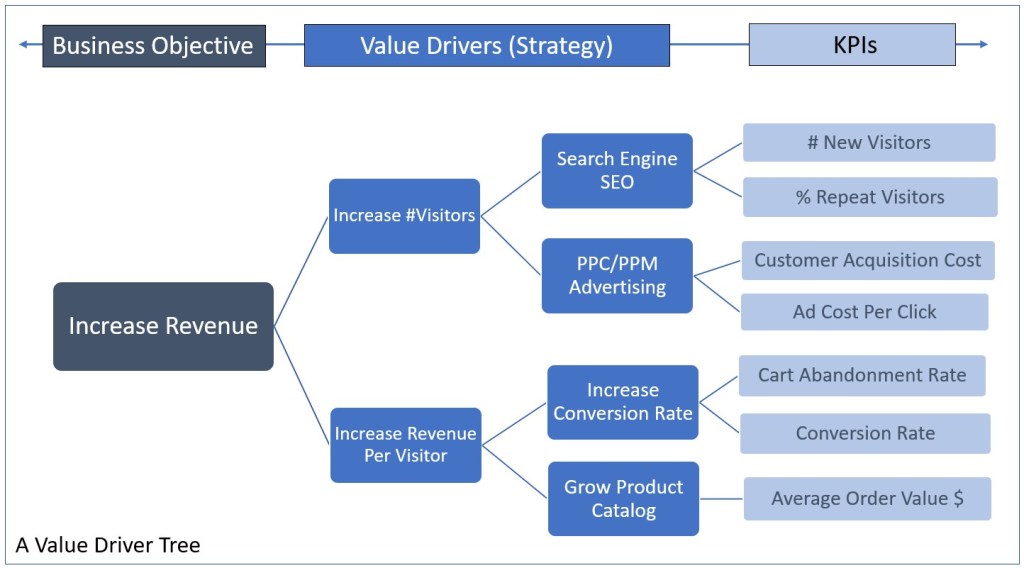
A Value Driver Tree (VDT) is a structured framework that breaks down an organization’s high-level business objectives into actionable and measurable components. It helps leaders identify the key levers that drive financial and operational performance.

Example: VDT for Retail e-Commerce Growth

Goal: Increase e-Commerce Revenue

👉 Sales Volume Growth
 🔹 Improve Website Conversion Rate
 🔹 Increase Traffic via Digital Marketing
👉 Average Order Value Increase
 🔹 Personalized Product Recommendations
 🔹 Bundled Pricing Strategy
👉 Customer Retention Improvement
 🔹 Loyalty Program Enhancements
 🔹 Improved Customer Support Response Time

This hierarchical breakdown helps organizations prioritize initiatives that have the most impact on revenue growth. Below one more example from the web on how to look at Value Drivers/KPIs.


2. Benefit Realization Management (BRM) – PMI Approach

PMI’s Benefit Realization Management (BRM) framework provides a structured approach to ensure that projects and programs deliver measurable benefits that align with strategic objectives. It consists of three key phases:

  1. Benefit Identification: Define expected benefits, align them with strategic goals, and establish key performance indicators (KPIs).
  2. Benefit Execution: Monitor benefits realization through governance and stakeholder engagement during project execution.
  3. Benefit Sustainment: Ensure ongoing measurement and reinforcement of benefits post-project completion.

Example: BRM in an ERP Implementation

Objective: Improve Operational Efficiency Through an ERP System
👉 Benefit: Reduced Order Processing Time
 🔹 Initiative: Automate manual order entry processes
 🔹 KPI: Reduce order processing time from 48 hours to 12 hours
👉 Benefit: Lower IT Costs
 🔹 Initiative: Consolidate legacy systems into a unified ERP platform
 🔹 KPI: Reduce IT maintenance costs by 30%

By applying BRM, organizations can ensure that digital transformation projects remain focused on delivering real business benefits rather than just implementing technology for technology’s sake.


How VDT and BRM Interact

VDT and BRM complement each other by linking high-level business value drivers with structured benefit realization processes. Here’s how they work together:

  1. VDT Identifies Key Business Drivers → Helps organizations understand where value comes from.
  2. BRM Ensures Benefits Are Tracked and Realized → Ensures projects are aligned with value drivers and measured effectively.
  3. VDT Provides a Data-Driven Basis for Prioritization → Helps select the most impactful initiatives.
  4. BRM Embeds Value Tracking into Governance → Ensures sustained realization of benefits post-implementation.

By integrating VDT and BRM, organizations can establish a clear, data-driven transformation roadmap and ensure continuous value creation.


Implementation Plan

Step 1: Develop a Value Driver Tree

  • Identify overarching business objectives (e.g., revenue growth, cost reduction, customer experience enhancement).
  • Break them down into measurable value drivers and initiatives.
  • Assign KPIs to each driver to establish clear tracking mechanisms.

Step 2: Align BRM to the Value Driver Tree

  • Define benefits based on value drivers.
  • Create a Benefits Dependency Network mapping initiatives to expected benefits.
  • Assign accountability for benefit realization.

Step 3: Establish Governance and Measurement

  • Integrate benefit tracking into program governance.
  • Set up regular benefit reviews (e.g., quarterly assessments).
  • Adjust strategies if expected benefits are not materializing.

Example: Applying VDT and BRM in a Digital Transformation Initiative

Scenario: A Bank’s Digital Banking Transformation

Step 1: Develop a Value Driver Tree

Goal: Enhance Digital Banking Experience
👉 Increase Mobile App Adoption
 🔹 Simplify Onboarding Process
 🔹 Improve User Interface & Experience
👉 Reduce Customer Support Costs
 🔹 Introduce AI-powered Chatbots
 🔹 Automate Fraud Detection Alerts

Step 2: Align BRM to VDT

BenefitKPIInitiativeMeasurement
Higher Mobile Adoption% of active usersUX RedesignMonthly user growth rate
Lower Support CostsReduction in live callsAI Chatbot DeploymentCall volume trend
Increased SecurityFraud incident reductionAI-driven fraud detectionFraud report metrics

Step 3: Governance & Tracking

  • Regular executive reviews track realized vs. projected benefits.
  • Adjustments made based on data insights and customer feedback.

Conclusion: Driving Digital Transformation Success with VDT and BRM

Successful digital transformation requires more than just implementing technology—it demands a structured approach to ensure value realization. By leveraging Value Driver Trees (VDT) and Benefit Realization Management (BRM) together, organizations can:

✅ Clearly define how transformation initiatives contribute to business objectives.
✅ Prioritize efforts based on quantifiable value impact.
✅ Continuously track and adjust for sustained benefit realization.

To drive real business outcomes, organizations should integrate these frameworks into their transformation governance, ensuring a clear line of sight from strategic objectives to measurable benefits.

Call to Action

If your organization is embarking on a digital transformation journey, start by building your Value Driver Tree and structuring a Benefit Realization Framework. Need help applying these methods? Let’s discuss how to tailor them to your organization’s needs.

How to Marry Process Management and AI

Process management is a critical function in any organization since it is through processes that organizations add value. Better-managed processes lead to higher efficiency, alignment with strategic goals, and continuous improvement. Due to new technologies and better availability of data, including AI, work can become faster and easier. The main challenge lies in how to integrate these advancements effectively into operations.

Inspired by the article in the Jan-Feb 2025 issue of Harvard Business Review titled “How to Marry Process Management and AI – Make sure people and your technology work well together,” I reflected on the challenges I have encountered during my 15+ years of involvement in transformations in this area. In this article, I will use the 7 Step framework described in the HBR article. While the original article provides interesting industry examples and insights by the authors, I will focus on my own approaches, tools I have worked with and firsthand experiences at each step.


Step 1: Establish Ownership and Define a High-Level Framework

The first step in process management is to identify key business owners responsible for overseeing and implementing process improvements:

  • Begin by creating a high-level process framework outlining the top-level processes in the organization. Existing frameworks, such as those from the American Production & Quality Center (APQC), can serve as references.
  • Establish executive-level owners who commit to driving standardization, implementation, and optimization of these processes.
  • Collaborate with executive owners to appoint dedicated Business Process Owners (BPOs) and Business Process Experts (BPEs). These roles should be empowered to design future processes, drive implementation, and ensure alignment with organizational strategies and goals.

Personal Insight: In my experience, getting executive buy-in at the outset is crucial. A clear and visual process framework often helps bring stakeholders on board by providing a shared vision and helping them understand where and how value is created.


Step 2: Identify Process Customers

Understanding who benefits from a process is essential. Customers, in my view, fall into two categories:

  • External customers: These are stakeholders such as customers, suppliers, and partners who experience the outcomes of the organization’s end-to-end processes (and pay for them).
  • Internal customers: These are internal teams directly influenced by the processes being (re-)designed. It is vital that they understand how their roles fit into the broader end-to-end picture to avoid silo thinking.

Personal Insight: I have found that facilitating workshops with representatives from both external and internal customer groups is invaluable. For example, mapping customer journeys together often uncovers pain points and fosters alignment on objectives.


Step 3: Map Out Existing Processes

A comprehensive mapping of current processes is crucial. Traditional Lean tools, including workshops and stakeholder sessions, are effective for documenting processes. Process mining tools further enhance this step by providing data-driven insights into:

  • Process flows and durations
  • Bottlenecks and inefficiencies
  • Process variations and exceptions

Personal Insight: I have worked extensively with process mining solutions such as Celonis, UIpath, and Signavio. While each tool has its pros and cons, they all provide actionable insights that can drive fact-based decisions. However, technology alone isn’t enough—you must have dedicated teams ready to act on the findings. Otherwise, these tools risk becoming underutilized investments.


Step 4: Establish Performance Metrics and Targets

Setting relevant and measurable KPIs (Key Performance Indicators) is critical. Metrics should directly link to business objectives, such as:

  • Customer satisfaction
  • Process efficiency and cost savings
  • Compliance and risk reduction

Personal Insight: Benchmarking KPIs against industry standards often helps set realistic targets. Combining data-driven insights with customer feedback will enable you to create alignment with all stakeholders on which targets to go for.


Step 5: Consider Process Enablers

Technology plays a key role in enhancing process efficiency. Core IT platforms, such as ERP systems (e.g., SAP), CRM tools (e.g., Salesforce), and HR platforms (e.g., Workday), offer significant automation potential. Additionally:

  • Workflow automation tools like Pega enable cross-platform processes.
  • Robotic Process Automation (RPA) streamlines repetitive tasks.
  • AI-powered tools like Optical Character Recognition (OCR) automate activities such as invoice or email processing.

Choosing the right enablers is essential. The number of companies offering process enabling tools is growing rapidly, and core IT platforms are increasingly AI-enabled (e.g., AgentForce in Salesforce and Joule for SAP).

Personal Insight: You need to strike a balance in your investments. Core IT platforms typically require larger investments and longer implementation times. In contrast, more specialized solutions can deliver faster impact but are often limited in scope and may become obsolete over time.


Step 6: Process Design & Simulation

Designing new processes should be a collaborative effort involving BPOs, subject matter experts, and functional business owners. Platforms such as Signavio and ARIS facilitate standardized documentation and link designs to IT and data architectures. These platforms also enable:

  • Documentation of new processes
  • Comparison of current vs. proposed processes using process mining outputs
  • Creation of Digital Twins to test and optimize execution models

Personal Insight: I have seen great value in involving cross-functional teams early in the design phase. Well documented and co-owned processes are crucial as foundation for building the technology solutions. Digital Twins help to simulate multiple process models, enabling us to choose the optimal approach before implementation.


Step 7: Implement and Monitor

Implementation is one of the most challenging aspects of process management. Success requires a structured rollout plan and robust change management strategies. To track progress and effectiveness:

  • Use dashboards to monitor adoption rates and usage.
  • Leverage process mining tools to evaluate the utilization of new processes.
  • Conduct regular business reviews to assess adoption rates and performance.

Personal Insight: In my experience, transparent communication during rollout builds trust and minimizes resistance. Dashboards that visualize progress in real time drives the right discussion in teams and enables them to drive towards required milestones and celebrate achievements.


Final Thoughts

Process management is not a one-time exercise but an ongoing cycle of analysis, optimization, and automation. Organizations that embrace data-driven decision-making and leverage emerging technologies will achieve greater efficiency, improve customer experiences, and maintain a competitive edge. AI is accelerating this shift, making now the ideal time to enhance your process management skills.