A pre-mortem is a proactive risk management exercise that helps teams anticipate potential failures before they occur. Unlike traditional risk assessments, which often focus on known risks, a pre-mortem encourages teams to imagine a scenario where the initiative has already failed and work backward to identify the causes. This method:
Uncovers hidden risks that might otherwise be overlooked.
Encourages open and candid discussions within teams.
Enhances risk mitigation strategies early in the process.
Strengthens team alignment and shared accountability for success.
What Are the Outcomes of a Pre-Mortem?
When executed effectively, a pre-mortem delivers several valuable outcomes:
A comprehensive list of potential failure points.
A prioritized risk register with mitigation actions.
Stronger team cohesion and ownership over the initiative’s success.
Improved decision-making, ensuring proactive rather than reactive responses to risks.
How to Execute a Pre-Mortem
Follow these structured steps to conduct an effective pre-mortem:
Set the Stage: Gather the key stakeholders, including project sponsors, team leads, and operational experts. Ensure a psychologically safe environment where candid discussions are encouraged.
Define the Scenario: Present the hypothetical situation: “It is six months (or an appropriate timeframe) in the future, and the project has completely failed. What went wrong?”
Brainstorm Failure Points: Each participant individually lists reasons for failure, considering strategic, operational, and technical factors.
Share and Categorize: Consolidate and group similar failure points into themes (e.g., governance issues, resource constraints, external disruptions).
Prioritize Risks: Use voting, ranking, or a risk assessment matrix to determine which failure points are the most critical.
Develop Mitigation Actions: For each high-priority risk, define preventive measures and contingency plans.
Integrate into Governance: Assign ownership for risk monitoring and integrate these insights into ongoing project reviews.
When and With Whom Should You Conduct a Pre-Mortem?
When: Ideally, before finalizing the transformation strategy or at key milestones in major initiatives (e.g., post-planning, before execution phases, during major pivots).
With Whom: A cross-functional group including executives, project managers, functional leads, risk officers, and frontline implementers.
By embedding the pre-mortem approach into your transformation governance, you significantly improve the likelihood of success by proactively identifying and addressing risks before they materialize.
This technique not only improves project outcomes but also builds stronger teams through enhanced communication and psychological safety.
Many digital transformations fail not because of technology, but because new ways of working don’t stick. Lean Thinking provides a structured approach to ensure transformation is effectively executed and fully integrated into daily operations. This article explores six key Lean concepts—five foundational tools plus Leader Standard Work—to create lasting impact.
1. Value Stream Mapping (VSM) – Creating Clarity on “As-Is” vs. “To-Be”
Why It Matters
Before launching any digital initiative, organizations need a clear understanding of current inefficiencies and how digital solutions will improve them. Value Stream Mapping (VSM) provides a structured approach to visualize workflows, eliminate waste, and define the future state.
Example: Bosch’s ERP Optimization
Bosch implemented a new digital ERP system but faced slow adoption and workflow inefficiencies. By applying VSM, they mapped the As-Is state, identified bottlenecks, and redesigned the To-Be process with simplified digital interfaces, leading to a 25% productivity increase.
Approach: VSM Mapping Framework
Step 1: Identify key processes and stakeholders.
Step 2: Map the As-Is state (manual steps, delays, inefficiencies).
Step 3: Define the To-Be state with digital solutions.
Step 4: Identify improvement actions and implementation roadmap.
2. Standard Work – Defining the New Way of Working
Why It Matters
Even after successful digital transformation, employees often revert to old habits unless new processes are clearly documented and reinforced. Standard Work ensures consistent execution and prevents variation.
Example: Danaher’s Digital Compliance
Danaher struggled with process inconsistencies post-digital transformation. By implementing Standard Work documents, they aligned global teams on digital best practices and saw a significant reduction in process variability.
Approach: Standard Work Document Structure
Process Name & Purpose
Step-by-Step Instructions (with screenshots where needed)
Roles & Responsibilities
Success Metrics
Review & Continuous Improvement Plan
3. Daily Management – Sustaining the Transformation
Why It Matters
Sustained digital transformation requires continuous monitoring and adjustment. Daily Management ensures teams review progress, discuss obstacles, and reinforce digital processes in short, structured meetings.
Example: Amazon’s AI-Driven Operations
Amazon implemented daily huddles to monitor its AI-driven supply chain. By reviewing key performance indicators (KPIs) daily, teams proactively resolved adoption issues, improving fulfillment speed while reducing errors.
Approach: Daily Management Meeting Agenda
Review Key Metrics (digital adoption, process performance)
Identify Issues & Roadblocks
Escalate Unresolved Problems
Celebrate Successes & Recognize Contributions
4. Visual Management – Making Gaps & Performance Visible
Why It Matters
Without clear visibility, employees and leaders struggle to measure progress. Visual Management (dashboards, Kanban boards) helps teams quickly identify gaps, monitor KPIs, and drive accountability.
Example: Toyota’s Digital Maintenance Dashboards
Toyota faced adoption resistance for a new digital maintenance system. By introducing real-time dashboards, operators could instantly see performance gaps, leading to a higher engagement rate.
5. Problem Solving – Addressing Gaps Systematically
Why It Matters
Digital transformations introduce new challenges. Instead of temporary fixes, structured problem-solving methods like PDCA (Plan-Do-Check-Act) or A3 thinking ensure issues are resolved at the root cause level.
Example: Ford’s Digital Production Line Improvements
Ford faced efficiency issues after implementing digital production tracking. By using PDCA cycles, they systematically identified and eliminated process gaps, improving production flow and reducing defects.
Approach: A3 Problem-Solving Approach
Define the Problem
Analyze Root Causes
Develop & Test Countermeasures
Implement & Sustain Improvements
6. Leader Standard Work – Driving & Sustaining Transformation
Why It Matters
Leaders play a crucial role in ensuring digital transformation is reinforced daily. Without active leadership engagement, employees revert to familiar processes, undermining long-term success.
Example: GE’s Lean Leadership Coaching
GE implemented Leader Standard Work (LSW) to ensure leaders consistently reinforced digital adoption. By embedding digital coaching into daily and weekly routines, they sustained digital engagement long after rollout.
Approach: Leader Standard Work Checklist
Daily: Attend team huddles, review dashboards, coach employees.
Weekly: Conduct structured digital adoption reviews, address problem-solving needs.
Monthly: Assess long-term impact, adjust Standard Work where needed.
Conclusion
Digital transformation is not just about technology—it’s about sustained operational change. By embedding these six Lean concepts, organizations can move from execution to full integration, ensuring digital initiatives drive long-term value.
Call to Action:
Which of these Lean concepts resonates most with your transformation journey?
How are you ensuring that digital changes truly stick in your organization?
The Evolution of Digital Platforms: From CRM to AI-Powered Automation
Over the past decade, digital platforms such as Customer Relationship Management (CRM) systems, process automation tools, and AI-driven content generation solutions have significantly reshaped the Marketing, Sales, and Customer Service functions. Platforms like Salesforce have centralized customer data, streamlined workflows, and enhanced customer relationship management, enabling organizations to gain a 360-degree view of customer interactions. This shift has driven more personalized engagement, improved forecasting, and increased operational efficiency.
Beyond CRM, AI-powered process automation has minimized manual administrative tasks while enhancing analytics and insights across marketing, sales, and service functions. This has freed teams to focus on strategic and creative aspects of their roles. AI-assisted content creation has further revolutionized the field, enabling marketers to generate personalized campaign materials, sales teams to craft compelling proposals, and customer service teams to automate responses and knowledge base updates.
Initially, digital transformation was centered on digitizing and organizing customer data, replacing spreadsheets and fragmented databases with integrated, cloud-based solutions. This allowed marketing teams to run more targeted campaigns, sales teams to track leads and opportunities systematically, and service teams to deliver more efficient support. Automation features—such as email workflows, lead scoring, chatbot-assisted support, and AI-generated content—enhanced efficiency and reduced reliance on manual execution.
However, despite these advancements, traditional systems still require significant manual input, leading to inefficiencies in leveraging insights, maintaining up-to-date information, and optimizing content creation for customer engagement.
The Rise of AI-Powered Digital Platforms: A Game Changer for Marketing, Sales, and Service
AI has fundamentally transformed digital platforms, evolving them from passive databases into intelligent assistants that augment decision-making, improve customer interactions, and enhance operational efficiency. Key areas of transformation include:
Predictive Analytics and Lead Scoring AI analyzes vast amounts of customer data to identify patterns, predict behavior, and prioritize leads with the highest conversion potential. This enables sales teams to focus their efforts more effectively.
Automated Personalization in Marketing AI-driven marketing tools power hyper-personalized campaigns by analyzing past interactions, preferences, and behaviors, significantly boosting engagement and conversion rates.
Conversational AI and Virtual Assistants AI-powered chatbots and virtual assistants now handle routine customer interactions, providing instant responses, qualifying leads, and even scheduling follow-ups—freeing up sales and support teams for higher-value interactions.
Sentiment Analysis and Churn Prediction AI-driven sentiment analysis across emails, chat conversations, and social media helps assess customer satisfaction and predict churn risks, enabling proactive customer retention strategies.
Sales Forecasting and Revenue Optimization AI-powered analytics provide more accurate sales forecasts by factoring in external market conditions, past performance, and industry trends, helping executives make informed strategic decisions.
AI-Generated Content and Automated Communication AI assists in generating marketing content, social media posts, blog articles, and email campaigns. Sales teams leverage AI-generated proposals and presentations, while customer service teams use AI-driven FAQs and documentation to enhance efficiency.
The Changing Roles in Marketing, Sales, and Customer Service with AI
As AI transforms CRM, process automation, and content generation, key roles across these functions are evolving:
Marketing Roles
Brand Manager AI-driven sentiment analysis and predictive analytics help Brand Managers monitor consumer perception in real time, enabling proactive brand positioning. AI-assisted content creation tools enhance brand messaging and marketing material development.
Marketing Manager AI automates campaign optimization, budget allocation, and audience segmentation, allowing Marketing Managers to focus on strategy and creativity. AI tools also assist in drafting and refining copy, visuals, and campaign assets.
Market Research Analyst AI automates market research, competitive intelligence analysis, and big data insights generation, reducing reliance on traditional research methods and streamlining the presentation of insights.
Digital Marketing Manager AI-driven algorithms enhance ad placements, personalize email marketing, and optimize content recommendations. AI-generated creative assets—including ad copy, social media posts, and videos—further boost engagement and ROI.
Sales Roles
Sales Executive AI-driven lead scoring and real-time insights enable Sales Executives to prioritize high-value prospects and personalize their outreach strategies. AI assists in crafting outreach emails, presentations, and proposals.
Account Manager AI-based customer analytics help Account Managers predict churn, strengthen client relationships, and personalize engagement strategies through AI-driven content and insights.
Sales Manager/Director AI optimizes sales tracking, provides real-time coaching recommendations, and enhances forecasting accuracy, enabling Sales Managers to make more data-driven decisions.
Business Development Manager AI identifies emerging market opportunities, automates lead generation, and supports the creation of sales pitches, decks, and customized proposals.
Customer Service Roles
Customer Service Representative AI-powered chatbots handle routine queries, allowing service representatives to focus on complex customer issues. AI also assists in drafting responses and managing customer interactions more effectively.
Customer Success Manager AI-driven insights enable Success Managers to proactively identify customer pain points, predict churn, and deliver personalized support strategies, aided by AI-generated knowledge base content.
Technical Support Specialist AI-assisted diagnostics enhance troubleshooting efficiency, accelerating issue resolution and predictive maintenance. AI-generated documentation and automated responses streamline customer support.
The Future: A Fully Autonomous Digital Platform?
As AI integration deepens, businesses may in future operate with fully autonomous digital platforms capable of handling lead nurturing, customer engagement, and even complex negotiations with minimal human intervention. The fusion of AI and generative capabilities will further enhance content personalization and customer interactions, transforming marketing, sales, and service functions into more precise, data-driven disciplines.
However, this transformation will require organizations to invest in workforce training and change management initiatives. Employees must develop new skill sets to collaborate effectively with AI-driven tools, shifting their focus from manual execution to strategy, analysis, and creative problem-solving. Companies that prioritize reskilling will ensure their workforce remains competitive and valuable in an AI-augmented environment.
Organizations that proactively prepare for this shift will not only gain a competitive edge but also facilitate a seamless transition into a more automated and AI-driven future.
2025 Example: The Promise of Agentforce
Salesforce’s Agentforce is set to redefine AI-driven business operations in 2025. As a comprehensive digital labor platform, Agentforce allows organizations to create, customize, and deploy autonomous AI agents across sales, marketing, service, and commerce functions. These AI agents operate independently, retrieving data, making decisions, and executing tasks without human oversight.
Key features of Agentforce include:
Pre-Built AI Skills & Workflow Integrations: Rapid customization for sales functions like Sales Development and Sales Coaching, allowing AI agents to nurture leads and provide instant feedback on prospecting calls.
Seamless Collaboration in Slack: AI agents integrate into team workflows, enabling real-time collaboration between human employees and digital assistants.
Atlas Reasoning Engine: AI agents retrieve data, analyze it, and autonomously take action, handling complex, multi-step tasks with precision.
By leveraging Agentforce, businesses can scale their workforce with AI-driven automation, unlocking new operational efficiencies and redefining the future of work. Organizations that embrace this next generation of AI-powered automation will gain a substantial competitive advantage in an increasingly digital landscape.
Digital transformation is a complex journey that requires strategic stakeholder management to ensure success. Engaging and managing stakeholders effectively across the four key phases—Strategy to Plan, Plan to Execution, Execution to Integration, and Sustainable Adoption to Value Realization—is essential. Below, we explore how to assess and engage key stakeholder groups throughout the transformation, leveraging three industry-proven frameworks I have applied in several different formats.
Using Mendelow’s Power-Interest Matrix for Stakeholder Assessment
To determine which stakeholders to focus on, organizations can use Mendelow’s Power-Interest Matrix, which categorizes stakeholders based on their level of influence (power) and engagement (interest). Stakeholders with high power and high interest should be closely managed, as they are critical to transformation success. Those with high power but low interest should be kept satisfied with updates, while those with low power but high interest should be informed and engaged appropriately. Finally, stakeholders with low power and low interest require only periodic monitoring to ensure alignment.
Applying the ADKAR Model to Assess Stakeholder Participation
The ADKAR model (Awareness, Desire, Knowledge, Ability, Reinforcement) is useful for evaluating where stakeholders stand in terms of engagement. Leaders should assess whether stakeholders are aware of the transformation, desire to participate, have the knowledge and ability to support the changes, and receive reinforcement to sustain engagement. This structured approach helps tailor communication and interventions to move stakeholders through the engagement journey effectively.
Leveraging Kotter’s Change Model for Stakeholder Engagement
Once stakeholders are assessed, Kotter’s 8-Step Change Model provides a roadmap for actively engaging them. This includes creating urgency, building coalitions of support, developing a clear vision, removing obstacles, generating quick wins, and institutionalizing change. By applying these principles, organizations can maintain momentum and ensure stakeholders are aligned and invested throughout the transformation.
In the following section, I will describe how to assess and engage with five main stakeholder groups—Employees, Managers, Executives/Leadership, Board of Management/Shareholders, and Customers/Suppliers/Industry Stakeholders—leveraging the aforementioned models.
1. Employees
Assessing Employees
The ADKAR model provides a structured approach to assessing employees’ engagement in digital transformation. Organizations should evaluate:
Awareness: Do employees understand the need for transformation?
Desire: Are they motivated to participate and embrace change?
Knowledge: Do they have the necessary training and information to contribute?
Ability: Can they effectively apply new skills and technologies?
Reinforcement: Are there mechanisms in place to sustain long-term adoption?
By leveraging this model, leaders can identify gaps and tailor interventions to support employees throughout the transformation journey.
Activities Across the Phases:
Strategy to Plan: Measure awareness, attitudes, and perceived impact on roles.
Plan to Execution: Identify resistance points and skill gaps.
Execution to Integration: Measure adoption levels and operational challenges.
Sustainable Adoption to Value Realization: Track engagement and digital proficiency.
Engaging Employees
Strategy to Plan: Communicate the vision, expected impact, and upskilling opportunities.
Plan to Execution: Involve in pilot programs and provide structured change management support.
Execution to Integration: Celebrate quick wins and reinforce cultural alignment.
Sustainable Adoption to Value Realization: Foster continuous learning and career growth.
2. Managers
Assessing Managers
For managers, the ADKAR approach can also be applied. The activities across the four phases include:
Strategy to Plan: Evaluate readiness to champion change and operational alignment with business plans.
Plan to Execution: Determine their ability and capacity to lead teams through change.
Execution to Integration: Assess change leadership effectiveness.
Sustainable Adoption to Value Realization: Ensure they incorporate the new ways of working into daily practices and sustain leadership in digital culture.
Engaging Managers
Strategy to Plan: Provide training and involve them in shaping implementation roadmaps, ensuring they are part of the guiding coalition as per Kotter’s model.
Plan to Execution: Equip with leadership coaching and transformation frameworks, enabling them to remove barriers and create short-term wins.
Execution to Integration: Ensure ongoing coaching and recognition programs to sustain acceleration and institutionalize changes.
Sustainable Adoption to Value Realization: Embed digital thinking in business processes and continuously reinforce new behaviors.
3. Executives/Leadership
Assessing Executives/Leadership
Executives and leadership play a crucial role in digital transformation due to their high power and interest, as highlighted in Mendelow’s Power-Interest Matrix. Given their influence, continuous engagement is essential to ensure alignment and sustained commitment.
Engaging Executives/Leadership
Strategy to Plan: Secure sponsorship, define measurable transformation goals, and obtain commitment on resources.
Plan to Execution: Maintain active participation in governance structures and involve them early through pilots and demos.
Execution to Integration: Adapt strategies based on real-time insights and ensure transformation adoption is part of leadership reviews.
Sustainable Adoption to Value Realization: Ensure transformation becomes an ongoing capability.
4. Board of Management/Shareholders
Assessing Board of Management/Shareholders
Strategy to Plan: Identify expectations and risk tolerance.
Plan to Execution: Monitor risk perceptions and alignment with corporate goals.
Execution to Integration: Measure financial and strategic outcomes.
Sustainable Adoption to Value Realization: Validate return on investment and future opportunities.
Engaging Board of Management/Shareholders
Strategy to Plan: Present a compelling business case with ROI projections.
Plan to Execution: Provide transparent reporting on progress and early wins.
Execution to Integration: Align transformation metrics with business performance.
Sustainable Adoption to Value Realization: Demonstrate sustained business value and future scalability.
5. Customers, Suppliers, and Industry Stakeholders
Engaging Customers
Strategy to Plan: Communicate potential benefits and involve key customers in feedback loops.
Plan to Execution: Gather feedback through prototype testing and focus groups.
Execution to Integration: Showcase improvements and deepen customer relationships.
Sustainable Adoption to Value Realization: Reinforce engagement through personalization and innovation.
Engaging Suppliers/Partners
Strategy to Plan: Engage in co-innovation discussions and assess digital readiness.
Plan to Execution: Co-develop implementation roadmaps.
Execution to Integration: Strengthen collaboration through integrated systems.
Sustainable Adoption to Value Realization: Strengthen ecosystems with emerging technologies.
Engaging Community & Industry/Competitors
Strategy to Plan: Share thought leadership and collaborate on industry best practices.
Plan to Execution: Establish partnerships for innovation and shared learning.
Execution to Integration: Share success stories and participate in industry forums.
Sustainable Adoption to Value Realization: Lead industry conversations and future transformations.
By structuring stakeholder management through a stakeholder-centric approach across the four phases of digital transformation, organizations can maximize adoption, mitigate risks, and ensure long-term success.
Although Change Management plays an important role in all phases of a transformation, I have put it in the Execution to Integration phase, where most of the heavy lifting is done. There are two concepts I have been leveraging successfully across several transformations. These approaches not only ensure the structural changes are implemented effectively but also address the critical human dimensions of change, enabling long term success.
Effective change management ensures that the human side of transformation aligns with technological and operational shifts, enabling sustainable results. It acts as a bridge between organizational goals and employee adaptation, addressing both strategic objectives and emotional well-being. By leveraging John Kotter’s 8-Step Process for Leading Change and acknowledging the emotional journey described in the Kubler-Ross Change Curve, organizations can navigate the complexities of transformation with a structured and empathetic approach.
Kotter’s 8-Step Process: A Roadmap for Change
John Kotter’s 8-Step Process for Leading Change provides a proven framework to drive successful organizational change. Below, we explore how these steps integrate with the human dimensions of transformation.
Create a Sense of Urgency: Digital transformation requires a compelling narrative to convey why change is essential. Highlight market disruptions, customer demands, and competitive pressures to galvanize action. Aligning urgency with the emotional reality of employees helps mitigate fear and denial, stages often seen early in the Kubler-Ross Change Curve.
Build a Guiding Coalition: Assemble a cross-functional team of influential leaders and change champions who can drive the initiative. Trust and emotional intelligence are crucial here, as people in the “anger” or “resistance” stages of the Change Curve need strong role models to inspire confidence.
Develop a Vision and Strategy: A clear and compelling vision simplifies the complexity of digital transformation. By connecting this vision to employees’ values and addressing their emotional concerns, organizations can foster greater buy-in.
Communicate the Change Vision: Frequent and transparent communication is key to overcoming skepticism. Tailor messages to different stakeholder groups, acknowledging their unique emotional journeys through the Kubler-Ross Curve, whether they’re experiencing doubt, curiosity, or acceptance.
Empower Broad-Based Action: Identify and remove obstacles that hinder progress. This step often coincides with individuals moving past resistance into exploration, a phase where empowerment and support are critical to maintaining momentum.
Generate Short-Term Wins: Early victories validate the transformation effort and boost morale. Recognizing and celebrating these milestones helps people move into the “adjustment” stage of the Kubler-Ross Curve, where they begin to see tangible benefits.
Consolidate Gains and Produce More Change: Use the credibility of early wins to drive deeper transformation. Address lingering resistance and reinforce the emotional shift from uncertainty to optimism.
Anchor New Approaches in the Culture: Sustain change by embedding new behaviors into the organizational culture. This involves reinforcing the emotional stability achieved at the “acceptance” stage and ensuring long-term alignment with the digital vision.
Kubler-Ross Change Curve: Navigating the Emotional Landscape
While Kotter’s framework provides a structured roadmap, the Kubler-Ross Change Curve offers insights into the emotional journey employees undergo during transformation. Originally developed to explain the stages of grief, this model applies to any significant change, including digital transformation. The stages—denial, anger, bargaining, depression, acceptance, and commitment—illustrate the human side of change.
Denial: At the onset of transformation, employees may resist acknowledging the need for change. Leaders must communicate urgency and provide clarity to address uncertainty.
Anger: As the implications of change become clear, frustration and resistance may arise. Empathy and active listening are critical to navigating this phase.
Bargaining: Employees may seek to negotiate the terms of change, clinging to familiar processes. Leaders should remain firm yet supportive, emphasizing the benefits of transformation.
Depression: A sense of loss or doubt may emerge as employees grapple with the reality of change. Providing support, training, and resources helps build resilience during this phase.
Acceptance: Gradually, employees begin to embrace the new reality. Celebrating milestones and reinforcing the vision strengthens this acceptance.
Commitment: At this stage, employees internalize the change and actively contribute to its success. Recognition and reinforcement ensure the transformation’s sustainability.
Integrating Kotter and Kubler-Ross: A Holistic Approach
Combining Kotter’s structured steps with the emotional insights of the Kubler-Ross Curve creates a holistic approach to change management. Leaders must:
Align strategic objectives with emotional realities, ensuring that both the “head” and “heart” are engaged.
Foster a culture of trust and openness, where employees feel supported throughout their journey.
Provide consistent communication and resources to navigate each phase of the transformation.
Conclusion
Digital transformation is as much about people as it is about technology. By integrating Kotter’s 8-Step Process with the Kubler-Ross Change Curve, organizations can address both the structural and emotional dimensions of change. This dual approach not only accelerates adoption but also fosters a resilient, adaptive workforce ready to thrive in the digital age. In the end, successful transformation hinges on the ability to manage change—not just in systems and processes, but in the hearts and minds of people.
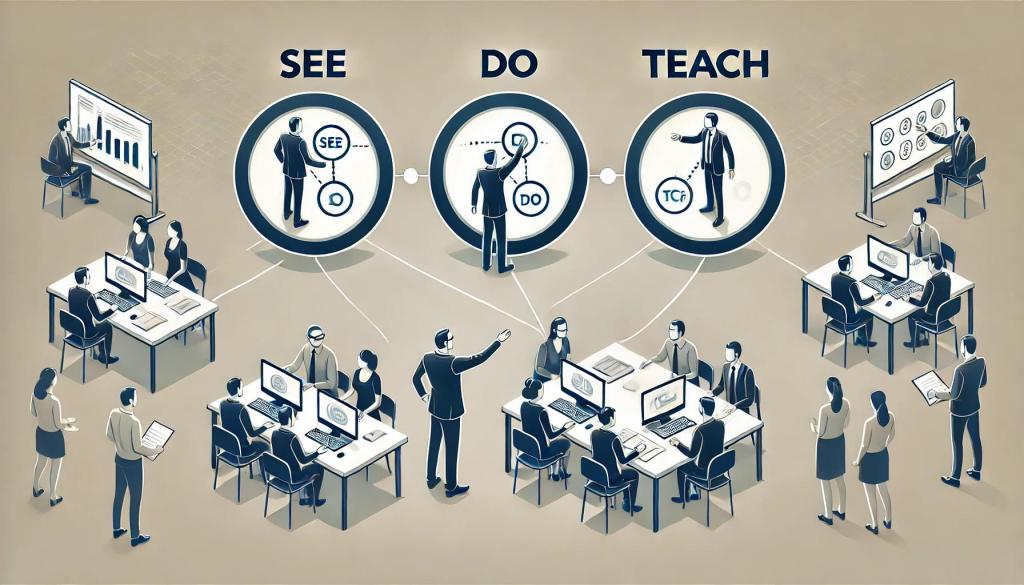
The See Do Teach method is a transformative approach to skill acquisition, team development, and leadership building. Rooted in experiential learning, it creates a dynamic cycle of observation, practice, and instruction that ensures not only the mastery of tasks but also the empowerment of individuals to become educators themselves. Here’s why it works so effectively and how it can be applied.
Why the See Do Teach Method Works
The See Do Teach method is built on the principle of active engagement, which is proven to improve retention and understanding. Each stage builds on the last, creating a progressive learning pathway that embeds skills deeply: 1. Observation Enhances Understanding: Seeing a task performed by an expert provides learners with a clear example of success, demystifying the process and showcasing best practices. 2. Practice Solidifies Skills: Doing the task immediately after observing allows learners to apply their newfound knowledge in a safe environment, with room for feedback and improvement. 3. Teaching Deepens Expertise: Explaining and demonstrating a skill to others reinforces the teacher’s mastery and ensures that knowledge is disseminated effectively across teams.
Breaking Down the Steps
Step 1: See
Observation is the foundation of the See Do Teach method. In this stage, learners watch a skilled individual perform a task, noting critical steps, techniques, and nuances.
Example: In order to train people inside the organization to become transformation managers, I worked with one of the big 4 strategic consultancies to show actual projects in the organization to our candidates.
Step 2: Do
After observing, learners move on to hands-on practice. Here, they replicate the task under guidance, applying what they’ve seen while gaining firsthand experience.
Example: After observing the expert consultants on one or two projects, the roles changed, with the internal teams executing the projects and the expert consultants reviewing and giving advice.
Step 3: Teach
The final stage involves teaching the newly learned skill to others. This step requires learners to organize their understanding and communicate it effectively, cementing their knowledge.
Example: After executing a couple of projects themselves, the internal teams became teachers to the next cohort of candidates (and the external consultants phased out) in their See-Do cycle.
The Flywheel Effect
The See Do Teach method operates as a flywheel—a self-reinforcing cycle that gains momentum over time. As learners become teachers, they perpetuate the process, creating a culture of continuous learning and growth. Over time, this approach not only spreads knowledge but also cultivates leadership qualities and drives organizational excellence.
Example in Practice: A company adopts the See Do Teach method to train employees on a new software system. Initially, a few experts demonstrate its usage (See). Next, these employees practice and refine their skills (Do). Finally, they teach the system to others (Teach). Within weeks, the organization’s proficiency with the software grows exponentially, reducing reliance on external trainers and fostering a collaborative learning environment.
Conclusion
The See Do Teach method is a simple yet profound approach to learning that combines observation, hands-on practice, and teaching. By embedding this cycle into your organization or personal development strategies, you can create a robust framework for skill acquisition, team growth, and leadership development. Over time, the method becomes a powerful flywheel, driving sustainable success and empowering individuals to achieve their full potential.




 Best of Digital Transformation