The human-side barriers to AI adoption — and how to overcome them
In my previous newsletter, “Where AI is Already Making a Significant Impact on Business Process Execution – 15 Areas Explained,” we explored how AI is streamlining tasks from claims processing to customer segmentation. But despite these breakthroughs, one question keeps surfacing:
If AI is delivering so much value… why are so many organizations struggling to actually adopt it?
The answer isn’t technical — it’s human.
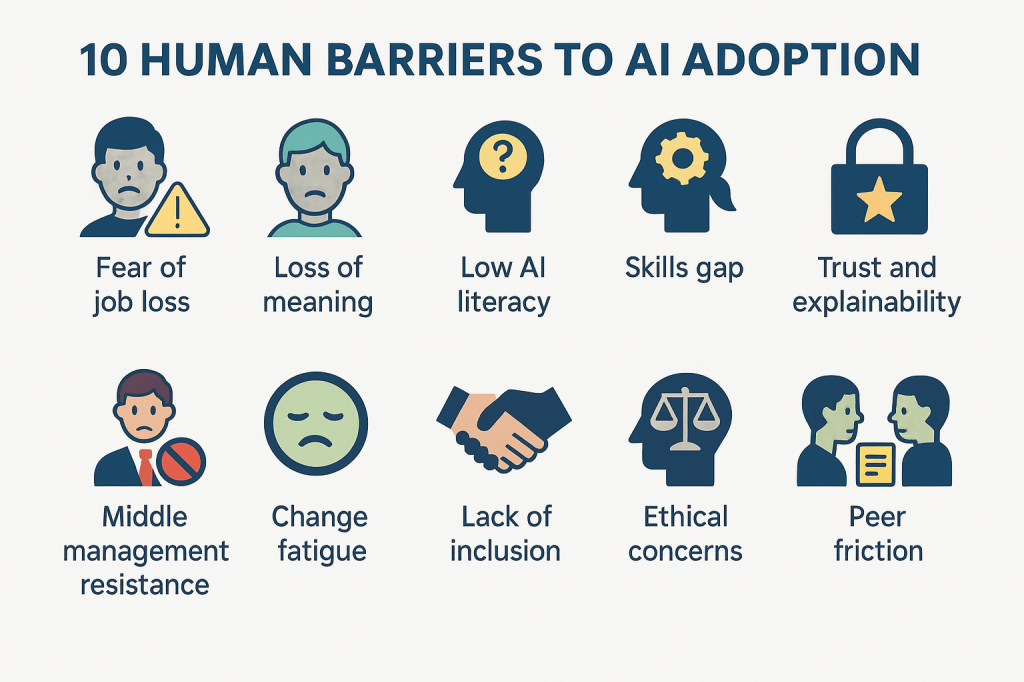
In this edition, I explore ten people-related reasons AI initiatives stall or underdeliver. Each barrier is followed by a practical example and suggestions for how to overcome it.
1. Fear of Job Loss and Role Redundancy
Employees fear AI will replace them, leading to resistance or disengagement. This is especially prevalent in operational roles and shared services.
Example: An EY survey found 75% of US workers worry about AI replacing their jobs. In several large organizations, process experts quietly slow-roll automation to protect their roles.
How to mitigate: Communicate early and often. Frame AI as augmentation, not replacement. Highlight opportunities for upskilling and create pathways for digitally enabled roles.
2. Loss of Meaning and Professional Identity
Even if employees accept AI won’t replace them, they may fear it will erode the craftsmanship and meaning of their work.
Example: In legal and editorial teams, professionals report reluctance to use generative AI tools because they feel it “cheapens” their contribution or downplays their expertise.
How to mitigate: Position AI as a creative partner, not a substitute. Focus on use cases that enhance quality and amplify human strengths.
3. Low AI Literacy and Confidence
Many knowledge workers don’t feel equipped to understand or apply AI tools. This leads to underutilization or misuse.
Example: I’ve seen this firsthand: employees hesitate to rely on AI tools and default to old ways of working out of discomfort or lack of clarity.
How to mitigate: Launch AI literacy programs tailored to roles. Give people space to experiment, and build a shared language for AI in the organization.
4. Skills Gap: Applying AI to Domain Work
Beyond literacy, many employees lack the applied skills needed to integrate AI into their actual workflows. They may know what AI can do — but not how to adapt it to their role.
Example: In a global supply chain function, team members were aware of AI’s capabilities but struggled to translate models into usable scenarios like demand sensing or inventory risk prediction.
How to mitigate: Invest in practical upskilling: scenario-based training, role-specific accelerators, and coaching. Empower cross-functional “AI translators” to bridge tech and business.
5. Trust and Explainability Concerns
Employees and managers hesitate to rely on AI if they don’t understand “how” it reached its output — especially in decision-making contexts.
Example: A global logistics firm paused the rollout of AI-based demand forecasting after regional leaders questioned unexplained fluctuations in output.
How to mitigate: Prioritize transparency for critical use cases. Use interpretable models where possible, and combine AI output with human judgment.
6. Middle Management Resistance
Mid-level managers may perceive AI as a threat to their control or relevance. They can become blockers, slowing momentum.
Example: In a consumer goods company, digital leaders struggled to scale AI pilots because local managers didn’t support or prioritize the initiatives.
How to mitigate: Involve middle managers in co-creation. Tie their success metrics to AI-enabled outcomes and make them champions of transformation.
7. Change Fatigue and Initiative Overload
Teams already dealing with hybrid work, restructurings, or system rollouts may see AI as just another corporate initiative on top of their daily work.
Example: A pharmaceutical company with multiple digital programs saw frontline disengagement with AI pilots due to burnout and lack of clear value.
How to mitigate: Embed AI within existing transformation goals. Focus on a few high-impact use cases, and consistently communicate their benefit to teams.
8. Lack of Inclusion in Design and Rollout
When AI tools are developed in technical silos, end users often feel the solutions don’t reflect their workflows or needs.
Example: A banking chatbot failed in deployment because call center staff hadn’t been involved in the design phase — leading to confusion and distrust.
How to mitigate: Involve users early and often. Use participatory design approaches and validate tools in real working environments.
9. Ethical Concerns and Mistrust
Some employees worry AI may reinforce bias, lack fairness, or be used inappropriately — especially in sensitive areas like HR, compliance, or performance assessment.
Example: An AI-based resume screener was withdrawn by a tech firm after internal concerns about gender and ethnicity bias, even before public rollout.
How to mitigate: Establish clear ethical guidelines for AI. Be transparent about data usage, and create safe channels for feedback and concerns.
10. Peer Friction: “They Let the AI Do Their Job”
Even when AI is used effectively, friction can arise when colleagues feel others are “outsourcing their thinking” or bypassing effort by relying on AI tools.
Example: In a shared services team, tension grew when some employees drafted client reports with AI in minutes — while others insisted on traditional methods, feeling their contributions were undervalued.
How to mitigate: Create shared norms around responsible AI use. Recognize outcomes, not effort alone, and encourage knowledge sharing across teams.
Final Thought: It’s Not the Tech — It’s the Trust
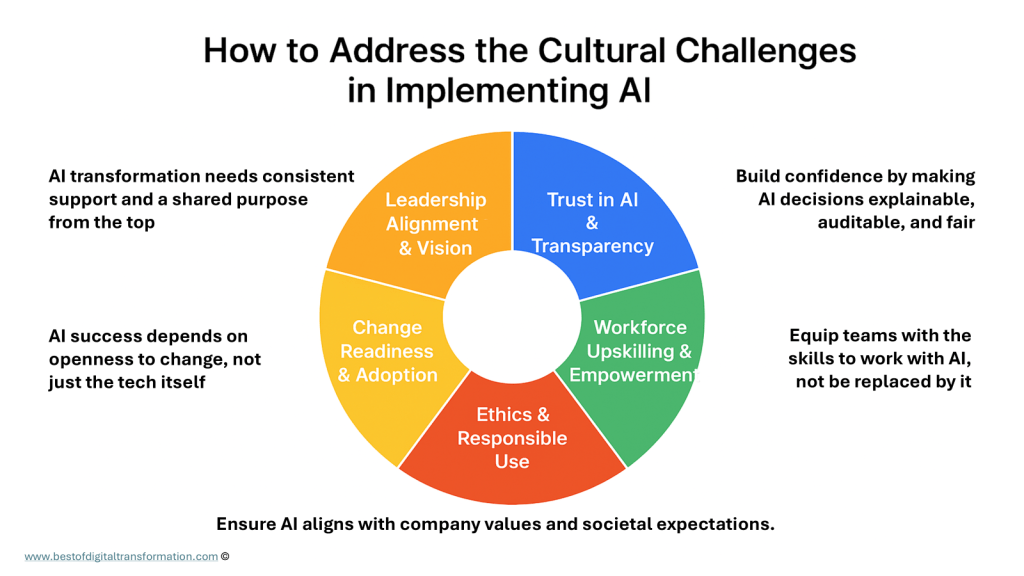
Successful AI adoption isn’t about algorithms or infrastructure — it’s about mindsets, motivation, and meaning.
If we want people to embrace AI, we must:
- Empower them with knowledge, skills, and confidence
- Engage them as co-creators in the journey
- Ensure they see personal and professional value in change
Human-centered adoption isn’t the soft side of transformation — it’s the hard edge of success. Let’s create our transformation plans with that in mind.










 Best of Digital Transformation