From AI-Enabled to AI-Centered – Reimagining How Enterprises Operate

Enterprises around the world are racing to deploy generative AI. Yet most remain stuck in the pilot trap; experimenting with copilots and narrow use cases while legacy operating models, data silos, and governance structures stay intact. The results are incremental: efficiency gains without strategic reinvention.

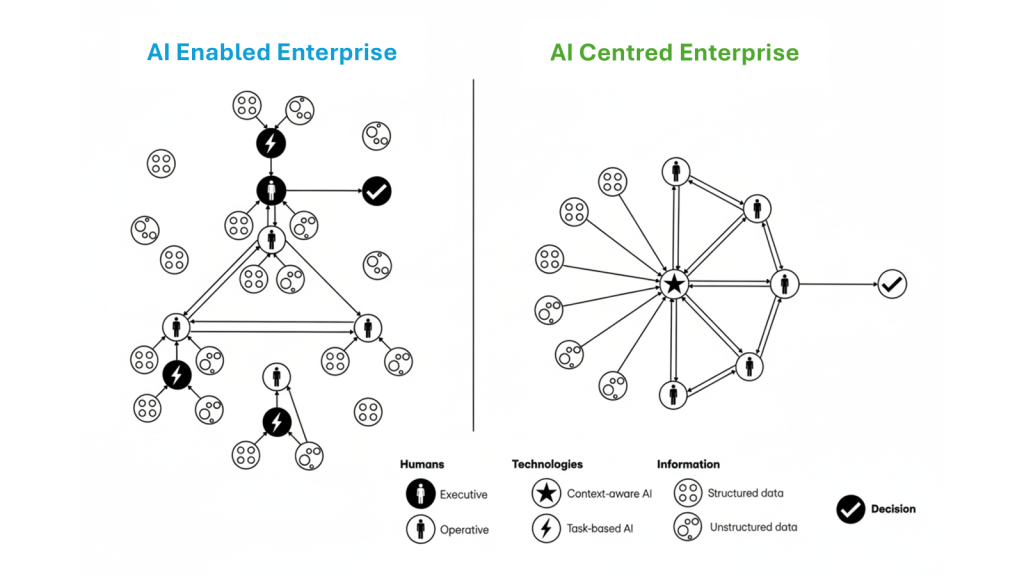
With the rapidly developing context aware AI we also can chart different course — making AI not an add-on, but the center of how the enterprise thinks, decides, and operates. This shift, captured powerfully in The AI-Centered Enterprise (ACE) by Ram Bala, Natarajan Balasubramanian, and Amit Joshi (IMD), signals the next evolution in business design: from AI-enabled to AI-centered.

The premise is bold. Instead of humans using AI tools to perform discrete tasks, the enterprise itself becomes an intelligent system, continuously sensing context, understanding intent, and orchestrating action through networks of people and AI agents. This is the next-generation operating model for the age of context-aware intelligence and it will separate tomorrow’s leaders from those merely experimenting today.


What an AI-Centered Enterprise Is

At its core, an AI-centered enterprise is built around Context-Aware AI (CAI), systems that understand not only content (what is being said) but also intent (why it is being said). These systems operate across three layers:

  • Interaction layer: where humans and AI collaborate through natural conversation, document exchange, or digital workflow.(ACE)
  • Execution layer: where tasks and processes are performed by autonomous or semi-autonomous agents.
  • Governance layer: where policies, accountability, and ethical guardrails are embedded into the AI fabric.

The book introduces the idea of the “unshackled enterprise” — one no longer bound by rigid hierarchies and manual coordination. Instead, work flows dynamically through AI-mediated interactions that connect needs with capabilities across the organization. The result is a company that can learn, decide, and act at digital speed — not by scaling headcount, but by scaling intelligence.

This is a profound departure from current “AI-enabled” organizations, which mostly deploy AI as assistants within traditional structures. In an AI-centered enterprise, AI becomes the organizing principle, the invisible infrastructure that drives how value is created, decisions are made, and work is executed.


How It Differs from Today’s Experiments

Today’s enterprise AI landscape is dominated by point pilots and embedded copilots: productivity boosters designed onto existing processes. They enhance efficiency but rarely transform the logic of value creation.

An AI-centered enterprise, by contrast, rebuilds the transaction system of the organization around intelligence. Key differences include:

  • From tools to infrastructure: AI doesn’t automate isolated tasks; it coordinates entire workflows; from matching expertise to demand, to ensuring compliance, to optimizing outcomes.
  • From structured data to unstructured cognition: Traditional analytics rely on structured databases. AI-centered systems start with unstructured information (emails, documents, chats) extracting relationships and meaning through knowledge graphs and retrieval-augmented reasoning.
  • From pilots to internal marketplaces: Instead of predefined processes, AI mediates dynamic marketplaces where supply and demand for skills, resources, and data meet in real time, guided by the enterprise’s goals and policies.

The result is a shift from human-managed bureaucracy to AI-coordinated agility. Decision speed increases, friction falls, and collaboration scales naturally across boundaries.


What It Takes: The Capability and Governance Stack

The authors of The AI-Centered Enterprise propose a pragmatic framework for this transformation, the 3Cs: Calibrate, Clarify, and Channelize.

  1. Calibrate – Understand the types of AI your business requires. What decisions depend on structured vs. unstructured data? What precision or control is needed? This step ensures technology choices fit business context.
  2. Clarify – Map your value creation network: where do decisions happen, and how could context-aware intelligence change them? This phase surfaces where AI can augment, automate, or orchestrate work for tangible impact.
  3. Channelize – Move from experimentation to scaled execution. Build a repeatable path for deployment, governance, and continuous improvement. Focus on high-readiness, high-impact areas first to build credibility and momentum.

Underneath the 3Cs lies a capability stack that blends data engineering, knowledge representation, model orchestration, and responsible governance.

  • Context capture: unify data, documents, and interactions into a living knowledge graph.
  • Agentic orchestration: deploy systems of task, dialogue, and decision agents that coordinate across domains.
  • Policy and observability: embed transparency, traceability, and human oversight into every layer.

Organizationally, the AI-centered journey requires anchored agility — a balance between central guardrails (architecture, ethics, security) and federated innovation (business-owned use cases). As with digital transformations before it, success depends as much on leadership and learning as on technology.


Comparative Perspectives — and Where the Field Is Heading

The ideas in The AI-Centered Enterprise align with a broader shift seen across leading research and consulting work, a convergence toward AI as the enterprise operating system.

McKinsey: The Rise of the Agentic Organization

McKinsey describes the next evolution as the agentic enterprise; organizations where humans work alongside fleets of intelligent agents embedded throughout workflows. Early adopters are already redesigning decision rights, funding models, and incentives to harness this new form of distributed intelligence.
Their State of AI 2025 shows that firms capturing the most value have moved beyond pilots to process rewiring and AI governance, embedding AI directly into operations, not as a service layer.

BCG: From Pilots to “Future-Built” Firms

BCG’s 2025 research (Sep 2025) finds that only about 5% of companies currently realize sustainable AI value at scale. Those that do are “future-built”, treating AI as a capability, not a project. These leaders productize internal platforms, reuse components across business lines, and dedicate investment to AI agents, which BCG estimates already generate 17% of enterprise AI value, projected to reach nearly 30% by 2028.
This mirrors the book’s view of context-aware intelligence and marketplaces as the next sources of competitive advantage.

Harvard Business Review: Strategy and Human-AI Collaboration

HBR provides the strategic frame. In Competing in the Age of AI, Iansiti and Lakhani show how AI removes the traditional constraints of scale, scope, and learning, allowing organizations to grow exponentially without structural drag. Wilson and Daugherty’s Collaborative Intelligence adds the human dimension, redefining roles so that humans shift from operators to orchestrators of intelligent systems.

Convergence – A New Operating System for the Enterprise

Across these perspectives, the trajectory is clear:

  • AI is moving from tools to coordination system capabilities.
  • Work will increasingly flow through context-aware agents that understand intent and execute autonomously.
  • Leadership attention is shifting from proof-of-concept to operating-model redesign: governance, role architecture, and capability building.
  • The competitive gap will widen between firms that use AI to automate tasks and those that rebuild the logic of their enterprise around intelligence.

In short, the AI-centered enterprise is not a future vision — it is the direction of travel for every organization serious about reinvention in the next five years.


The AI-Centered Enterprise – A Refined Summary

The AI-Centered Enterprise (Bala, Balasubramanian & Joshi, 2025) offers one of the clearest playbooks yet for this new organisational architecture. The authors begin by defining the limitations of today’s AI adoption — fragmented pilots, structured-data basis, and an overreliance on human intermediaries to bridge data, systems, and decisions.

They introduce Context-Aware AI (CAI) as the breakthrough: AI that understands not just information but the intent and context behind it, enabling meaning to flow seamlessly across functions. CAI underpins an “unshackled enterprise,” where collaboration, decision-making, and execution happen fluidly across digital boundaries.

The book outlines three core principles:

  1. Perceive context: Use knowledge graphs and natural language understanding to derive meaning from unstructured information — the true foundation of enterprise knowledge.
  2. Act with intent: Deploy AI agents that can interpret business objectives, not just execute instructions.
  3. Continuously calibrate: Maintain a human-in-the-loop approach to governance, ensuring AI decisions stay aligned with strategy and ethics.

Implementation follows the 3C framework — Calibrate, Clarify, Channelize — enabling leaders to progress from experimentation to embedded capability.

The authors conclude that the real frontier of AI is not smarter tools but smarter enterprises; organizations designed to sense, reason, and act as coherent systems of intelligence.


Closing Reflection

For executives navigating transformation, The AI-Centered Enterprise reframes the challenge. The question is no longer how to deploy AI efficiently, but how to redesign the enterprise so intelligence becomes its organizing logic.

Those who start now, building context-aware foundations, adopting agentic operating models, and redefining how humans and machines collaborate, will not just harness AI. They will become AI-centered enterprises: adaptive, scalable, and truly intelligent by design.
GAINing Clarity – Demystifying and Implementing GenAI

Herewith my final summer reading book review as part of my newsletter series.
GAIN – Demystifying GenAI for Office and Home by Michael Wade and Amit Joshi offers clarity in a world filled with AI hype. Written by two respected IMD professors, this book is an accessible, structured, and balanced guide to Generative AI (GenAI), designed for a broad audience—executives, professionals, and curious individuals alike.

What makes GAIN especially valuable for leaders is its practical approach. It focuses on GenAI’s real-world relevance: what it is, what it can do, where it can go wrong, and how individuals and organizations can integrate it effectively into daily workflows and long-term strategies.

What’s especially nice is that Michael and Amit have invited several other thought and business leaders to contribute their perspectives and examples to the framework provided. (I especially liked the contribution of Didier Bonnet.)

The GAIN Framework

The book is structured into eight chapters, each forming a step in a logical journey—from understanding GenAI to preparing for its future impact. Below is a summary of each chapter’s key concepts.


Chapter 1 – EXPLAIN: What Makes GenAI Different

This chapter distinguishes GenAI from earlier AI and digital innovations. It highlights GenAI’s ability to generate original content, respond to natural-language prompts, and adapt across tasks with minimal input. Key concepts include zero-shot learning, democratized content creation, and rapid adoption. The authors stress that misunderstanding GenAI’s unique characteristics can undermine effective leadership and strategy.


Chapter 2 – OBTAIN: Unlocking GenAI Value

Wade and Joshi explore how GenAI delivers value at individual, organizational, and societal levels. It’s accessible and doesn’t require deep technical expertise to drive impact. The chapter emphasizes GenAI’s role in boosting productivity, enhancing creativity, and aiding decision-making—especially in domains like marketing, HR, and education—framing it as a powerful augmentation tool.


Chapter 3 – DERAIL: Navigating GenAI’s Risks

This chapter outlines key GenAI risks: hallucinations, privacy breaches, IP misuse, and embedded bias. The authors warn that GenAI systems are inherently probabilistic, and that outputs must be questioned and validated. They introduce the concept of “failure by design,” reminding readers that creativity and unpredictability often go hand in hand.


Chapter 4 – PREVAIL: Creating a Responsible AI Environment

Here, the focus turns to managing risks through responsible use. The authors advocate for transparency, human oversight, and well-structured usage policies. By embedding ethics and review mechanisms into workflows, organizations can scale GenAI while minimizing harm. Ultimately, it’s how GenAI is used—not just the tech itself—that defines its impact.


Chapter 5 – ATTAIN: Scaling with Anchored Agility

This chapter presents “anchored agility” as a strategy to scale GenAI responsibly. It encourages experimentation, but within a framework of clear KPIs and light-touch governance. The authors promote an adaptive, cross-functional approach where teams are empowered, and successful pilots evolve into embedded capabilities.

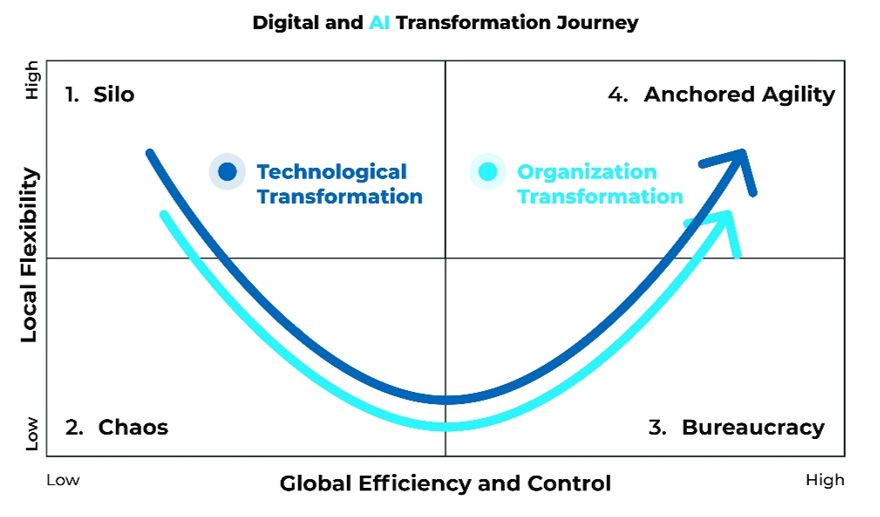
One of the most actionable frameworks in GAIN is the Digital and AI Transformation Journey, which outlines how organizations typically mature in their use of GenAI:

  • Silo – Individual experimentation, no shared visibility or coordination.
  • Chaos – Widespread, unregulated use. High potential but rising risk.
  • Bureaucracy – Management clamps down. Risk is reduced, but innovation stalls.
  • Anchored Agility – The desired state: innovation at scale, supported by light governance, shared learning, and role clarity.

This model is especially relevant for transformation leaders. It mirrors the organizational reality many face—not only with AI, but with broader digital initiatives. It gives leaders a language to assess their current state and a vision for where to evolve.


Chapter 6 – CONTAIN: Designing for Trust and Capability

Focusing on organizational readiness, this chapter explores structures like AI boards and CoEs. It also addresses workforce trust, re-skilling, and role evolution. Rather than replacing jobs, GenAI changes how work gets done—requiring new hybrid roles and cultural adaptation. Containment is about enabling growth, not restricting it.


Chapter 7 – MAINTAIN: Ensuring Adaptability Over Time

GenAI adoption is not static. This chapter emphasizes the need for feedback loops, continuous learning, and responsive processes. Maintenance involves both technical tasks—like tuning models—and organizational updates to governance and team roles. The authors frame GenAI maturity as an ongoing journey.


Chapter 8 – AWAIT: Preparing for the Future

The book closes with a pragmatic look ahead. It touches on near-term shifts like emerging GenAI roles, evolving regulations, and tool commoditization. Rather than speculate, the authors urge leaders to stay informed and ready to adapt, fostering a mindset of proactive anticipation.posture of informed anticipation: not reactive panic, but intentional readiness. As the GenAI field evolves, so must its players.


What GAIN Teaches Us About Digital Transformation

Beyond the specifics of GenAI, GAIN offers broader lessons that are directly applicable to digital transformation initiatives:

  • Start with shared understanding. Whether you’re launching a transformation program or exploring AI pilots, alignment starts with clarity.
  • Balance risk with opportunity. The GAIN framework models a mature transformation mindset—one that embraces experimentation while putting safeguards in place.
  • Transformation is everyone’s job. GenAI success is not limited to IT or data teams. From HR to marketing to the executive suite, value creation is cross-functional.
  • Governance must be adaptive. Rather than rigid control structures, “anchored agility” provides a model for iterative scaling—one that balances speed with oversight.
  • Keep learning. Like any transformation journey, GenAI is not linear. Feedback loops, upskilling, and cultural evolution are essential to sustaining momentum.

In short, GAIN helps us navigate the now, while preparing for what’s next. For leaders navigating digital and AI transformation, it’s a practical compass in a noisy, fast-moving world.

Amplifying the Human Advantage over AI – Lessons from Pascal Bornet’s Irreplaceable

For this holiday season I had, Pascal Bornet’s book Irreplaceable: The Art of Standing Out in the Age of Artificial Intelligence on top of my reading list. His work delivers a clear and timely message: the more digital the world becomes, the more essential our humanity is.

For executives and transformation leaders navigating the impact of AI, Bornet provides a pragmatic and optimistic blueprint. This article summarizes the core insights of Irreplaceable, explores its implications for digital transformation, and offers a practical lens for application (Insights).


AI as Enabler, Not Replacer

Bornet challenges the zero-sum narrative of “AI vs. Humans.” Instead, he positions AI as an enabler: capable of handling repetitive, structured tasks, it liberates humans to focus on what machines can’t do—leading, empathizing, creating, and judging. AI, in this view, is not the destination but the vehicle to a more human future.

Insight: Use AI to augment human roles—especially in decision-making, customer experience, and creative problem-solving—rather than replacing them.


The “Humics”: Redefining the Human Advantage

At the heart of Irreplaceable lies the concept of Humics: the uniquely human capabilities that define our irreducibility in an AI-powered world. Bornet identifies several:

  • Genuine Creativity – The capacity to generate novel ideas and innovations by drawing on intuition, imagination, and deeply personal lived experiences that machines cannot emulate.
  • Critical Thinking – The ability to evaluate information critically, reason ethically, and make contextualized decisions that reflect both logic and values.
  • Emotional Intelligence – A complex combination of self-awareness, empathy, and the ability to manage interpersonal relationships and influence with authenticity.
  • Adaptability & Resilience – The readiness to embrace change, learn continuously, and maintain performance under stress and uncertainty.
  • Social Authenticity – The human ability to create trust and meaning in relationships through transparency, shared values, and emotional connection.

Insight: Elevate Humics from soft skills to strategic assets. Build them into hiring, training, and leadership development.


The IRREPLACEABLE Framework: Three Competencies for the Future

Bornet proposes a universal framework built on three future-facing competencies:

  • AI-Ready: Develop the ability to understand and leverage AI technologies by becoming fluent in their capabilities, applications, and ethical boundaries. This involves not just using AI tools, but knowing when and how to apply them effectively.
  • Human-Ready: Focus on strengthening Humics—the inherently human skills like empathy, critical thinking, and creativity—that make people indispensable in roles where AI falls short.
  • Change-Ready: Build resilience and adaptability by fostering a growth mindset, embracing continuous learning, and staying flexible in the face of constant technological and organizational change.

Insight: These competencies should be embedded into your workforce strategies, talent models, and cultural transformation agenda.


Human-AI Synergy: The New Collaboration Model

Bornet advocates for symbiotic teams where AI and humans complement each other. Rather than compete, the two work in tandem to drive better outcomes.

  • AI delivers scale, speed, and precision.
  • Humans provide context, ethics, judgment, and empathy.

Insight: Use this pairing in high-impact roles like diagnostics, content creation, customer service, and product design.


Avoiding “AI Obesity”: The Risk of Over-Automation

Bornet warns against AI Obesity: a condition where organizations over-rely on AI, leading people to lose touch with essential human skills like critical thinking, empathy, and creativity. The solution? Regularly exercise our Humics and ensure humans remain in the loop, especially where oversight, ethics, or trust are required.

Insight: Define clear roles for human oversight, especially in ethical decisions, people management and policy enforcement.


Real-World Application: Individuals, Parents, and Businesses

Bornet offers tailored strategies for:

  • Individuals: Blend digital fluency with human depth to future-proof your career. Learn how to partner with AI tools to enhance your strengths, stay adaptable, and lead with human judgment in an increasingly automated environment.
  • Parents & Educators: Teach kids curiosity, resilience, and emotional intelligence alongside digital skills. Equip the next generation not only to use technology responsibly but also to cultivate the uniquely human traits that will help them thrive in any future scenario.
  • Businesses: Redesign roles and culture to embed AI-human collaboration, with trust and values at the core. Shift from a purely efficiency-driven mindset to one that sees AI as a co-pilot, empowering employees to do more meaningful, value-adding work.

Note: This is not just about new tools; it’s about new mindsets and behaviors across the organization.


Implications for Digital Transformation Leaders

Irreplaceable aligns seamlessly with modern transformation priorities:

  • Technology as Amplifier: Deploy AI to expand human capabilities, not to replace them.
  • Human-Centric KPIs: Add creativity, employee experience, and trust metrics to your dashboards.
  • Purpose-Driven Change: Frame digital transformation as an opportunity to become more human, not less.

How to Apply This in Practice

Start with a diagnostic: Where is human judgment undervalued in your current operating model? Then:

  1. Redesign roles with AI + Human pairings
  2. Invest in Humics through people development and learning journeys
  3. Update metrics to track human and AI impact
  4. Communicate the purpose: Align AI initiatives with a human-centered narrative

Conclusion

Pascal Bornet’s Irreplaceable offers more than optimism. It provides a strategic lens to ensure your organization thrives in the AI age—by amplifying what makes us human. For digital and transformation leaders, the message is clear: being more human is your greatest competitive advantage.

For more information you can check out: Become IRREPLACEABLE and unlock your true potential in the age of AI

How AI Changes the Digital Transformation Playbook

I recently revisited David L. Rogers’ 2016 book, The Digital Transformation Playbook. This work was foundational in how I approached digital strategy in the years that followed. It helped executives move beyond viewing digital as a technology problem and instead rethink strategy for a digital enabled business. As I now reflect on the accelerating impact of artificial intelligence—especially generative and adaptive AI—I found myself asking: how would this playbook evolve if it were written today? What shifts, additions, or reinterpretations does AI demand of us?

Rogers identified five strategic domains where digital forces reshaped the rules of business: customers, competition, data, innovation, and value. These domains remain as relevant as ever—but in the age of AI, each requires a fresh lens.

In this article, I revisit each domain, beginning with Rogers’ foundational insight and then exploring how AI transforms the picture. I also propose three new strategic domains that have become essential in the AI era: workforce, governance, and culture.


1. Customers → From Networks of Relationships to Intelligent Experiences

Rogers’ Insight (2016):
In the traditional business model, customers were treated as passive recipients of value. Rogers urged companies to reconceive customers as active participants in networks—communicating, sharing, and shaping brand perceptions in real-time. The shift was toward engaging these dynamic networks, understanding behavior through data, and co-creating value through dialogue, platforms, and personalization.

AI Shift (Now):
AI enables companies to move beyond personalized communication to truly intelligent experiences. By analyzing vast datasets in real-time, AI systems can predict needs, automate responses, and tailor interactions across channels. From recommendation engines to digital agents, AI transforms customer experience into something anticipatory and adaptive—redefining engagement, loyalty, and satisfaction.


2. Competition → From Industry Ecosystems to Model-Driven Advantage

Rogers’ Insight (2016):
Rogers challenged the notion of fixed industry boundaries, arguing that digital platforms enable competition across sectors. Businesses could no longer assume their competitors would come from within their own industry. Instead, value was increasingly co-created in fluid ecosystems involving customers, partners, and even competitors.

AI Shift (Now):
Today, the competitive battlefield is increasingly defined by AI capabilities. Winning organizations are those that can develop, fine-tune, and scale AI models faster than others. Competitive advantage comes from proprietary data, high-performing models, and AI-native organizational structures. In some cases, the model itself becomes the product—shifting power to those who own or control AI infrastructure.


3. Data → From Strategic Asset to Lifeblood of Intelligent Systems

Rogers’ Insight (2016):
Data, once a by-product of operations, was reimagined as a core strategic asset. Rogers emphasized using data to understand customers, inform decisions, and drive innovation. The shift was toward capturing more data and applying analytics to create actionable insights and competitive advantage.

AI Shift (Now):
AI transforms the role of data from decision-support to system training. Data doesn’t just inform—it powers intelligent behavior. The focus is now on quality, governance, and real-time flows of data that continuously refine AI systems. New challenges around data bias, provenance, and synthetic generation raise the stakes for ethical and secure data management.


4. Innovation → From Agile Prototyping to AI-Augmented Co-Creation

Rogers’ Insight (2016):
Rogers advocated for agile, iterative approaches to innovation. Instead of long development cycles, companies needed to embrace experimentation, MVPs, and customer feedback loops. Innovation was not just about new products—it was about learning fast and adapting to change.

AI Shift (Now):
AI amplifies every step of the innovation process. Generative tools accelerate ideation, design, and prototyping. Developers and designers can co-create with AI, testing multiple solutions instantly. The loop from idea to execution becomes compressed, with AI as a creative collaborator, not just a tool.


5. Value → From Digital Delivery to Adaptive Intelligence

Rogers’ Insight (2016):
Value creation, in Rogers’ view, moved from static supply chains to fluid, digital experiences. Companies needed to rethink how they delivered outcomes—shifting from products to services, from ownership to access, and from linear value chains to responsive platforms.

AI Shift (Now):
With AI, value is increasingly delivered through systems that learn and adapt. Intelligent services personalize in real time, optimize continuously, and evolve with user behavior. The value proposition becomes dynamic—embedded in a loop of sensing, reasoning, and responding.


Why We Must Expand the Playbook: The Rise of New Strategic Domains

The original five domains remain vital. Yet AI doesn’t just shift existing strategies—it introduces entirely new imperatives. As intelligent systems become embedded in workflows and decisions, organizations must rethink how they manage talent, ensure ethical oversight, and shape organizational culture. These aren’t adjacent topics—they are central to sustainable AI transformation.


6. Workforce → From Talent Strategy to Human–AI Teaming

AI is not replacing the workforce—it is changing it. Leaders must redesign roles, workflows, and capabilities to optimize human–AI collaboration. This means upskilling for adaptability, integrating AI into daily work, and ensuring people retain agency in AI-supported decisions. Human capital strategy must now include how teams and algorithms learn and perform together.


7. Governance → From Digital Risk to Responsible AI

AI introduces new dimensions of risk: bias, security, and regulatory complexity. Governance must now ensure not only compliance but also ethical development, explainability, and trust. Boards, executive teams, and product leaders need frameworks to evaluate and oversee AI initiatives—not just for effectiveness but for responsibility.


8. Culture → From Digital Fluency to AI Curiosity and Trust

The mindset shift required to scale AI is cultural as much as technological. Organizations must foster curiosity about what AI can do, confidence in its potential, and clarity about its limits. Trust becomes a cultural asset—built through transparency, education, and inclusive experimentation. Without it, AI adoption stalls.


Conclusion: A Playbook for the AI Era

Rogers’ original playbook gave us a framework to reimagine business strategy in a digital world. That foundation still holds. But as AI redefines how we compete, create, and lead, we need a new version—one that not only shifts the lens on customers, competition, data, innovation, and value, but also adds the critical dimensions of workforce, governance, and culture. These eight domains form the new playbook for transformation in the age of intelligence.

Genesis – Artificial Intelligence, Hope, and the Human Spirit

In Genesis, three titans from the worlds of diplomacy, technology, and innovation—Henry A. Kissinger, Eric Schmidt, and Craig Mundie—collaborate to offer a sweeping, contemplative exploration of artificial intelligence and its far-reaching implications.

What stands out immediately is how clearly the book captures this moment as a historic inflection point: a time when AI is poised to profoundly reshape society, governance, and what it means to be human. It balances an articulate exploration of opportunities—from accelerating innovation to solving global challenges—with a candid warning about the threats and disruptions AI could bring. Most powerfully, it forces us to reflect on the implications for humanity itself: our role, our agency, and our responsibility in shaping the trajectory of intelligent machines.

An Inflection Point in Human History

The central thesis of Genesis is that we stand at a defining juncture. Like the printing press or nuclear technology, AI introduces a new form of intelligence—one that challenges our existing institutions, ethical frameworks, and even our concept of reason.

AI’s ability to generate insights, patterns, and autonomous decisions has already begun to outpace human comprehension. The authors argue that this creates a new epistemology—an AI-driven way of “knowing” that may diverge significantly from human logic. And unlike past technologies, AI does not merely extend our abilities—it begins to redefine them.

Hope and Possibility

The authors make it clear that AI is not inherently a threat. In fact, they devote significant attention to its constructive potential. AI can enhance decision-making, speed up scientific discovery, optimize infrastructure, and help address systemic global issues like climate change and healthcare access.

At its best, AI can serve as a partner to human intelligence, extending the boundaries of creativity and solving problems that previously seemed intractable. The authors envision AI systems that support rather than replace human reasoning—providing tools to elevate, not diminish, the human spirit.

The Ethical and Existential Challenge

Yet, the transformative potential of AI brings existential questions into sharp focus:

  • What happens when AI makes decisions its creators cannot fully explain?
  • How do we preserve human values in systems that learn from data, not ethics?
  • Can AI uphold human dignity—or will it simply optimize for utility?

Kissinger, Schmidt, and Mundie stress the moral responsibility that comes with creating such powerful tools. The systems we build will increasingly influence not only productivity and security, but human identity and freedom. If not guided by clear ethics, AI could prioritize efficiency over empathy, precision over justice, and control over autonomy.

AI and the Transformation of Knowledge

One of the most insightful contributions of the book is its examination of how AI changes the nature of knowledge. Traditionally, knowledge has been built on human reasoning—observation, logic, debate, and reflection. AI, however, learns through statistical association, surfacing patterns and solutions that may be correct but unexplainable.

This shift has enormous implications. If humans increasingly accept AI-generated outputs without understanding them, we risk ceding authority to systems we cannot interrogate or hold accountable. Kissinger in particular warns of the long-term consequences for democratic governance, education, and scientific integrity.

Geopolitical Power and Global Governance

The geopolitical implications of AI are far-reaching. Schmidt and Mundie describe how AI development is currently concentrated in a small group of corporations and nations, creating a technological asymmetry that could rival or surpass those of the industrial and nuclear eras.

Without global cooperation and shared governance principles, AI could be weaponized—not just in military contexts, but through surveillance, manipulation, and digital authoritarianism. The authors urge policymakers to approach AI with the same strategic foresight that defined arms control during the Cold War.

Coexistence: Humans and AI as Partners

At the heart of Genesis is the idea of coexistence. The authors do not suggest halting AI development—but rather, ensuring that humans remain central to its evolution. We must design systems that align with human values and develop the emotional, ethical, and strategic capacities to work alongside them.

This also requires a transformation in education and leadership. Future leaders will need to pair technical literacy with philosophical depth—understanding not just how AI works, but how it fits within a broader human context.

A Call to Action for Leaders

For senior executives and transformation leaders, Genesis offers both insight and urgency. The authors call on decision-makers to:

  • Understand the transformational nature of AI and its long-term strategic implications.
  • Champion cross-disciplinary approaches, combining technology, ethics, and governance.
  • Cultivate AI literacy within their organizations to promote informed adoption and responsible innovation.
  • Advocate for global cooperation, recognizing that competitive advantage must be balanced with collective safety.

Conclusion

Genesis is not a technical manual—it’s a meditation on the choices that will shape our future. It challenges us to move beyond surface-level conversations about automation or productivity and to engage deeply with what AI means for human dignity, identity, and progress.

The authors leave us with a message that resonates long after the final page: the future of AI is not predetermined. It will be defined by the values, courage, and vision of those who lead today.

As we stand on the threshold of an AI-driven era, Genesis urges us not only to ask what AI can do—but to reflect on what we, as humans, ought to do.

Book Review: Digital Transformation – Survive and Thrive in an Era of Mass Extinction

Although already published in 2019 (more than 5 years ago), this book points several concepts still very relevant in the fast changing world of Digital Transformation. Below a summary of these concepts and recommended actions

In Digital Transformation, technology visionary Thomas Siebel offers a compelling and pragmatic guide for business leaders confronting the rapidly converging forces of cloud computing, big data, artificial intelligence (AI), and the Internet of Things (IoT). These technologies are creating an extinction-level event for legacy business models. Siebel contends that digital transformation is not optional—it is a matter of survival.

Drawing on his experience as founder of C3.ai, Siebel presents a clear strategic playbook and numerous real-world examples that demonstrate how companies across sectors can reinvent themselves using digital technologies. His message is direct: act now, or risk irrelevance.


Key Concepts

1. The Four Technology Pillars

  • Cloud Computing – On-demand computing infrastructure enabling scalability and speed
  • Big Data – Massive, diverse datasets that can be analyzed in real-time
  • Artificial Intelligence (AI) – Predictive, adaptive algorithms that learn from data
  • Internet of Things (IoT) – Billions of connected devices generating actionable data

2. A Mass Extinction Event for Legacy Businesses

  • Over half of Fortune 500 companies have disappeared since 2000
  • Disruption is hitting all industries—not just tech
  • Traditional business models are no longer sustainable

3. Digital Transformation Is a Strategic Reinvention

  • Not about marginal gains—requires full-scale operating model redesign
  • Core focus on operational efficiency, customer experience, and new value creation

4. Data as the Foundation for AI

  • Success with AI requires clean, integrated, and governed enterprise data
  • Enterprises must break down data silos and standardize architecture

5. Speed and Scale as Differentiators

  • Companies must move fast, think big, and deliver value quickly
  • Long, drawn-out transformations are no longer viable

6. Real-World Case Studies

  • Enel – Predictive maintenance across its global energy grid
  • Royal Dutch Shell – AI for well safety, energy trading, and asset optimization
  • U.S. Department of Defense – AI and IoT for battlefield awareness

Implementation Recommendations

1. Modernize Your Tech Stack

  • Shift from legacy systems to modern, elastic cloud infrastructure

2. Centralize and Unify Data

  • Build a data integration layer across all business units
  • Ensure governance and real-time accessibility

3. Deploy High-Value AI Use Cases First

  • Focus on predictive maintenance, customer churn, fraud detection, etc.

4. Adopt Agile and DevOps at Scale

  • Encourage continuous delivery and rapid iterations

5. Re-skill and Upskill the Workforce

  • Provide training in AI, data science, and cloud technologies

6. Build a Cross-Functional Operating Model

  • Blend business, IT, and data science in unified delivery teams

7. Create a Transformation Office

  • Establish a dedicated team with budget, authority, and board-level visibility

Siebel’s 10-Point CEO Action Plan

  1. Declare Digital Transformation a Strategic Priority
  2. Establish a Digital Transformation Office (DTO)
  3. Unify Enterprise Data Architecture
  4. Identify High-Impact Use Cases
  5. Deploy Agile Methodologies
  6. Form Cross-Functional Teams
  7. Invest in AI and IoT Capabilities
  8. Lead Cultural Change from the Top
  9. Develop Digital Talent and Skills
  10. Track Progress and Iterate Continuously

Final Thoughts

Digital Transformation by Thomas Siebel is a must-read for executives seeking to lead their organizations through an era of exponential change. The convergence of cloud, big data, AI, and IoT isn’t just a tech revolution—it’s a business survival imperative. With practical insights, a strong strategic framework, and a CEO-focused action plan, this book is a blueprint for industrial-scale reinvention.

Highly recommended for leaders ready to move from intention to impact.

Competing in the Age of AI

Although Competing in the Age of AI: Strategy and Leadership When Algorithms and Networks Run the World by Marco Iansiti and Karim Lakhani was published in 2021—and much has happened since, including the launch of ChatGPT—it remains highly relevant. It provides valuable insights into why companies that control digital networks are capturing more and more business value.

Unlike traditional firms that rely on human-driven processes, AI-driven organizations leverage algorithms and digital networks to deliver unprecedented efficiency, scalability, and innovation. Companies such as Amazon, Ant Financial, and Google have shown how AI-powered models can create new markets, redefine value chains, and leave legacy competitors struggling to catch up.

For executives and transformation leaders, the challenge is clear: how can traditional organizations adapt to this new era? How can they integrate AI into their operations to drive agility, innovation, and sustainable competitive advantage? This summary breaks down the book’s key insights chapter by chapter, supplemented with real-world examples and strategic takeaways.


Chapter 1: AI-Centric Organizations – A New Operating Paradigm

Key Takeaways:

  • AI-driven firms operate fundamentally differently from traditional businesses, removing the need for human-driven decision-making at scale.
  • These companies leverage digital networks and algorithms to scale without being constrained by physical assets or labor.
  • AI enables firms to create more agile and adaptive business models, continuously refining their offerings through real-time learning.

Example: Ant Financial

Ant Financial, a subsidiary of Alibaba, transformed the financial services industry by using AI to assess credit risk, detect fraud, and approve loans within seconds—without human intervention. Unlike traditional banks, which rely on manual underwriting processes, Ant Financial’s AI-powered approach allows it to serve millions of customers instantly, with a near-zero marginal cost per transaction.


Chapter 2: AI-Driven Scale, Scope, and Learning – Breaking Traditional Constraints

Key Takeaways:

  • AI allows organizations to scale without the traditional constraints of labor and physical assets.
  • AI-driven companies can expand into adjacent industries more easily than traditional firms.
  • Machine learning continuously improves business models, creating a competitive advantage that compounds over time.

Example: Netflix’s AI-Powered Content Strategy

Netflix uses AI to optimize content recommendations, predict demand for original shows, and personalize the user experience. Unlike traditional media companies that rely on executives to decide what content to produce, Netflix’s AI-driven strategy allows it to maximize engagement, reduce churn, and improve content investments.


Chapter 3: AI and the Transformation of Operating Models

Key Takeaways:

  • AI-driven companies automate decision-making, making operations more efficient and responsive.
  • Traditional processes that rely on human judgment are replaced by real-time algorithmic decision-making.
  • AI-powered platforms connect suppliers, consumers, and partners more efficiently than traditional business models.

Example: Amazon’s AI-Powered Logistics

Amazon’s fulfillment centers use AI-driven robotics and predictive analytics to optimize inventory, reduce shipping times, and anticipate customer demand. This allows Amazon to deliver millions of packages per day with unmatched efficiency compared to traditional retailers.


Chapter 4: Rewiring the Value Chain with AI

Key Takeaways:

  • AI disrupts traditional value chains by enabling direct-to-consumer and on-demand business models.
  • AI enables firms to optimize supply chains, reduce waste, and improve efficiency.
  • Traditional firms struggle to adapt because of legacy processes and siloed data.

Example: Tesla’s AI-Driven Manufacturing

Tesla reimagined the automotive value chain by integrating AI into manufacturing, autonomous driving, and direct-to-consumer sales. Unlike legacy automakers, Tesla collects real-time data from vehicles, allowing it to improve its autonomous driving algorithms and enhance product performance over time.


Chapter 5: The Strategic Challenges of AI-First Companies

Key Takeaways:

  • AI-first companies create network effects, making them difficult to compete with once they achieve scale.
  • Traditional companies must choose whether to compete, collaborate, or transform their models.
  • Ethical issues such as bias, data privacy, and regulatory challenges must be addressed.

Example: Facebook’s AI and Ethical Challenges

Facebook’s AI-powered content recommendation system maximizes engagement but has faced scrutiny for spreading misinformation and bias. This demonstrates that while AI offers business advantages, leaders must also consider its societal impact and ethical responsibilities.


Chapter 6: AI and Competitive Dynamics – A New Battlefield

Key Takeaways:

  • AI reshapes competitive advantage, prioritizing firms with superior data and algorithms.
  • The speed of AI-driven innovation reduces the response time for traditional competitors.
  • Regulatory and policy challenges emerge as AI disrupts traditional industries.

Example: Google vs. Traditional Advertising

Google’s AI-driven ad targeting disrupted the traditional advertising industry, replacing intuition-based media buying with precision-targeted digital advertising. Legacy media companies struggled to keep up as Google and Facebook captured the majority of digital ad revenue.


Chapter 7: Managing the Risks of AI

Key Takeaways:

  • AI introduces new risks such as bias, security vulnerabilities, and lack of transparency.
  • Governance frameworks are essential to ensure responsible AI usage.
  • Organizations must navigate regulatory uncertainty and ethical concerns.

Example: Microsoft’s Responsible AI Initiative

Microsoft has implemented governance structures to ensure AI transparency, mitigate bias, and adhere to ethical principles. This proactive approach highlights the importance of responsible AI leadership.


Chapter 8: Leading in an AI-Driven World

Key Takeaways:

  • Leaders must embrace AI-driven decision-making and foster a data-centric culture.
  • AI literacy is essential for executives guiding digital transformation.
  • Workforce reskilling is critical to aligning human expertise with AI capabilities.

Example: Satya Nadella’s AI-Driven Leadership at Microsoft

Under Nadella’s leadership, Microsoft transformed into an AI-powered enterprise by embedding AI into products and services while ensuring responsible innovation.


Chapter 9: Reinventing the Enterprise for AI

Key Takeaways:

  • Organizations must undergo fundamental redesigns to remain competitive in the AI era.
  • Agile, cross-functional teams replace bureaucratic decision-making structures.
  • AI integration must be continuous, not a one-time project.

Example: Goldman Sachs’ AI Transformation

Goldman Sachs is using AI to automate trading, manage risk, and enhance customer experiences, shifting from a traditional financial services model to an AI-powered financial technology firm.


Chapter 10: The Future of AI and Business Strategy

Key Takeaways:

  • AI will continue to reshape industries, creating new market leaders and rendering others obsolete.
  • Balancing technological innovation with ethical and regulatory concerns is crucial.
  • Firms that fail to evolve their AI strategies risk becoming irrelevant.

Example: AI’s Role in the Future of Healthcare

AI is transforming healthcare through predictive analytics, personalized medicine, and robotic surgery, changing the landscape for providers, insurers, and patients alike.


Actionable Steps for Transformation Leaders

  1. Develop an AI Strategy: Align AI with business objectives and competitive differentiation.
  2. Invest in Data and AI Talent: Build capabilities in AI, data science, and automation.
  3. Redesign Organizational Processes: Move from human-driven to AI-driven decision-making.
  4. Embrace Ethical AI Governance: Ensure AI is transparent, fair, and responsible.
  5. Continuously Adapt: AI is not a one-time project—organizations must continuously evolve.

Final Thought

The AI revolution is not a distant future—it is happening now. Transformation leaders must act decisively to harness AI’s potential, reshape their organizations, and build a sustainable competitive advantage. The choice is clear: adapt or be disrupted.

Future of Work: Insights from Human + Machine

Human + Machine: Reimagining Work in the Age of AI, written by Paul R. Daugherty and H. James Wilson, has garnered widespread acclaim for its insightful and practical approach to integrating artificial intelligence into business operations. Readers have praised its clear analysis and inspiring examples of AI applications across various industries.

The book is recognized as a thought-provoking and essential resource for understanding the future of work, emphasizing the symbiotic relationship between humans and machines. It makes complex AI concepts approachable, providing a compelling roadmap for leaders aiming to harness AI’s full potential while navigating its ethical and operational complexities.

More than just a technical guide, Human + Machine serves as a strategic playbook for executives seeking to lead AI-driven transformation effectively.


The Core Premise: Collaborative Intelligence

At the heart of Human + Machine is the concept of collaborative intelligence—the idea that AI is not a replacement for human talent but a powerful complement that enhances human capabilities. The book challenges the traditional view of automation as a job eliminator and instead presents a more optimistic, structured framework where AI and humans work symbiotically to create exponential value.

Daugherty and Wilson introduce the MELDS Framework, which identifies five crucial shifts in how businesses can approach AI transformation:

  • Mindset Shift – Moving from a technology-first approach to a human-centered AI adoption strategy.
  • Experimentation – Encouraging a culture of iterative learning and agile AI deployments.
  • Leadership – Ensuring executives play a hands-on role in AI integration and ethics.
  • Data – Harnessing the right data in ethical, transparent, and responsible ways.
  • Skills – Investing in upskilling and reskilling employees to thrive in AI-driven environments.

This review captures the key insights from each chapter and provides actionable takeaways for leaders looking to embrace AI effectively.


Chapter Summaries and Leadership Actions

Chapter 1: The AI Work Redesign Imperative

  • AI does not simply replace jobs; it transforms them by reshaping roles and responsibilities.
  • Leadership Action: Conduct workforce planning to identify roles that AI will augment rather than replace. Create structured transition plans to help employees adapt.

Chapter 2: The Missing Middle: Humans + AI

  • Successful AI adoption requires a balance between automation and human judgment.
  • Leadership Action: Invest in training programs that help employees collaborate with AI, emphasizing decision-making, creativity, and ethics.

Chapter 3: Reimagining Business Processes with AI

  • AI-driven process redesign should focus on innovation rather than mere efficiency.
  • Leadership Action: Develop a framework to assess which processes should be augmented, automated, or reinvented entirely using AI.

Chapter 4: AI and Data: The Foundation of Intelligent Workflows

  • AI’s effectiveness depends on high-quality, structured, and unbiased data.
  • Leadership Action: Implement strong data governance policies to ensure data integrity, fairness, and transparency in AI applications.

Chapter 5: Scaling AI Across the Enterprise

  • Many companies struggle to scale AI beyond initial pilot projects.
  • Leadership Action: Create cross-functional AI implementation teams and define clear metrics to measure AI adoption success.

Chapter 6: AI and the Future of Work

  • AI will create new job roles while transforming existing ones.
  • Leadership Action: Establish continuous learning initiatives and reskilling programs to equip employees with AI-relevant competencies.

Chapter 7: The Responsible AI Framework

  • AI governance should focus on transparency, accountability, and fairness.
  • Leadership Action: Develop and enforce AI ethics guidelines to ensure responsible deployment and mitigate bias.

Chapter 8: A Leader’s Guide to Reimagining Processes

  • Leaders must actively drive AI-powered transformation by fostering an experimental and adaptable mindset.
  • Leadership Action: Encourage a culture of AI-driven experimentation, allowing teams to iterate on AI solutions and adapt based on real-world learnings.

Chapter 9: Eight New Fusion Skills for an AI Workplace

  • AI-driven work environments require hybrid skill sets that combine human expertise with AI capabilities.
  • Leadership Action: Create mentorship and coaching programs that help employees develop these fusion skills:
    • Intelligent Inquiry – Leveraging AI insights effectively through critical questioning.
    • Bot-Based Empowerment – Collaborating with AI tools to enhance productivity.
    • Reciprocal Learning – Ensuring continuous feedback between humans and AI systems.
    • Relentless Reimagination – Consistently rethinking processes and strategies.
    • Holistic Judgment – Balancing AI-generated insights with human intuition.
    • Ethical Guardian – Upholding ethical standards in AI development and deployment.
    • AI Exponential Thinking – Using AI-driven innovation to scale business impact.
    • Constructive Skepticism – Evaluating AI recommendations critically to avoid over-reliance.

Final Thoughts

Human + Machine provides a compelling roadmap for senior executives and transformation leaders seeking to leverage AI as a force multiplier for their businesses. By integrating real-world case studies, actionable frameworks, and the latest AI trends, the updated edition is more relevant than ever for organizations embarking on or refining their AI journeys.

The book’s optimistic yet pragmatic approach distinguishes it from other AI literature, making it an essential read for leaders looking to harness AI’s full potential while navigating its ethical and operational complexities. If you are serious about the future of work and digital transformation, Human + Machine is a must-read that will equip you with the strategies needed to stay ahead in an AI-powered world.

The AI-Savvy Leader: Key Concepts and Actions for Leaders

David De Cremer’s The AI-Savvy Leader: Nine Ways to Take Back Control and Make AI Work has been widely acknowledged by leaders as an essential resource for understanding why AI implementations often fail and, more importantly, how to ensure their success. Among the books I’ve read recently, this stands out as one of the most practical and insightful guides for leaders.

The book provides invaluable insights for navigating the challenges of integrating AI into organizations. Below is a summary, crafted with the assistance of AI (ChatGPT), highlighting the most critical concepts and actionable steps for leaders to take.


1: Learning – Get to Know AI, and Learn to Use It as a Leader

Leaders don’t need to be AI experts, but a foundational understanding of AI’s capabilities and limitations is crucial. This knowledge enables leaders to make informed decisions and oversee AI projects effectively.

Actions for Leaders:

  • Invest time in learning AI fundamentals through workshops or seminars.
  • Regularly consult AI experts to remain informed on advancements.
  • Encourage AI literacy across leadership teams to drive strategic decisions.

2: Purpose – Use Your Purpose to Ask the Right Kind of Questions

AI initiatives should align with the organization’s mission and values. Purpose-driven projects ensure AI is used meaningfully to serve strategic goals.

Actions for Leaders:

  • Define a clear organizational purpose that guides AI projects.
  • Evaluate AI initiatives to ensure alignment with long-term goals.
  • Ask questions like, “How does this AI solution contribute to our mission?”

3: Inclusion – Work in Inclusive Ways to Drive Human-AI Collaborations

Inclusive environments foster better human-AI collaboration by leveraging diverse perspectives. This diversity leads to more innovative and adaptable AI solutions.

Actions for Leaders:

  • Build cross-functional teams to design and implement AI projects.
  • Solicit input from employees, customers, and partners to improve AI solutions.
  • Promote inclusivity to reduce biases in AI systems.

4: Communication – Build a Flat Communication Culture to Drive AI Adoption

Transparent communication accelerates AI adoption and fosters trust. Leaders must ensure open dialogue across all organizational levels.

Actions for Leaders:

  • Establish regular forums to discuss AI initiatives and progress.
  • Use clear, non-technical language when communicating about AI.
  • Encourage feedback loops to address concerns and refine strategies.

5: Vision – Be Visionary in How to Use AI

A strong vision defines how AI will transform the organization and creates a shared sense of purpose. Vision-driven leadership inspires confidence and commitment to change.

Actions for Leaders:

  • Craft and articulate a clear vision for AI’s role in the next decade.
  • Link AI efforts to tangible outcomes, such as improved customer experiences.
  • Share success stories to build enthusiasm and confidence in AI initiatives.

6: Balance – Adopt AI with All Stakeholders in Mind

Balancing stakeholder interests ensures ethical and sustainable AI adoption. This approach builds trust and minimizes resistance to change.

Actions for Leaders:

  • Conduct impact assessments for all AI initiatives.
  • Engage stakeholders—employees, customers, and partners—in discussions about AI.
  • Implement governance frameworks to address ethical challenges.

7: Empathy – Use a Human-Centered Approach to AI Adoption

Adopting a human-centered approach prioritizes user needs, experiences, and trust. This ensures AI enhances rather than disrupts human well-being.

Actions for Leaders:

  • Gather insights from users to understand how AI impacts them.
  • Ensure transparency in how AI systems make decisions.
  • Provide mechanisms for feedback and continuous improvement of AI tools.

8: Mission – Augment (Don’t Automate) to Create Jobs

AI should augment human capabilities rather than replace them. This approach fosters innovation and creates new opportunities.

Actions for Leaders:

  • Identify processes where AI can enhance productivity without job loss.
  • Invest in employee reskilling programs for AI-augmented roles.
  • Communicate how AI can create opportunities for growth and innovation.

9: Emotional Intelligence – Accept That Soft Skills Are the New Hard Skills, and Practice Them

Soft skills like empathy, adaptability, and communication are vital in managing the human side of AI adoption. Emotional intelligence ensures AI serves people effectively.

Actions for Leaders:

  • Develop emotional intelligence within the leadership team.
  • Lead by example, showing empathy and adaptability during AI integration.
  • Address employee concerns with transparency and understanding.

Conclusion: Becoming an AI-Savvy Leader

Leaders play a pivotal role in ensuring AI serves their organization’s purpose while enhancing human capabilities. By following the actionable steps outlined in each chapter of The AI-Savvy Leader, leaders can drive meaningful and ethical AI adoption that aligns with their organization’s values and long-term vision.


My Takeaways from: Welcome to AI – A Human Guide to Artificial Intelligence

Since I am still in the early stages of my AI journey, the title Welcome to AI immediately caught my attention, particularly because I am interested in how we as humans need to adapt driven by the rapid proliferation of AI.

David Shrier offers thought-provoking insights into the transformative impact of AI on society, emphasizing its implications for businesses and leadership.

My Key Insights from the Book:

  1. Democratization of AI
    The release of new platforms, like TensorFlow, has made advanced machine learning easy accessible, enabling widespread AI adoption. This democratization lowers entry barriers and drives innovation and competition across industries. For businesses, this directly impacts their strategic planning, including where to allocate resources effectively to stay competitive.
  2. Workforce Evolution and Job Displacement
    AI is automating tasks across various sectors, leading to the displacement of traditional roles. Entire professions, including, design, copywriting, and even engineering are evolving or becoming obsolete. However, AI is also creating demand for new roles, particularly those requiring uniquely human skills such as problem-solving, adaptability, and interpersonal communication.
  3. The Future of Work: Hybrid Teams
    The workplace of the future will be defined by hybrid teams where humans and AI systems collaborate to enhance productivity and capabilities. AI excels in handling repetitive or data-intensive tasks, freeing humans to focus on strategic, creative, and relational aspects of work. To enable this synergy, leaders must prioritize user-friendly AI systems and equip their teams with the skills to integrate AI effectively.
  4. Ethical AI Integration
    The lack of global standards for ethical AI applications calls for proactive leadership. Establishing clear ethical frameworks for AI use, centered on transparency, fairness, and accountability, is essential for maintaining trust among customers, employees, and other stakeholders.

Recommended Actions for Leaders:

  • Invest in AI Literacy: Develop a robust understanding of AI technologies to make informed and strategic decisions.
  • Foster a Culture of Continuous Learning: Promote reskilling and upskilling initiatives that emphasize soft skills and adaptability, preparing the workforce to thrive alongside AI.
  • Promote Human-AI Synergy: Implement AI tools that enhance human strengths, building teams that combine AI efficiency with human creativity and insight.
  • Establish Ethical Guidelines: Create and adhere to ethical standards for AI usage to ensure responsible implementation and long-term trust.

I am convinced that these insights and actions will empower us to navigate the AI revolution effectively, positioning our organizations for sustainable success in an increasingly AI-enhanced and automated world.