Why Centres of Excellence Are the Backbone of Sustainable Transformation

Real-world lessons from building CoEs across domains

In every transformation I’ve led—whether in supply chain, commercial, innovation, or enabling functions—one thing has remained constant: transformation only sticks when it becomes part of the organizational DNA. That’s where Centres of Excellence (CoEs) come in.

Over the years, I’ve built and led CoEs across foundational disciplines, transformation approaches, and specific capabilities. When set up well, they become more than just support groups—they build skill, drive continuous improvement, and scale success.

This newsletter shares how I’ve approached CoEs in three distinct forms, and what I’ve learned about setting them up for lasting impact.


What is a CoE? (From Theory to Practice)

In theory, a CoE is a group of people with expertise in a specific area, brought together to drive consistency, capability, and performance. In practice, I’ve seen them evolve into vibrant communities of practitioners where people connect to:

  • Share business challenges and solutions
  • Scale learnings and continuously evolve best practices
  • Facilitate exchange between experts and users
  • Build a knowledge base and provide education

The most successful CoEs I’ve led were about enabling people to learn from each other, work smarter, and operate more consistently.


Three Types of CoEs I’ve built and led

1. Foundational CoEs – Building Core Capabilities

These are the bedrock. Without them, transformation initiatives often lack structure and miss out on leveraging proven approaches. Examples from my experience include:

  • Program & Project Management CoE
    Built on PMI (PMBoK) and Prince2 standards, this CoE offered training, templates, mentoring, and coaching. It became the go-to place for planning and executing complex programs and projects.
  • Process Management CoE
    Using industry frameworks (e.g., APQC), platforms (ARIS, Signavio), and process mining tools (Celonis, UiPath, Signavio), this CoE helped standardize processes and enabled teams to speak a shared process language and identify improvement opportunities through data.
  • Change Management CoE
    Drawing from Kotter’s principles and other industry best practices, we developed a change playbook and toolkit. This CoE played a critical role in stakeholder alignment and adoption across transformation efforts.
  • Performance Management CoE
    Perhaps less commonly named, but highly impactful. We developed strategy-linked KPI frameworks and supported teams in embedding performance reviews into regular business rhythms.
  • Emerging: AI Enablement CoE
    Looking ahead, I believe the next foundational capability for many organizations will be the smart and responsible use of AI. I’ve begun shaping my thinking around how a CoE can support this journey—governance, tooling, education, and internal use case sharing.

2. Transformation-Focused CoEs – Orchestrating Change Across the Enterprise

Unlike foundational CoEs, these focus on embedding transformation methodologies and driving continuous improvement across functions. In my experience, they’re essential for changing both mindsets and behaviors.

  • Continuous Improvement | Lean CoE
    Anchored in Toyota’s principles, our Lean CoE supported everything from strategic Hoshin Kanri deployment to local Kaizens. It equipped teams with the tools and mindset to solve problems systemically, and offered structured learning paths for Lean certification.
  • Agile CoE
    Created during our shift from traditional project models to Agile, this CoE helped scale Agile practices—first within IT, then into business areas like marketing and product development.
  • End-to-End Transformation CoE
    One of the most impactful setups I was part of. At Philips, in collaboration with McKinsey, we created a CoE to lead 6–9 month E2E value stream transformations. It brought together Lean, Agile, and advanced analytics in a structured, cross-functional method.

3. Capability & Process CoEs – Scaling New Ways of Working

These CoEs are typically created during the scaling phase of transformation to sustain newly introduced systems and processes.

  • Supply Chain CoEs
    I’ve helped build several, covering Integrated Planning, Procurement (e.g., SRM using Coupa/Ariba), and Manufacturing Execution Systems (e.g., SAP ME). These CoEs ensured continuity and ownership post-rollout.
  • Innovation CoE
    Focused on design thinking, ideation frameworks, and Product Lifecycle Management (e.g., Windchill). It enabled structured creativity, process adoption, and skill development.
  • Commercial CoEs
    Anchored new ways of working in e-Commerce, CRM (e.g., Salesforce), and commercial AI tools—helping frontline teams continuously evolve their practices.
  • Finance CoEs
    Supported ERP deployment and harmonized finance processes across regions and business units. These CoEs were key in driving standardization, transparency, and scalability.

Lessons Learned – How to Build an Effective CoE

Having built CoEs in global organizations, here’s what I’ve found to be essential:

  • Start with a Clear Purpose
    Don’t set up a CoE just because it sounds good. Be explicit about what the CoE is solving or enabling. Clarify scope—and just as importantly, what it doesn’t cover (e.g., handling IT tickets).
  • Design the Right Engagement Model
    Successful CoEs balance push (structured knowledge and solutions) with pull (responsiveness to business needs). Two-way communication is critical.
  • Build the Community
    Experts are crucial, but practitioners keep the CoE alive. Foster interaction, feedback, and peer-to-peer learning—not just top-down communication.
  • Leverage the Right Tools
    Teams, SharePoint, Slack, Yammer, newsletters, and webcasts all support collaboration. Establish clear principles for how these tools are used.
  • Measure What Matters
    Track adoption, usage, and impact—not just activity. Set CoE-specific KPIs and regularly celebrate visible value creation.

Closing Thought

CoEs aren’t a magic fix—but they are one of the most effective ways I’ve found to institutionalize change. They help scale capabilities, sustain momentum, and embed transformation into the organization’s ways of working.

If you’re designing or refreshing your CoE strategy, I hope these reflections spark new ideas. I’m always open to exchanging thoughts.

Scaling Digital Transformation: From MVP Success to Enterprise-Wide Impact

In many organizations, digital transformation starts strong but struggles to scale. Initial pilots show promise, yet momentum often stalls when leaders attempt to replicate success across the broader enterprise. Based on my own experience leading global transformations, I’ve found that the key to scaling lies in a phased, learning-driven approach—one that combines fast wins, co-creation, and structured rollout methodology with rigorous focus on adoption and impact.

I’ve applied this phased scaling approach in multiple global transformations—ranging from a Lean-based, end-to-end value chain transformation developed with McKinsey, to process standardization and operating model redesign in Innovation, Commercial, and Supply Chain domains. It also proved highly effective during large-scale ERP implementation programs, where structured rollout and local ownership were critical to success. These experiences shaped the approach outlined below.


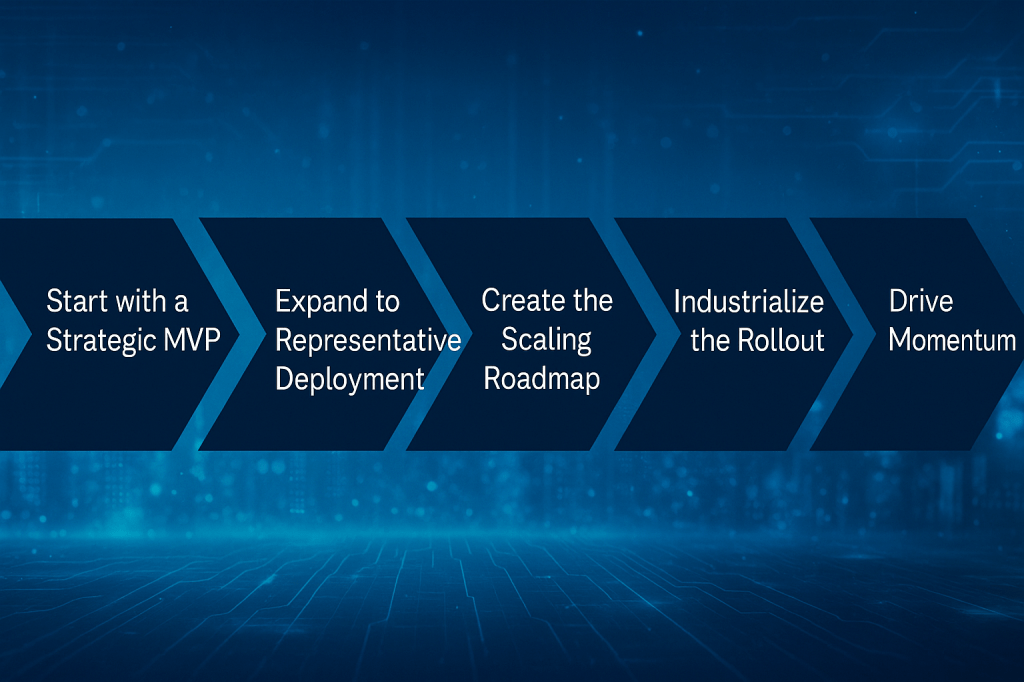
1. Start with a Strategic MVP

Every transformation needs a spark—a Minimum Viable Product (MVP) that proves value fast. This is not about testing technology in isolation but selecting a use case that matters to the business and can deliver tangible outcomes quickly.

In practice:
During a global ERP rollout, we launched the MVP in smaller countries in South America. These markets had limited existing system support, so the gains from automation and standardized processes were immediate and highly visible. It was the ideal environment to test the new design while delivering clear early value to the business.

The goal: build credibility and show that “this works.” More importantly, use this phase to create internal advocates who will help carry the message forward.


2. Expand to a Representative Deployment

Once momentum is created, the next step is critical: move beyond the pilot phase and test your approach in a part of the organization that reflects the broader complexity and scale.

In practice:
In the same ERP program, we selected North America as the next deployment—arguably the toughest environment due to its scale, criticality, and history of customized automation. If we could succeed there, we knew we could scale globally. Through co-creation with local business and functional teams, we built the assets, governance model, and deployment methodology that became the foundation for all subsequent rollouts.


3. Codify Learnings and Create the Scaling Roadmap

After two deployments, you’ll have rich insight into what works, what doesn’t, and what needs to adapt. This is the time to capture and codify those learnings into a repeatable transformation playbook.

In practice:
In the end-to-end Lean transformations, we developed a comprehensive playbook that included standard tools, templates, and real-world examples. We also created resource models and scaling scenarios to support portfolio-level roadmap planning. This gave the transformation program clarity on how to scale with confidence.


4. Industrialize the Rollout

With a clear roadmap in place, the focus shifts to scaling with speed and consistency. This requires an empowered central team that operates as an enabler, that works closely with the business, regional and functional teams.

In practice:
As we scaled our end-to-end transformations from 2 to more than 70 deployments in three years, we enhanced the playbook continuously and established an internal academy. This academy enabled employees to follow a structured learning journey and certify their transformation skills. At the same time, we implemented clear communication strategies and dashboards to track adoption, progress, and value realized—keeping everyone aligned and accountable.


5. Drive Momentum

Scaling isn’t just about delivery—it’s about sustaining energy and belief. Even the best plans will stall without a mechanism to drive momentum and reinforce impact.

In practice:
In the ERP program, we implemented regular health checks to assess deployment progress and identify adoption risks early. Senior leaders were actively involved in championing each phase, reinforcing the “why” and spotlighting success stories across regions. We knew that technical go-live was just the beginning—the real success comes from business adoption, continuous improvement and realized value.


Final Reflections

Many transformations fail at different phases of the journey. Some stumble at the very start by choosing a pilot that is too complex to succeed quickly. Others struggle to make the leap from isolated success to broader relevance. Some lose steam by over-engineering the scale-up, while others fail to sustain momentum once the initial excitement fades.

Next to the examples of what worked, I’ve also seen where things went wrong—or could have gone significantly better. These lessons are just as valuable, and they underscore the importance of staying pragmatic, agile, and focused on value throughout the scaling process.

A successful digital-enabled transformation moves from MVP to full scale through a deliberate series of learnings, adjustments, and investments—not just in technology, but in people, process, and governance.

By starting with fast, meaningful wins, expanding through co-creation, and scaling with discipline, organizations can move from isolated experiments to enterprise-wide impact—with clarity, confidence, and speed.

Why Systems Thinking Is Crucial in Designing Digital Transformations

Digital transformations are hard. Despite bold ambitions, most still fall short—projects stall, teams get overwhelmed, and new technologies fail to deliver lasting value.

One major reason is that many organizations approach transformation in a fragmented, linear way—missing the underlying complexity of the systems they’re trying to change.

Systems thinking offers a powerful alternative. It equips leaders to design transformations that are more coherent, more efficient, and more likely to succeed. The approach helps teams see connections, anticipate ripple effects, and align initiatives across silos. Systems thinking increases the odds that transformation efforts won’t just launch—they’ll land, scale, and sustain real impact. It helps leaders see and communicate the bigger picture, connect the dots across silos, and design smarter interventions that actually stick.


What Is Systems Thinking?

Think of a transformation not as a set of initiatives, but as a connected system. Systems thinking helps you:

  • Spot how parts are connected—across tech, people, data, and processes.
  • Understand ripple effects—how changes in one area can help or hurt others.
  • Design smarter interventions—by targeting the right pressure points, not just the most obvious problem.

Example: Adding AI to customer support won’t drive impact unless you also rethink workflows, retrain staff, align incentives, and adjust how performance is measured. Systems thinking shows you the whole picture.


When to apply Systems Thinking?

Most transformations are cut into initiatives and get locked into “project mode” too early—jumping to solutions before fully understanding the system they aim to change.

That’s why systems thinking is most valuable during the Design and Scoping phase—from shaping strategy to turning it into an actionable plan. It helps:

  • Identify where the real bottlenecks are—not just symptoms.
  • Avoid siloed planning.
  • Create a roadmap that aligns required resources, impact, and ownership.

In the transformations I was involved in the Design and Scoping phase, I always used four angles: People, Process, Data and IT to look at the systems. In combination with bringing in the mindset to think through each of the topics, End to End, we looked across the silo’s and approached the transformation holistically.

In several of the transformations we leveraged experts in this field (like McKinsey, BCG, Accenture and Deloitte) and also publications from leading institutions were used as inspiration. Below a couple of excerpts of what they write about the topic.


What Thought Leaders Say applying System Thinking in Digital Transformation

MIT Sloan highlights that true digital transformation requires more than upgrading technology. Success depends on aligning tech, data, talent, and leadership—treating them as parts of one evolving system. Their research urges leaders to think integratively, not incrementally.

Harvard Business Review stresses the need for adaptive leadership in complex environments. Traditional linear planning falls short in today’s dynamic systems. Leaders must learn to coordinate across organizational boundaries and steer transformation with responsiveness and curiosity.

McKinsey & Company argues that managing transformation complexity demands a systems mindset. They emphasize the importance of understanding how processes, technologies, and people influence one another—revealing hidden dependencies that can derail progress if left unaddressed.

Deloitte offers practical tools to tackle so-called “messy problems” using systems thinking. They advocate mapping interactions and identifying root causes rather than reacting to surface-level symptoms. This approach is especially useful in large-scale enterprise or public-sector transformations.

Boston Consulting Group (BCG) connects systems thinking with platform innovation and agile ways of working. Their work emphasizes the importance of thinking in flows rather than functions—designing transformations around end-to-end customer, data, and value journeys.

Stanford University’s d.school and HAI combine systems thinking with design and AI ethics. Their research underscores the importance of aligning technology, people, and social systems—especially when integrating AI into existing structures. They promote a holistic view to ensure responsible and sustainable change.


How to Apply Systems Thinking in 5 Practical Steps

1. Define the Big Picture
What system are you trying to change?
Start by mapping the environment you want to influence. Identify key players, teams, technologies, and processes involved. Look at how value is created today, where it flows, and where it gets stuck. This helps frame the real scope of the challenge and ensures you don’t miss critical pieces.

2. Spot Key Connections
What influences what?
Once the landscape is clear, explore how the elements interact. Look for patterns, cause-and-effect relationships, and feedback loops. For instance, increasing automation may speed up service but also drive new types of demand. These dynamics are crucial for anticipating second-order effects.

3. Find the Pressure Points
Where can a small change make a big difference?
Focus on areas where a strategic adjustment could generate disproportionate impact. This might be a policy that shapes behavior, a workflow bottleneck, or a metric that drives priorities. The goal is to shift the system in ways that amplify positive change and reduce resistance.

4. Design the Roadmap Around the System
Move the whole system, not just parts.
Align your initiatives across domains—technology, data, process, people, and culture. Sequence interventions so that early wins unlock momentum for deeper shifts. Consider how one change enables another, and make sure efforts reinforce rather than compete with each other.

5. Build in Feedback and Learning
How will you measure and adapt?
Transformations unfold over time. Equip your teams with ways to detect what’s working, what’s not, and where unintended consequences arise. This includes system-level KPIs, qualitative insights, and space for reflection. The ability to course-correct is what makes a systems approach resilient.

Conclusion: The Payoff of Thinking in Systems

When systems thinking becomes a consistent practice, the result is not just better-designed transformation programs—it’s a smarter, more adaptive organization. Leaders begin to anticipate change instead of reacting to it. Teams work across boundaries instead of within silos. And investments create compounding value rather than isolated wins. Ultimately, systems thinking enables transformation efforts to scale with clarity, resilience, and lasting impact.

What We Can Learn from Lego: Three Transformation Lessons

During my recent visit to Lego House in Billund, I was reminded just how much more this iconic brand represents than simply being a maker of plastic bricks. Lego is a great example of smart design, purposeful transformation, and digital innovation. Organizations aiming to stay relevant in a changing market can learn a lot from Lego’s ability to reinvent itself.

In this article, I explore three interconnected dimensions of Lego’s success: how its design principles mirror modern architectural thinking, how the company has transformed while staying true to its purpose, and how it is leveraging digital and AI to lead in both product and operational innovation.


1. Architecture & Design Thinking: From Bricks to Platforms

As a child, I already experienced the smart design of Lego—how one collection of components allowed me to create countless structures. Each brick is designed with a standard interface that guarantees compatibility—regardless of shape, size, or decade of manufacture. This is the physical-world equivalent of APIs in digital architecture: enabling endless creativity through constraint-based design.

Beyond modularity, Lego also embodies platform thinking. With Lego Ideas, they invite users into the design process, allowing them to co-create and even commercialize their models. This open innovation model has helped extend Lego’s reach beyond its internal capabilities.

Lego also uses digital twins to simulate the behavior of physical Lego components and production systems. This enables the company to test product performance, optimize assembly processes, and reduce waste—before anything is physically produced.

Lesson: Embrace modularity—not only in your product and system design but in your organizational setup. Invest in simulation and digital twin technology to test, iterate, and scale with greater speed and lower risk. And treat your users not just as consumers but as contributors to your platform.


2. Organizational Transformation: Reinvention with Purpose

Lego’s transformation journey is a great example of how established companies under pressure can reinvent themselves without losing their DNA. In the early 2000s, Lego faced a financial crisis caused by over-diversification and lack of focus. The turnaround required painful choices: divesting non-core businesses, simplifying product lines, and reconnecting with the company’s core mission—”inspiring and developing the builders of tomorrow.”

But Lego didn’t stop at operational restructuring. It also launched a broader innovation strategy to stay commercially relevant to changing customers. This included launching new experiences like The Lego Movie, which reinvented the brand for a new generation, and partnering with global content leaders such as Disney, Star Wars, and Formula 1 to create product ranges that merged Lego’s design with beloved franchises. These moves helped strengthen the brand and attract new audiences without alienating loyal fans.

Sustainability has become another important dimension—especially for a company built on plastic. Lego has committed to making all core products from sustainable materials by 2032 and is investing heavily in bio-based and recyclable plastics.

Lesson: Transformation isn’t about discarding the old; it’s about strengthening your core value and building on that foundation. Focused innovation, clear communication, and a culture that supports learning, sustainability, and adaptation are crucial.


3. Digital & AI Integration: Enhancing Experience and Performance

As a customer, I’ve already experienced how Lego.com tracks and rewards my purchases. For the younger user group, they’ve developed the Lego Life platform. Here, AI is used to moderate content and create engaging digital experiences for children. Personalization engines recommend content and products based on individual preferences and behaviors.

Lego has embraced digital not just to modernize, but to structurally improve its value chain. Robotics and automation are widely implemented in both production and warehousing. Their supply chain uses real-time data, predictive analytics, and machine learning to forecast demand, optimize production, and manage global inventory.

Perhaps the most innovative example is LegoGPT, an AI model developed with Carnegie Mellon University. It allows users to describe ideas in natural language and receive buildable Lego models in return. By converting abstract intent into tangible design, LegoGPT showcases the power of generative AI to bridge imagination and engineering.

Lesson: Use digital and AI to create meaningful impact—whether by enhancing customer experiences, increasing operational agility, or unlocking new creative possibilities.


Conclusion: Building with Intent

Lego teaches us that true transformation lies at the intersection of smart innovation, strong organizational purpose, and enabling technologies. Its enduring success comes from continually reinterpreting its core principles to meet the needs of a changing world.

For transformation leaders, Lego is more than a nostalgic brand—it’s a masterclass in building the future, one brick at a time.

The Battle of the Agents – Choosing the Right AI Platform for Your Enterprise

The market for AI agents is booming — and it’s just getting started. According to a 2024 McKinsey report, the market for AI agent applications across customer service, sales, operations, and IT support is expected to exceed $100 billion by 2030. Business and technology leaders are rapidly embracing AI agents to automate tasks, enhance decision-making, and create seamless interactions across digital and human channels.

Amidst this explosion, two distinct categories of AI agents are emerging:

  • Embedded agents, seamlessly integrated into existing enterprise platforms.
  • Universal agents, developed to operate across diverse systems and workflows.

This article explores this critical divide by comparing two landmark examples: Agentforce from Salesforce, and Agentspace from Google Cloud.

Embedded Agents: Agentforce by Salesforce

Agentforce is Salesforce’s embedded AI agent framework, designed to supercharge user productivity across its Sales, Service, and Marketing Clouds. Powered by Einstein GPT and native CRM data, Agentforce deploys autonomous agents that can automate tasks, recommend next-best actions, or even interact with customers directly. These agents operate safely within Salesforce’s governance, security, and compliance standards — making them ideal for organizations seeking low-risk, high-impact AI augmentation without leaving their CRM ecosystem.

The promise of Agentforce is simple: smarter workflows, better outcomes, minimal disruption.

Universal Agents: Agentspace by Google Cloud

Agentspace is Google Cloud’s flexible development environment for creating powerful, domain-specific AI agents. It allows organizations to orchestrate multiple AI models (including Gemini and open-source options), integrate enterprise data sources, and define complex multi-step task flows. Agents built with Agentspace can operate across cloud, on-premise, and SaaS environments, offering vast flexibility.

Unlike embedded solutions, Agentspace demands a stronger technical investment — but in return, it enables businesses to build sophisticated, enterprise-wide AI capabilities tailored to their unique environments and strategies.

Comparison Table: Agentforce vs. Agentspace

FeatureAgentforce (Salesforce)Agentspace (Google Cloud)
Primary FocusEnhancing customer service, sales, and marketing productivity within Salesforce.Building custom, autonomous AI agents for a wide range of enterprise applications.
Target UserBusiness users (e.g., customer service agents, sales managers) and Salesforce administrators.Developers, AI engineers, and cloud architects.
IntegrationDeep integration within the Salesforce CRM and Service Cloud environment.Flexible integration across cloud services, APIs, and enterprise systems.
Core FunctionalityReal-time assistance, task automation, knowledge suggestions, next-best actions, customer interaction support.Multi-step task execution, information retrieval, workflow orchestration, natural language understanding, integration with external systems.
Customization LevelConfiguration and workflow adjustments within Salesforce boundaries.High customization — full control over logic, models, tools, and integrations.
AI FoundationSalesforce Einstein GPT and proprietary AI models tied to CRM data.Google’s Gemini models, open-source models, and Google’s AI/ML toolsets.
Use CasesCustomer support, case management, sales assistance, marketing automation.Custom automation, digital assistants, chatbots, research agents, operational task agents.
Development EffortLower — focuses on using built-in features and low-code tools.Higher — requires development, model orchestration, and cloud engineering expertise.
Autonomy LevelPrimarily agent-assisted — supports and augments human workflows.High autonomy — agents capable of independent, multi-system operations.
EcosystemSalesforce platform ecosystem.Google Cloud Platform and broader multi-cloud and SaaS ecosystem.
Deployment SpeedFast — minimal technical lift for Salesforce customers.Moderate to slow — requires planning, development, and integration efforts.
ScalabilityScales within Salesforce CRM and Service Cloud contexts.Cloud-native scaling across diverse workloads and environments.
Governance & Risk ManagementStrong governance built into Salesforce’s compliance and security frameworks.Flexible — enterprises must implement their own governance, security, and monitoring.
Cost ConsiderationsPredictable — tied to Salesforce licensing models.Variable — dependent on cloud consumption, storage, and AI compute costs.

Conclusion: Choosing the Right Path for AI Agents

Selecting between Agentforce and Agentspace ultimately depends on your organization’s strategic priorities, technology landscape, and appetite for AI innovation.

Choose Agentforce when:

  • You are heavily invested in Salesforce and want seamless AI augmentation within existing sales, service, and marketing operations.
  • Your primary goal is to boost employee productivity, reduce response times, and enhance customer satisfaction through AI-powered guidance and automation.
  • You need quick deployment with minimal technical lift, leveraging Salesforce’s built-in governance, security, and compliance frameworks.
  • Your focus is on agent enablement — empowering human workers with intelligent tools, not fully automating complex workflows.

Key takeaway: Agentforce is ideal for organizations seeking trusted, low-risk AI augmentation embedded into the Salesforce environment, driving faster operational improvements without disrupting existing workflows.


Choose Agentspace when:

  • You require highly customized, autonomous AI agents capable of performing complex, multi-system tasks.
  • Your ambition is to build AI solutions that extend far beyond CRM — into operations, product development, knowledge work, and customer experience innovation.
  • You have technical resources (developers, AI engineers, cloud architects) to design, deploy, and govern sophisticated agent architectures.
  • You want to leverage Google’s powerful AI models and enjoy the flexibility to orchestrate bespoke workflows across your technology stack.

Key takeaway: Agentspace is suited for enterprises seeking strategic AI innovation — building differentiated, high-autonomy agents that drive transformation across the business, provided the necessary expertise and investment are in place.


Annex: Extending the Comparison Beyond Salesforce and Google

While this article focuses on the comparison between Salesforce’s Agentforce and Google Cloud’s Agentspace, it is important to note that similar considerations apply when evaluating other leading AI agent solutions.

Other Embedded AI Agent Platforms:

  • ServiceNow: ServiceNow’s Generative AI Controller and Virtual Agent capabilities offer embedded AI assistance across IT Service Management, HR, and customer workflows.
  • SAP: SAP’s Joule AI integrates conversational AI into ERP, CRM, and supply chain systems to drive workflow automation and insights.
  • Oracle: Oracle’s Digital Assistant delivers pre-built AI agents across CX, HCM, and ERP applications with deep process integration.
  • Pega: Pega’s AI and decisioning capabilities embed adaptive intelligence into customer service, case management, and workflow automation platforms.

These embedded solutions share common traits:
✅ Deep integration within their respective ecosystems.
✅ Faster deployment with lower technical lift.
✅ Strong governance, but less flexibility outside the platform boundaries.


Other Customizable AI Agent Platforms:

  • Microsoft Azure AI: Azure OpenAI Service, Azure AI Studio, and Cognitive Services provide a robust environment to build, orchestrate, and deploy enterprise-grade AI agents across the Microsoft ecosystem and beyond.
  • AWS AI Services: AWS offers powerful capabilities through Bedrock, SageMaker, and Lambda-based orchestration to create highly customized and scalable AI agents.
  • IBM Watson: IBM Watsonx platform enables businesses to build domain-specific AI agents with strong support for enterprise governance, regulatory compliance, and hybrid cloud environments.

These customizable platforms share characteristics:
✅ High degree of design flexibility and autonomy.
✅ Potential for cross-system orchestration at enterprise scale.
✅ Require greater investment in technical resources, governance, and lifecycle management.


Key Takeaway:

Whether you evaluate embedded solutions or custom platforms, the core decision principles remain the same:

  • Speed and simplicity versus flexibility and autonomy.
  • Platform integration versus ecosystem-wide orchestration.
  • Operational augmentation versus strategic innovation.

As the agent economy matures, technology leaders must align their agent strategy with their overall digital transformation roadmap, balancing immediate needs with future ambitions.

How AI Changes the Digital Transformation Playbook

I recently revisited David L. Rogers’ 2016 book, The Digital Transformation Playbook. This work was foundational in how I approached digital strategy in the years that followed. It helped executives move beyond viewing digital as a technology problem and instead rethink strategy for a digital enabled business. As I now reflect on the accelerating impact of artificial intelligence—especially generative and adaptive AI—I found myself asking: how would this playbook evolve if it were written today? What shifts, additions, or reinterpretations does AI demand of us?

Rogers identified five strategic domains where digital forces reshaped the rules of business: customers, competition, data, innovation, and value. These domains remain as relevant as ever—but in the age of AI, each requires a fresh lens.

In this article, I revisit each domain, beginning with Rogers’ foundational insight and then exploring how AI transforms the picture. I also propose three new strategic domains that have become essential in the AI era: workforce, governance, and culture.


1. Customers → From Networks of Relationships to Intelligent Experiences

Rogers’ Insight (2016):
In the traditional business model, customers were treated as passive recipients of value. Rogers urged companies to reconceive customers as active participants in networks—communicating, sharing, and shaping brand perceptions in real-time. The shift was toward engaging these dynamic networks, understanding behavior through data, and co-creating value through dialogue, platforms, and personalization.

AI Shift (Now):
AI enables companies to move beyond personalized communication to truly intelligent experiences. By analyzing vast datasets in real-time, AI systems can predict needs, automate responses, and tailor interactions across channels. From recommendation engines to digital agents, AI transforms customer experience into something anticipatory and adaptive—redefining engagement, loyalty, and satisfaction.


2. Competition → From Industry Ecosystems to Model-Driven Advantage

Rogers’ Insight (2016):
Rogers challenged the notion of fixed industry boundaries, arguing that digital platforms enable competition across sectors. Businesses could no longer assume their competitors would come from within their own industry. Instead, value was increasingly co-created in fluid ecosystems involving customers, partners, and even competitors.

AI Shift (Now):
Today, the competitive battlefield is increasingly defined by AI capabilities. Winning organizations are those that can develop, fine-tune, and scale AI models faster than others. Competitive advantage comes from proprietary data, high-performing models, and AI-native organizational structures. In some cases, the model itself becomes the product—shifting power to those who own or control AI infrastructure.


3. Data → From Strategic Asset to Lifeblood of Intelligent Systems

Rogers’ Insight (2016):
Data, once a by-product of operations, was reimagined as a core strategic asset. Rogers emphasized using data to understand customers, inform decisions, and drive innovation. The shift was toward capturing more data and applying analytics to create actionable insights and competitive advantage.

AI Shift (Now):
AI transforms the role of data from decision-support to system training. Data doesn’t just inform—it powers intelligent behavior. The focus is now on quality, governance, and real-time flows of data that continuously refine AI systems. New challenges around data bias, provenance, and synthetic generation raise the stakes for ethical and secure data management.


4. Innovation → From Agile Prototyping to AI-Augmented Co-Creation

Rogers’ Insight (2016):
Rogers advocated for agile, iterative approaches to innovation. Instead of long development cycles, companies needed to embrace experimentation, MVPs, and customer feedback loops. Innovation was not just about new products—it was about learning fast and adapting to change.

AI Shift (Now):
AI amplifies every step of the innovation process. Generative tools accelerate ideation, design, and prototyping. Developers and designers can co-create with AI, testing multiple solutions instantly. The loop from idea to execution becomes compressed, with AI as a creative collaborator, not just a tool.


5. Value → From Digital Delivery to Adaptive Intelligence

Rogers’ Insight (2016):
Value creation, in Rogers’ view, moved from static supply chains to fluid, digital experiences. Companies needed to rethink how they delivered outcomes—shifting from products to services, from ownership to access, and from linear value chains to responsive platforms.

AI Shift (Now):
With AI, value is increasingly delivered through systems that learn and adapt. Intelligent services personalize in real time, optimize continuously, and evolve with user behavior. The value proposition becomes dynamic—embedded in a loop of sensing, reasoning, and responding.


Why We Must Expand the Playbook: The Rise of New Strategic Domains

The original five domains remain vital. Yet AI doesn’t just shift existing strategies—it introduces entirely new imperatives. As intelligent systems become embedded in workflows and decisions, organizations must rethink how they manage talent, ensure ethical oversight, and shape organizational culture. These aren’t adjacent topics—they are central to sustainable AI transformation.


6. Workforce → From Talent Strategy to Human–AI Teaming

AI is not replacing the workforce—it is changing it. Leaders must redesign roles, workflows, and capabilities to optimize human–AI collaboration. This means upskilling for adaptability, integrating AI into daily work, and ensuring people retain agency in AI-supported decisions. Human capital strategy must now include how teams and algorithms learn and perform together.


7. Governance → From Digital Risk to Responsible AI

AI introduces new dimensions of risk: bias, security, and regulatory complexity. Governance must now ensure not only compliance but also ethical development, explainability, and trust. Boards, executive teams, and product leaders need frameworks to evaluate and oversee AI initiatives—not just for effectiveness but for responsibility.


8. Culture → From Digital Fluency to AI Curiosity and Trust

The mindset shift required to scale AI is cultural as much as technological. Organizations must foster curiosity about what AI can do, confidence in its potential, and clarity about its limits. Trust becomes a cultural asset—built through transparency, education, and inclusive experimentation. Without it, AI adoption stalls.


Conclusion: A Playbook for the AI Era

Rogers’ original playbook gave us a framework to reimagine business strategy in a digital world. That foundation still holds. But as AI redefines how we compete, create, and lead, we need a new version—one that not only shifts the lens on customers, competition, data, innovation, and value, but also adds the critical dimensions of workforce, governance, and culture. These eight domains form the new playbook for transformation in the age of intelligence.

Rewiring the Workforce: Aligning HR and IT in the Age of AI

AI is already changing how teams operate, how leaders make decisions, and how value is delivered to customers. For organizations, this means rethinking not just what work gets done, but how it’s done, and by whom. Therefor it is crucial to think about how we bring Human and AI resource management together.

The 2023 MIT Sloan / BCG study, The Rise of AI-Powered Organizations, found that the most successful companies with AI are those where HR and IT work closely together to redesign processes and roles. That collaboration is critical. If AI is deployed without rethinking how humans and machines collaborate, companies risk missed value, employee resistance, and ethical missteps.


Designing the Hybrid Workforce: Teams, Tasks, and Talent

AI doesn’t eliminate jobs—it changes them. To prepare, organizations need to break down roles into specific tasks:

  • What can be automated?
  • What can be enhanced by AI?
  • What should remain Human-led?

From there, teams can be redesigned around how people and AI tools work together. In practice, this might mean:

  • A customer service team using AI to summarize queries while humans resolve complex issues
  • A product development team using AI to generate design options that humans refine

The HBR article Collaborative Intelligence: Humans and AI Are Joining Forces (Wilson & Daugherty, 2018) highlights five human roles in human-AI collaboration, such as AI trainers, explainers, sustainers, amplifiers and translators. These roles are already emerging in forward-looking teams and should be reflected in new job descriptions and team capabilities.


Organizational Change: Leading Through Disruption

Adding AI isn’t just a tech upgrade—it changes how decisions are made, who makes them, and what leadership looks like. For example:

  • Middle managers might now focus more on coaching and less on reporting, as AI handles data consolidation.
  • Teams may need to consult AI before acting, introducing a new rhythm to collaboration.

Gartner’s 2023 report How to Measure AI-Augmented Employee Productivity stresses that success in AI transformation isn’t just about productivity—it’s about how well teams adapt, collaborate, and trust AI tools. That requires strong change management, hands-on leadership, and clear guidance on when to trust AI versus when to override it.


Performance and Culture in an AI-Augmented Workplace

With AI in the mix, traditional performance reviews fall short. Leaders need to ask:

  • How are employees using AI tools to improve their work?
  • Are decisions more consistent, inclusive, and data-informed?
  • Is the AI system fair and explainable?

The Stanford HAI Annual AI Index Report 2024 shows that AI systems are improving technically, but companies often lack the tools to measure human impact—such as employee trust or the inclusiveness of AI-driven decisions. Stanford HAI provides several frameworks that can be leveraged to measure Human + AI teams performance.


HR + IT: From Functional Silos to Strategic Workforce Partners

To make AI work, HR and IT must be in lockstep. Here’s what that looks like:

  • Shared strategy: Joint planning on where AI will impact jobs and what new skills are needed
  • Reskilling programs: Co-owned initiatives to help employees build digital and AI literacy
  • Data and governance: Shared ownership of tools that measure workforce readiness and ensure responsible AI use

IBM’s 2023 Enterprise Guide to Closing the Skills Gap highlights that companies closing the skills gap at scale have strong HR–IT alignment. It’s not about HR specifying training needs and IT buying tools. It’s about building workforce capabilities together, with shared accountability.


Practical Implementation Guide

Step-by-Step

  1. Start with a vision: What does AI mean for how your people work?
  2. Create joint ownership: HR and IT should lead together from day one
  3. Map current tasks and roles: Where can AI add value or remove friction?
  4. Pilot hybrid teams: Run experiments in one area (e.g., marketing, finance) and scale what works
  5. Define ethical rules: Decide where AI should assist, and where humans must retain control
  6. Track impact: Use KPIs that include both productivity and human experience

Avoid These Pitfalls

  • Launching AI without involving HR
  • Treating AI as an isolated IT solution
  • Ignoring cultural resistance or trust issues
  • Failing to update roles, reviews, or incentives

Patterns That Work

  • Embedding AI in learning programs led by both HR and IT
  • Using AI to support—not replace—human decision-making in recruiting
  • Creating workforce councils to oversee AI ethics and inclusion

Conclusion: Time to Rewire

AI is a shift in how people, teams, and organizations operate. Making that shift successful requires deep collaboration between HR and IT, clear direction from leadership, and a willingness to rethink everything from team design to performance reviews.

Organizations that embrace this challenge with practical steps and shared ownership will not only manage AI’s impact—they’ll harness its full potential to build a smarter, more adaptive workforce.

Revolutionizing Finance with AI Automation

Finance is one of the business functions most primed for disruption through AI. With its high volume of repetitive transactions, rich data environments, and structured processes, the finance and controlling function is uniquely positioned to benefit from automation and intelligent analytics. As AI technologies mature, they are enabling a shift from transactional finance to strategic finance, unlocking new efficiencies, predictive capabilities, and business insights.

The implications are not just technological but organizational. With automation potential ranging from 30% to over 80% across various activities, it is likely that finance teams of the future will require less than 50% of the current workforce for traditional roles. The roles that remain will be more analytical, advisory, and technology-driven.

This article explores the key activities of the Finance function, how AI is transforming each area, and what the finance function could look like in 5–10 years. We also outline two distinct transformation scenarios—one focused on rapid implementation and another on sustainable foundations—to help finance leaders chart their course.

Key Activities of the Finance & Controlling Function and AI’s Impact

  1. Financial Planning & Analysis (FP&A)
    • Activities: Budgeting, forecasting, scenario modeling, variance analysis.
    • AI Impact: Predictive forecasting, automated scenario generation, and anomaly detection increase speed and accuracy.
  2. Management Reporting
    • Activities: Internal performance reports, dashboards, KPI tracking.
    • AI Impact: Natural language generation and self-service analytics personalize insights and automate commentary.
  3. Controlling
    • Activities: Cost control, investment analysis, policy compliance.
    • AI Impact: AI uncovers cost drivers, monitors ROI, and enforces compliance rules automatically.
  4. Accounting & Financial Close
    • Activities: AP/AR, reconciliations, journal entries, intercompany close.
    • AI Impact: OCR, bots, and smart matching drastically reduce manual work and cycle times.
  5. Treasury & Cash Management
    • Activities: Cash forecasting, liquidity management, FX risk, banking.
    • AI Impact: Predictive models optimize cash positions and detect fraud in real time.
  6. Tax & Compliance
    • Activities: Tax classification, filings, regulatory adherence.
    • AI Impact: Automated tax coding, real-time compliance monitoring, and AI-driven audit trails.
  7. Audit & Risk Management
    • Activities: Internal/external audit support, control testing, risk management.
    • AI Impact: Continuous audit monitoring, real-time risk scoring, and policy breach alerts.
  8. Financial Systems & Data Management
    • Activities: ERP management, data quality, automation enablement.
    • AI Impact: Data cleansing, process mining, and AI copilots transform finance operations.

AI Automation Potential Across Finance

AreaAutomation PotentialComments
FP&AModerateForecasting and analysis are automatable, but strategic planning remains human-led.
Management ReportingHighReport generation and commentary can be mostly automated.
ControllingModerateRoutine cost analysis is automatable; investment decisions are not.
Accounting & CloseHighReconciliations and entries are ideal for automation.
TreasuryModerateForecasting and fraud detection can be automated; decisions require oversight.
Tax & ComplianceModerateClassification and monitoring are automatable; legal interpretation is not.
Audit & RiskLow to ModerateMonitoring can be automated; assessments need human judgment.
Financial SystemsHighData tasks and support functions are highly automatable.

The Finance Function in 5–10 Years: AI-Augmented and Insight-Driven
Finance in the future will be lean, real-time, and forward-looking. The traditional role of finance as a scorekeeper will evolve into that of a strategic partner. Key shifts will include:

  • Near real-time closing and continuous forecasting
  • Proactive risk management through AI-driven monitoring
  • AI copilots supporting analysts with real-time insights
  • Self-optimizing processes and embedded business advisory

This transformation also entails a significant redefinition of workforce composition. Many routine roles will be phased out or reshaped, with the remaining talent focused on analytics, business partnering, and data stewardship. Finance teams may operate with less than half the current headcount, but with higher impact and strategic relevance.

Two Roadmap Scenarios for AI Transformation

1. Go Fast: Rapid AI Deployment in High-Impact Areas

  • Focus on automating high-volume, repetitive tasks for fast ROI.
  • Prioritize areas like reporting, financial close, and forecasting.
  • Launch an AI Center of Excellence to scale use cases.
  • Upskill teams in AI tools and data literacy.
  • Risks: Process fragmentation, change fatigue.

2. Build to Last: Strengthen Foundations Before Scaling AI

  • Begin with standardizing processes and modernizing ERP/data.
  • Use process mining to identify where AI fits best.
  • Pilot AI while building trust in systems and data.
  • Drive long-term scalability through structured change management.
  • Risks: Slower benefits realization, loss of momentum.

Conclusion: Finance Leaders Must Shape the AI Journey
AI offers unprecedented potential to elevate finance from an operational function to a strategic powerhouse. Whether choosing to go fast or build to last, success will require clear vision, strong governance, and continuous upskilling.

But leaders must also prepare for the workforce transformation ahead. With many transactional roles set to disappear, reskilling, talent planning, and organizational redesign must become part of the AI roadmap. Finance leaders who act now—balancing ambition with structure—will define the future of the profession and unlock new value for their organizations.

How to Assess and Advance Your Data Maturity for Transformation

Why Frameworks Matter for Digital Transformation

In today’s business environment, data is the foundation for innovation, agility, and competitive advantage. It is a key area for your transformation. However, the ability to use data effectively depends not just on having data, but on how mature an organization’s data management practices are. Therefor herewith a deep dive into a number of frameworks and tools to help you mature your data.

Data Maturity Frameworks provide a structured lens to:

  • Evaluate the organization’s current capabilities across governance, quality, integration, and usage.
  • Identify critical gaps that could slow down digital, data, and AI initiatives.
  • Prioritize investments that align data management with strategic business goals.

By anchoring digital transformation programs in recognized data maturity frameworks, leaders ensure they are building on a solid, scalable, and business-aligned data foundation — rather than risking value loss from fragmented, low-quality data landscapes.


Leading Data Maturity Frameworks

Measuring and improving data maturity begins with selecting the right guiding model.
Three leading frameworks stand out for their depth, business relevance, and proven industry adoption:

1. DAMA-DMBOK / Data Management Maturity (DMM) Model

The Data Management Maturity (DMM) Model, grounded in DAMA-DMBOK standards, offers a comprehensive evaluation across governance, quality, operations, architecture, and security. Organizations progress through five levels, from Ad Hoc to Optimized, providing a detailed improvement roadmap.

Best for: Organizations seeking deep, structured management of data as a strategic asset.

Link: DMBoK – Data Management Body of Knowledge


2. Gartner Enterprise Information Management (EIM) Maturity Model

Gartner’s model links data management directly to business value creation. It assesses governance, integration, metadata management, and security across five stages, from Aware to Transformational, focusing on enabling better decisions, agility, and growth.

Best for: Enterprises aligning data strategies tightly to digital transformation outcomes.

Link: Understand Data Governance Trends & Strategies | Gartner


3. McKinsey Data Maturity Framework

McKinsey’s approach positions data as a driver of innovation and business model evolution. It evaluates maturity across strategy, governance, culture, talent, and architecture, emphasizing how organizations can unlock tangible value and new revenue streams from data.

Best for: Companies positioning data as a growth engine rather than just a technical enabler.

Link: The data-driven enterprise of 2025 | McKinsey


Comparison: Leading Frameworks

FeatureDAMA-DMBOK / DMMGartner EIM MaturityMcKinsey Data Maturity
Primary FocusEnterprise data management excellenceInformation management for business valueData as a lever for innovation and performance
CoverageGovernance, quality, architecture, operations, securityGovernance, integration, quality, metadata, securityStrategy, culture, governance, monetization
Maturity Stages5 (Initial → Optimized)5 (Aware → Transformational)5 (Foundational → Transformational)
Best FitDetailed structure and controlStrategic business alignmentScaling for innovation and growth
Typical UsersCDOs, Data Management LeadersCIOs, CDOs, Digital OfficersCEOs, Business Transformation Leaders

From Frameworks to Action: Why Assessment Tools Matter

Selecting a maturity framework sets the strategic direction — but real progress begins with a clear-eyed, objective assessment of where you stand today.

Data Maturity Assessment Tools help organizations:

  • Map their current capabilities against best practice models.
  • Benchmark against industry standards.
  • Identify quick wins and critical gaps to address.

Choosing the right tool ensures that your transformation journey is grounded in reality — not assumptions.


Practical Tools to Assess Your Data Maturity

Here are five proven tools that align with leading frameworks and provide practical, actionable insights:

1. EDM Council’s DCAM Assessment

A standards-based evaluation covering governance, quality, operations, architecture, and ethics, offering detailed benchmarking and industry alignment.

Best for: Enterprises seeking comprehensive, validated assessments aligned to DAMA-DMBOK/DMM.


2. Gartner Data and Analytics Maturity Assessment Toolkit

A fast, executive-level self-assessment providing immediate insights across governance, integration, and information usage dimensions.

Best for: Organizations seeking quick, strategic diagnostics.


3. McKinsey Data Diagnostic Survey

A strategic assessment linking data maturity directly to business value creation, uncovering growth, efficiency, and innovation opportunities.

Best for: Companies aiming to scale data-driven growth and innovation.


4. Informatica Data Maturity Assessment Tool

A practical, operations-focused online survey that delivers quick recommendations for improving data management capabilities.

Best for: Quick internal benchmarking and operational improvements.


5. Microsoft Data Maturity Assessment

An evaluation emphasizing cloud readiness, governance, and AI-enablement, ideal for organizations modernizing through Azure and advanced analytics.

Best for: Cloud modernization and AI scaling initiatives.


Comparison: Assessment Tools

ToolFramework AlignmentStrengthAccess TypeBest Fit
EDM Council DCAM™DAMA-DMBOK / DMMComprehensive, standards-basedMembership or consultancy-ledFormal enterprise assessments
Gartner D&A Maturity ToolkitGartner EIMExecutive-level, quick insightsSubscription / occasional free accessStrategic initial diagnostics
McKinsey Data DiagnosticMcKinsey MaturityStrategic, business value focusConsulting-led / some self-guidesLinking data to growth and innovation
Informatica Assessment ToolGeneral (Data Management)Quick, operationally actionableFree onlineInternal benchmarking
Microsoft Data Maturity AssessmentMicrosoft Data StrategyCloud and AI readiness focusFree via Azure partnershipsCloud data modernization

How to Apply Frameworks and Tools Effectively

  • Anchor your transformation in a recognized data maturity framework that matches your strategic goals.
  • Conduct an honest assessment using a structured tool to identify your true starting point — don’t rely on assumptions.
  • Prioritize actions that link data maturity gaps directly to business value opportunities, not just technical fixes.
  • Treat maturity as a journey, not a one-off exercise: integrate regular reassessments into your transformation governance.
  • Balance detail and speed: Use lighter diagnostics for initial framing and deeper assessments for large investment decisions.

By applying a framework thoughtfully and leveraging the right tools at the right stages, organizations can dramatically accelerate their journey from managing data to monetizing it, unlocking sustainable digital advantage.

Key Insights from Digital Forum Amsterdam: AI’s Global Impact

Last week, I had the opportunity to present at the Digital Forum in Amsterdam, where over 100 executives and transformation leaders gathered to explore the future of leadership in the digital era. My keynote, titled “AI Without Borders – Harnessing Artificial Intelligence for Global Impact”, was met with great engagement and sparked many thoughtful discussions afterward.

In this article, I’d like to share the highlights and insights from the session—with the slides embedded between paragraphs for context.


AI is Reshaping Work—Across All Roles and Industries

My opening message was simple: no matter where you work or what your role is, AI will impact your processes, job content, and organization over the next 5 to 10 years. The only uncertainty is the scale and speed of this change.

To reinforce this, I brought in research findings from the WEF, MIT, PwC, McKinsey, Gartner, IBM, and Goldman Sachs. These sources highlight both the immense economic potential of AI (up to $15.7 trillion by 2030) and its disruptive impact on the workforce—millions of jobs created, transformed, or displaced, and a pressing need for upskilling on a global scale.


Staying Ahead: Why AI Fluency Matters

One statement particularly resonated with the audience: “It’s not that your job will be replaced by AI—but it might be replaced by someone who uses AI better than you.”

This is a wake-up call for continuous learning. The pace of development is breathtaking. I shared a snapshot of Q1 2025 breakthroughs and hinted at Google’s recent launch of AgentSpace, which I’ll cover in a future edition.


The Real Impact: AI in Marketing, Supply Chain, and Innovation

We then looked deeper into three core business areas—Marketing & Sales, Supply Chain, and Innovation—to see how AI is already creating tangible value.

In Marketing & Sales, AI is now embedded across the funnel—from awareness to retention. At Brenntag, for example, we successfully used AI to predict customer churn and recommend next-best actions, helping our commercial teams serve customers more effectively.

I also highlighted how large brands are already using AI to generate marketing content at scale. But the exciting shift is that these same capabilities are now accessible to smaller companies too—lowering the barriers to entry and leveling the playing field.


In Supply Chain, we see a dual reality: some companies still struggle with visibility and fragmented data, while others are unlocking efficiency gains with advanced AI tools. My message here: building end-to-end supply chain visibility is foundational. Only then can AI deliver its full potential.

As an example, I shared how, more than a decade ago at Philips, we began using IoT and early predictive maintenance for MRI machines. Today, this has evolved into a sophisticated system combining sensors, analytics, and AI—ensuring optimal equipment uptime and smooth patient flow in diagnostic imaging.


AI Accelerates the Innovation Cycle

AI is also supercharging innovation, reducing the time and cost of development across all phases—from identifying unmet needs to prototyping and testing.

I used the breakthrough example of AlphaFold by DeepMind, which dramatically accelerates drug discovery and the design of new materials. And at Brenntag, we’ve experimented with AI to accelerate lab innovation in the chemical sector—demonstrating that even smaller-scale applications can yield significant gains.


Data: The Essential Fuel for AI

Of course, none of this works without data. But many organizations face persistent challenges: fragmented systems, inconsistent standards, unclear data ownership, and poor governance.

I emphasized that improving data quality, accessibility, and trust is a prerequisite for AI success. Only when teams believe in the data and the systems built on top of it will adoption and results follow.


People and Culture Make the Difference

Finally, I addressed the cultural and organizational shifts required for AI to succeed. This includes:

  • Building trust and transparency into AI solutions
  • Empowering people to work ethically and responsibly with AI
  • Driving change management and adoption
  • And most importantly: ensuring consistent leadership support, with a clear vision and shared purpose

My Closing Message

I wrapped up with four key takeaways for leaders steering AI transformations:

  • AI will change processes, jobs, and businesses – only the speed is unknown
  • Data is the fuel for AI – make it fit for purpose and ready to use
  • The future is Human + AI – a cultural transformation is essential
  • Embed AI in your Operating Model – start small, scale fast, and learn continuously