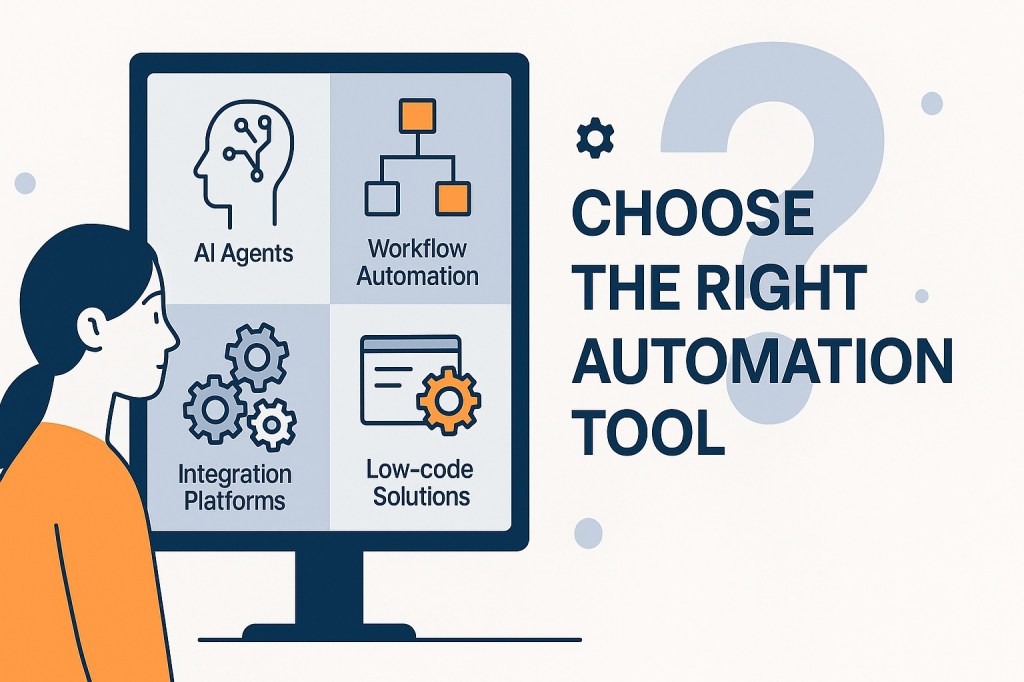
Agents vs. Automation – How to Choose the Right Tool for the Job

As AI agents storm the market and automation technologies mature, transformation leaders face a critical question: Not just what to automate — but how.

From RPA and low-code platforms to intelligent agents and native automation tools, the choices are expanding fast.

This article offers a practical framework to help you make the right decisions — and build automation that scales with your organization.


A Layered View of the Automation Landscape

Modern automation isn’t a single tool — it’s leveraging a full stack. Here are the key layers:

🔹 1. Digital Core Platforms

Systems like SAP, Salesforce, ServiceNow and Workday host your enterprise data and business processes. They often come with native automation tools (e.g., Salesforce Flow, SAP BTP), ideal for automating workflows within the platform.

🔹 2. Integration Platforms (iPaaS)

Tools like MuleSoft, Boomi, and Microsoft Power Platform play a foundational role in enterprise automation. These Integration Platforms as a Service (iPaaS) connect applications, data sources, and services across your IT landscape — allowing automation to function seamlessly across systems rather than in silos.

🔹 3. Automation Tools

  • RPA (e.g., UiPath) automates rule-based, repetitive tasks
  • Workflow Automation manages structured, multi-step business processes
  • Low-/No-Code Platforms (e.g., Power Apps, Mendix) empower teams to build lightweight apps and automations with minimal IT support

🔹 4. AI Agents

Tools and platforms like OpenAI Agents, Microsoft Copilot Studio, Google Vertex AI Agent Builder, and LangChain enable reasoning, adaptability, and orchestration — making them well-suited for knowledge work, decision support, and dynamic task execution.


Choosing the Right Tool for the Job

No single tool is right for every use case. Here’s how to decide:

ScenarioBest Fit
Rule-based, repetitive workRPA
Structured, approval-based flowsWorkflow Automation
Inside one platform (e.g., CRM/ERP)Native Platform Automation
Cross-system data & process flowsIntegration Platforms (iPaaS)
Lightweight cross-platform appsLow-/No-Code Platforms
Knowledge-driven or dynamic tasksAI Agents

The most effective automation strategies are hybrid — combining multiple tools for end-to-end value.


Implementation Roadmaps: One Journey, Many Paths

While all automation projects follow a shared journey — identify, pilot, scale — each tool requires a slightly different approach.


1. Identify the Right Opportunities

  • Native Platform Tools: Start with what’s already built into Salesforce, SAP, etc.
  • iPaaS: Identify silos where data must flow between systems
  • RPA: Use process/task mining to find repeatable, rule-based activities
  • Workflow: Focus on bottlenecks, exceptions, and handoffs
  • Low-/No-Code: Empower teams to surface automation needs and prototype fast
  • AI Agents: Look for unstructured, knowledge-heavy processes

2. Design for Fit and Governance

Each automation type requires a different design mindset — based on scope, user ownership, and risk profile.

  • Native Platform Automation: Stay aligned with vendor architecture and update cycles
  • iPaaS: Build secure, reusable data flows
  • RPA: Design for stability, handle exceptions
  • Workflow: Focus on roles, rules, and user experience
  • Low-/No-Code Platforms: Enable speed, but embed clear guardrails
  • AI Agents: Use iterative prompt design, test for reliability

Key distinction:

  • Native platform automation is ideal for secure, internal process flows.
  • Low-/no-code platforms are better for lightweight, cross-functional solutions — but they need structure to avoid sprawl.

3. Pilot, Learn, and Iterate

  • Platform-native pilots are quick to deploy and low-risk
  • RPA pilots deliver fast ROI but require careful exception handling
  • Workflow Automation start with one process and involve users early to validate flow and adoption.
  • Low-/no-code pilots accelerate innovation, especially at the edge
  • iPaaS pilots often work quietly in the background — but are critical for scale
  • AI agent pilots demand close supervision and feedback loops

4. Scale with Structure

To scale automation, focus not just on tools, but on governance:

  • Workflow and Low-Code: Set up federated ownership or Centres of Excellence
  • RPA and iPaaS: Track usage, manage lifecycles, prevent duplication
  • AI Agents: Monitor for performance, hallucination, and compliance
  • Native Platform Tools: Coordinate with internal admins and platform owners

The most successful organizations won’t just automate tasks — they’ll design intelligent ecosystems that scale innovation, decision-making, and value creation.


Conclusion: Architect the Ecosystem

Automation isn’t just about efficiency — it’s about scaling intelligence across the enterprise.

  • Use native platform tools when speed, security, and process alignment matter most
  • Use low-/no-code platforms to empower teams and accelerate delivery
  • Use RPA and workflows for high-volume or structured tasks
  • Use AI agents to enhance decision-making and orchestrate knowledge work
  • Use integration platforms to stitch it all together

The winners will be the ones who build coherent, adaptive automation ecosystems — with the right tools, applied the right way, at the right time.

The Battle of the Agents – Choosing the Right AI Platform for Your Enterprise

The market for AI agents is booming — and it’s just getting started. According to a 2024 McKinsey report, the market for AI agent applications across customer service, sales, operations, and IT support is expected to exceed $100 billion by 2030. Business and technology leaders are rapidly embracing AI agents to automate tasks, enhance decision-making, and create seamless interactions across digital and human channels.

Amidst this explosion, two distinct categories of AI agents are emerging:

  • Embedded agents, seamlessly integrated into existing enterprise platforms.
  • Universal agents, developed to operate across diverse systems and workflows.

This article explores this critical divide by comparing two landmark examples: Agentforce from Salesforce, and Agentspace from Google Cloud.

Embedded Agents: Agentforce by Salesforce

Agentforce is Salesforce’s embedded AI agent framework, designed to supercharge user productivity across its Sales, Service, and Marketing Clouds. Powered by Einstein GPT and native CRM data, Agentforce deploys autonomous agents that can automate tasks, recommend next-best actions, or even interact with customers directly. These agents operate safely within Salesforce’s governance, security, and compliance standards — making them ideal for organizations seeking low-risk, high-impact AI augmentation without leaving their CRM ecosystem.

The promise of Agentforce is simple: smarter workflows, better outcomes, minimal disruption.

Universal Agents: Agentspace by Google Cloud

Agentspace is Google Cloud’s flexible development environment for creating powerful, domain-specific AI agents. It allows organizations to orchestrate multiple AI models (including Gemini and open-source options), integrate enterprise data sources, and define complex multi-step task flows. Agents built with Agentspace can operate across cloud, on-premise, and SaaS environments, offering vast flexibility.

Unlike embedded solutions, Agentspace demands a stronger technical investment — but in return, it enables businesses to build sophisticated, enterprise-wide AI capabilities tailored to their unique environments and strategies.

Comparison Table: Agentforce vs. Agentspace

FeatureAgentforce (Salesforce)Agentspace (Google Cloud)
Primary FocusEnhancing customer service, sales, and marketing productivity within Salesforce.Building custom, autonomous AI agents for a wide range of enterprise applications.
Target UserBusiness users (e.g., customer service agents, sales managers) and Salesforce administrators.Developers, AI engineers, and cloud architects.
IntegrationDeep integration within the Salesforce CRM and Service Cloud environment.Flexible integration across cloud services, APIs, and enterprise systems.
Core FunctionalityReal-time assistance, task automation, knowledge suggestions, next-best actions, customer interaction support.Multi-step task execution, information retrieval, workflow orchestration, natural language understanding, integration with external systems.
Customization LevelConfiguration and workflow adjustments within Salesforce boundaries.High customization — full control over logic, models, tools, and integrations.
AI FoundationSalesforce Einstein GPT and proprietary AI models tied to CRM data.Google’s Gemini models, open-source models, and Google’s AI/ML toolsets.
Use CasesCustomer support, case management, sales assistance, marketing automation.Custom automation, digital assistants, chatbots, research agents, operational task agents.
Development EffortLower — focuses on using built-in features and low-code tools.Higher — requires development, model orchestration, and cloud engineering expertise.
Autonomy LevelPrimarily agent-assisted — supports and augments human workflows.High autonomy — agents capable of independent, multi-system operations.
EcosystemSalesforce platform ecosystem.Google Cloud Platform and broader multi-cloud and SaaS ecosystem.
Deployment SpeedFast — minimal technical lift for Salesforce customers.Moderate to slow — requires planning, development, and integration efforts.
ScalabilityScales within Salesforce CRM and Service Cloud contexts.Cloud-native scaling across diverse workloads and environments.
Governance & Risk ManagementStrong governance built into Salesforce’s compliance and security frameworks.Flexible — enterprises must implement their own governance, security, and monitoring.
Cost ConsiderationsPredictable — tied to Salesforce licensing models.Variable — dependent on cloud consumption, storage, and AI compute costs.

Conclusion: Choosing the Right Path for AI Agents

Selecting between Agentforce and Agentspace ultimately depends on your organization’s strategic priorities, technology landscape, and appetite for AI innovation.

Choose Agentforce when:

  • You are heavily invested in Salesforce and want seamless AI augmentation within existing sales, service, and marketing operations.
  • Your primary goal is to boost employee productivity, reduce response times, and enhance customer satisfaction through AI-powered guidance and automation.
  • You need quick deployment with minimal technical lift, leveraging Salesforce’s built-in governance, security, and compliance frameworks.
  • Your focus is on agent enablement — empowering human workers with intelligent tools, not fully automating complex workflows.

Key takeaway: Agentforce is ideal for organizations seeking trusted, low-risk AI augmentation embedded into the Salesforce environment, driving faster operational improvements without disrupting existing workflows.


Choose Agentspace when:

  • You require highly customized, autonomous AI agents capable of performing complex, multi-system tasks.
  • Your ambition is to build AI solutions that extend far beyond CRM — into operations, product development, knowledge work, and customer experience innovation.
  • You have technical resources (developers, AI engineers, cloud architects) to design, deploy, and govern sophisticated agent architectures.
  • You want to leverage Google’s powerful AI models and enjoy the flexibility to orchestrate bespoke workflows across your technology stack.

Key takeaway: Agentspace is suited for enterprises seeking strategic AI innovation — building differentiated, high-autonomy agents that drive transformation across the business, provided the necessary expertise and investment are in place.


Annex: Extending the Comparison Beyond Salesforce and Google

While this article focuses on the comparison between Salesforce’s Agentforce and Google Cloud’s Agentspace, it is important to note that similar considerations apply when evaluating other leading AI agent solutions.

Other Embedded AI Agent Platforms:

  • ServiceNow: ServiceNow’s Generative AI Controller and Virtual Agent capabilities offer embedded AI assistance across IT Service Management, HR, and customer workflows.
  • SAP: SAP’s Joule AI integrates conversational AI into ERP, CRM, and supply chain systems to drive workflow automation and insights.
  • Oracle: Oracle’s Digital Assistant delivers pre-built AI agents across CX, HCM, and ERP applications with deep process integration.
  • Pega: Pega’s AI and decisioning capabilities embed adaptive intelligence into customer service, case management, and workflow automation platforms.

These embedded solutions share common traits:
✅ Deep integration within their respective ecosystems.
✅ Faster deployment with lower technical lift.
✅ Strong governance, but less flexibility outside the platform boundaries.


Other Customizable AI Agent Platforms:

  • Microsoft Azure AI: Azure OpenAI Service, Azure AI Studio, and Cognitive Services provide a robust environment to build, orchestrate, and deploy enterprise-grade AI agents across the Microsoft ecosystem and beyond.
  • AWS AI Services: AWS offers powerful capabilities through Bedrock, SageMaker, and Lambda-based orchestration to create highly customized and scalable AI agents.
  • IBM Watson: IBM Watsonx platform enables businesses to build domain-specific AI agents with strong support for enterprise governance, regulatory compliance, and hybrid cloud environments.

These customizable platforms share characteristics:
✅ High degree of design flexibility and autonomy.
✅ Potential for cross-system orchestration at enterprise scale.
✅ Require greater investment in technical resources, governance, and lifecycle management.


Key Takeaway:

Whether you evaluate embedded solutions or custom platforms, the core decision principles remain the same:

  • Speed and simplicity versus flexibility and autonomy.
  • Platform integration versus ecosystem-wide orchestration.
  • Operational augmentation versus strategic innovation.

As the agent economy matures, technology leaders must align their agent strategy with their overall digital transformation roadmap, balancing immediate needs with future ambitions.