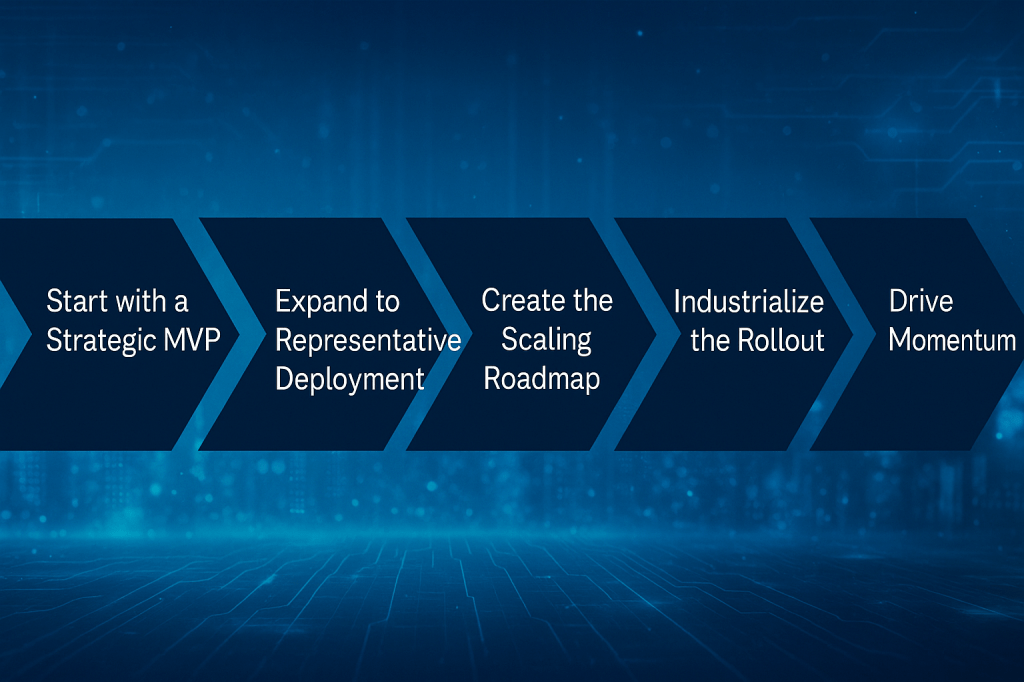
In many organizations, digital transformation starts strong but struggles to scale. Initial pilots show promise, yet momentum often stalls when leaders attempt to replicate success across the broader enterprise. Based on my own experience leading global transformations, I’ve found that the key to scaling lies in a phased, learning-driven approach—one that combines fast wins, co-creation, and structured rollout methodology with rigorous focus on adoption and impact.
I’ve applied this phased scaling approach in multiple global transformations—ranging from a Lean-based, end-to-end value chain transformation developed with McKinsey, to process standardization and operating model redesign in Innovation, Commercial, and Supply Chain domains. It also proved highly effective during large-scale ERP implementation programs, where structured rollout and local ownership were critical to success. These experiences shaped the approach outlined below.
1. Start with a Strategic MVP
Every transformation needs a spark—a Minimum Viable Product (MVP) that proves value fast. This is not about testing technology in isolation but selecting a use case that matters to the business and can deliver tangible outcomes quickly.
In practice:
During a global ERP rollout, we launched the MVP in smaller countries in South America. These markets had limited existing system support, so the gains from automation and standardized processes were immediate and highly visible. It was the ideal environment to test the new design while delivering clear early value to the business.
The goal: build credibility and show that “this works.” More importantly, use this phase to create internal advocates who will help carry the message forward.
2. Expand to a Representative Deployment
Once momentum is created, the next step is critical: move beyond the pilot phase and test your approach in a part of the organization that reflects the broader complexity and scale.
In practice:
In the same ERP program, we selected North America as the next deployment—arguably the toughest environment due to its scale, criticality, and history of customized automation. If we could succeed there, we knew we could scale globally. Through co-creation with local business and functional teams, we built the assets, governance model, and deployment methodology that became the foundation for all subsequent rollouts.
3. Codify Learnings and Create the Scaling Roadmap
After two deployments, you’ll have rich insight into what works, what doesn’t, and what needs to adapt. This is the time to capture and codify those learnings into a repeatable transformation playbook.
In practice:
In the end-to-end Lean transformations, we developed a comprehensive playbook that included standard tools, templates, and real-world examples. We also created resource models and scaling scenarios to support portfolio-level roadmap planning. This gave the transformation program clarity on how to scale with confidence.
4. Industrialize the Rollout
With a clear roadmap in place, the focus shifts to scaling with speed and consistency. This requires an empowered central team that operates as an enabler, that works closely with the business, regional and functional teams.
In practice:
As we scaled our end-to-end transformations from 2 to more than 70 deployments in three years, we enhanced the playbook continuously and established an internal academy. This academy enabled employees to follow a structured learning journey and certify their transformation skills. At the same time, we implemented clear communication strategies and dashboards to track adoption, progress, and value realized—keeping everyone aligned and accountable.
5. Drive Momentum
Scaling isn’t just about delivery—it’s about sustaining energy and belief. Even the best plans will stall without a mechanism to drive momentum and reinforce impact.
In practice:
In the ERP program, we implemented regular health checks to assess deployment progress and identify adoption risks early. Senior leaders were actively involved in championing each phase, reinforcing the “why” and spotlighting success stories across regions. We knew that technical go-live was just the beginning—the real success comes from business adoption, continuous improvement and realized value.
Final Reflections
Many transformations fail at different phases of the journey. Some stumble at the very start by choosing a pilot that is too complex to succeed quickly. Others struggle to make the leap from isolated success to broader relevance. Some lose steam by over-engineering the scale-up, while others fail to sustain momentum once the initial excitement fades.
Next to the examples of what worked, I’ve also seen where things went wrong—or could have gone significantly better. These lessons are just as valuable, and they underscore the importance of staying pragmatic, agile, and focused on value throughout the scaling process.
A successful digital-enabled transformation moves from MVP to full scale through a deliberate series of learnings, adjustments, and investments—not just in technology, but in people, process, and governance.
By starting with fast, meaningful wins, expanding through co-creation, and scaling with discipline, organizations can move from isolated experiments to enterprise-wide impact—with clarity, confidence, and speed.
 Best of Digital Transformation