How AI Changes the Digital Transformation Playbook

I recently revisited David L. Rogers’ 2016 book, The Digital Transformation Playbook. This work was foundational in how I approached digital strategy in the years that followed. It helped executives move beyond viewing digital as a technology problem and instead rethink strategy for a digital enabled business. As I now reflect on the accelerating impact of artificial intelligence—especially generative and adaptive AI—I found myself asking: how would this playbook evolve if it were written today? What shifts, additions, or reinterpretations does AI demand of us?

Rogers identified five strategic domains where digital forces reshaped the rules of business: customers, competition, data, innovation, and value. These domains remain as relevant as ever—but in the age of AI, each requires a fresh lens.

In this article, I revisit each domain, beginning with Rogers’ foundational insight and then exploring how AI transforms the picture. I also propose three new strategic domains that have become essential in the AI era: workforce, governance, and culture.


1. Customers → From Networks of Relationships to Intelligent Experiences

Rogers’ Insight (2016):
In the traditional business model, customers were treated as passive recipients of value. Rogers urged companies to reconceive customers as active participants in networks—communicating, sharing, and shaping brand perceptions in real-time. The shift was toward engaging these dynamic networks, understanding behavior through data, and co-creating value through dialogue, platforms, and personalization.

AI Shift (Now):
AI enables companies to move beyond personalized communication to truly intelligent experiences. By analyzing vast datasets in real-time, AI systems can predict needs, automate responses, and tailor interactions across channels. From recommendation engines to digital agents, AI transforms customer experience into something anticipatory and adaptive—redefining engagement, loyalty, and satisfaction.


2. Competition → From Industry Ecosystems to Model-Driven Advantage

Rogers’ Insight (2016):
Rogers challenged the notion of fixed industry boundaries, arguing that digital platforms enable competition across sectors. Businesses could no longer assume their competitors would come from within their own industry. Instead, value was increasingly co-created in fluid ecosystems involving customers, partners, and even competitors.

AI Shift (Now):
Today, the competitive battlefield is increasingly defined by AI capabilities. Winning organizations are those that can develop, fine-tune, and scale AI models faster than others. Competitive advantage comes from proprietary data, high-performing models, and AI-native organizational structures. In some cases, the model itself becomes the product—shifting power to those who own or control AI infrastructure.


3. Data → From Strategic Asset to Lifeblood of Intelligent Systems

Rogers’ Insight (2016):
Data, once a by-product of operations, was reimagined as a core strategic asset. Rogers emphasized using data to understand customers, inform decisions, and drive innovation. The shift was toward capturing more data and applying analytics to create actionable insights and competitive advantage.

AI Shift (Now):
AI transforms the role of data from decision-support to system training. Data doesn’t just inform—it powers intelligent behavior. The focus is now on quality, governance, and real-time flows of data that continuously refine AI systems. New challenges around data bias, provenance, and synthetic generation raise the stakes for ethical and secure data management.


4. Innovation → From Agile Prototyping to AI-Augmented Co-Creation

Rogers’ Insight (2016):
Rogers advocated for agile, iterative approaches to innovation. Instead of long development cycles, companies needed to embrace experimentation, MVPs, and customer feedback loops. Innovation was not just about new products—it was about learning fast and adapting to change.

AI Shift (Now):
AI amplifies every step of the innovation process. Generative tools accelerate ideation, design, and prototyping. Developers and designers can co-create with AI, testing multiple solutions instantly. The loop from idea to execution becomes compressed, with AI as a creative collaborator, not just a tool.


5. Value → From Digital Delivery to Adaptive Intelligence

Rogers’ Insight (2016):
Value creation, in Rogers’ view, moved from static supply chains to fluid, digital experiences. Companies needed to rethink how they delivered outcomes—shifting from products to services, from ownership to access, and from linear value chains to responsive platforms.

AI Shift (Now):
With AI, value is increasingly delivered through systems that learn and adapt. Intelligent services personalize in real time, optimize continuously, and evolve with user behavior. The value proposition becomes dynamic—embedded in a loop of sensing, reasoning, and responding.


Why We Must Expand the Playbook: The Rise of New Strategic Domains

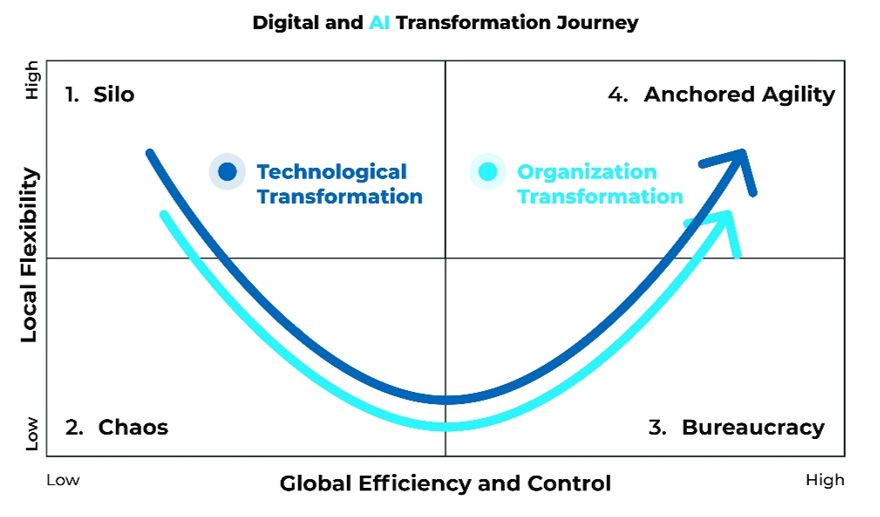
The original five domains remain vital. Yet AI doesn’t just shift existing strategies—it introduces entirely new imperatives. As intelligent systems become embedded in workflows and decisions, organizations must rethink how they manage talent, ensure ethical oversight, and shape organizational culture. These aren’t adjacent topics—they are central to sustainable AI transformation.


6. Workforce → From Talent Strategy to Human–AI Teaming

AI is not replacing the workforce—it is changing it. Leaders must redesign roles, workflows, and capabilities to optimize human–AI collaboration. This means upskilling for adaptability, integrating AI into daily work, and ensuring people retain agency in AI-supported decisions. Human capital strategy must now include how teams and algorithms learn and perform together.


7. Governance → From Digital Risk to Responsible AI

AI introduces new dimensions of risk: bias, security, and regulatory complexity. Governance must now ensure not only compliance but also ethical development, explainability, and trust. Boards, executive teams, and product leaders need frameworks to evaluate and oversee AI initiatives—not just for effectiveness but for responsibility.


8. Culture → From Digital Fluency to AI Curiosity and Trust

The mindset shift required to scale AI is cultural as much as technological. Organizations must foster curiosity about what AI can do, confidence in its potential, and clarity about its limits. Trust becomes a cultural asset—built through transparency, education, and inclusive experimentation. Without it, AI adoption stalls.


Conclusion: A Playbook for the AI Era

Rogers’ original playbook gave us a framework to reimagine business strategy in a digital world. That foundation still holds. But as AI redefines how we compete, create, and lead, we need a new version—one that not only shifts the lens on customers, competition, data, innovation, and value, but also adds the critical dimensions of workforce, governance, and culture. These eight domains form the new playbook for transformation in the age of intelligence.

Rewiring the Workforce: Aligning HR and IT in the Age of AI

AI is already changing how teams operate, how leaders make decisions, and how value is delivered to customers. For organizations, this means rethinking not just what work gets done, but how it’s done, and by whom. Therefor it is crucial to think about how we bring Human and AI resource management together.

The 2023 MIT Sloan / BCG study, The Rise of AI-Powered Organizations, found that the most successful companies with AI are those where HR and IT work closely together to redesign processes and roles. That collaboration is critical. If AI is deployed without rethinking how humans and machines collaborate, companies risk missed value, employee resistance, and ethical missteps.


Designing the Hybrid Workforce: Teams, Tasks, and Talent

AI doesn’t eliminate jobs—it changes them. To prepare, organizations need to break down roles into specific tasks:

  • What can be automated?
  • What can be enhanced by AI?
  • What should remain Human-led?

From there, teams can be redesigned around how people and AI tools work together. In practice, this might mean:

  • A customer service team using AI to summarize queries while humans resolve complex issues
  • A product development team using AI to generate design options that humans refine

The HBR article Collaborative Intelligence: Humans and AI Are Joining Forces (Wilson & Daugherty, 2018) highlights five human roles in human-AI collaboration, such as AI trainers, explainers, sustainers, amplifiers and translators. These roles are already emerging in forward-looking teams and should be reflected in new job descriptions and team capabilities.


Organizational Change: Leading Through Disruption

Adding AI isn’t just a tech upgrade—it changes how decisions are made, who makes them, and what leadership looks like. For example:

  • Middle managers might now focus more on coaching and less on reporting, as AI handles data consolidation.
  • Teams may need to consult AI before acting, introducing a new rhythm to collaboration.

Gartner’s 2023 report How to Measure AI-Augmented Employee Productivity stresses that success in AI transformation isn’t just about productivity—it’s about how well teams adapt, collaborate, and trust AI tools. That requires strong change management, hands-on leadership, and clear guidance on when to trust AI versus when to override it.


Performance and Culture in an AI-Augmented Workplace

With AI in the mix, traditional performance reviews fall short. Leaders need to ask:

  • How are employees using AI tools to improve their work?
  • Are decisions more consistent, inclusive, and data-informed?
  • Is the AI system fair and explainable?

The Stanford HAI Annual AI Index Report 2024 shows that AI systems are improving technically, but companies often lack the tools to measure human impact—such as employee trust or the inclusiveness of AI-driven decisions. Stanford HAI provides several frameworks that can be leveraged to measure Human + AI teams performance.


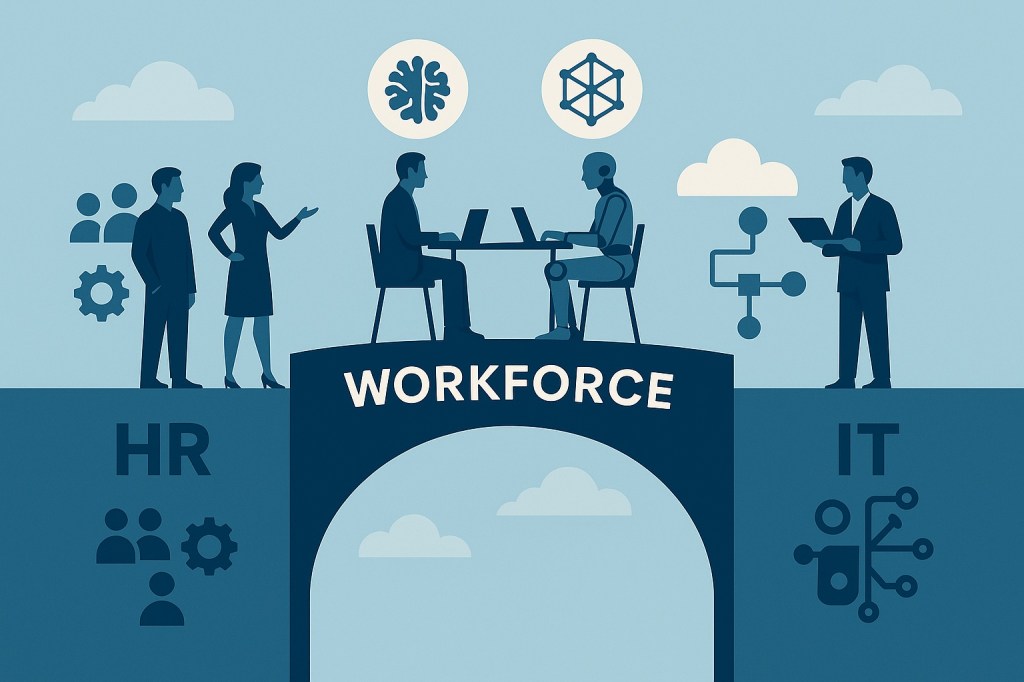
HR + IT: From Functional Silos to Strategic Workforce Partners

To make AI work, HR and IT must be in lockstep. Here’s what that looks like:

  • Shared strategy: Joint planning on where AI will impact jobs and what new skills are needed
  • Reskilling programs: Co-owned initiatives to help employees build digital and AI literacy
  • Data and governance: Shared ownership of tools that measure workforce readiness and ensure responsible AI use

IBM’s 2023 Enterprise Guide to Closing the Skills Gap highlights that companies closing the skills gap at scale have strong HR–IT alignment. It’s not about HR specifying training needs and IT buying tools. It’s about building workforce capabilities together, with shared accountability.


Practical Implementation Guide

Step-by-Step

  1. Start with a vision: What does AI mean for how your people work?
  2. Create joint ownership: HR and IT should lead together from day one
  3. Map current tasks and roles: Where can AI add value or remove friction?
  4. Pilot hybrid teams: Run experiments in one area (e.g., marketing, finance) and scale what works
  5. Define ethical rules: Decide where AI should assist, and where humans must retain control
  6. Track impact: Use KPIs that include both productivity and human experience

Avoid These Pitfalls

  • Launching AI without involving HR
  • Treating AI as an isolated IT solution
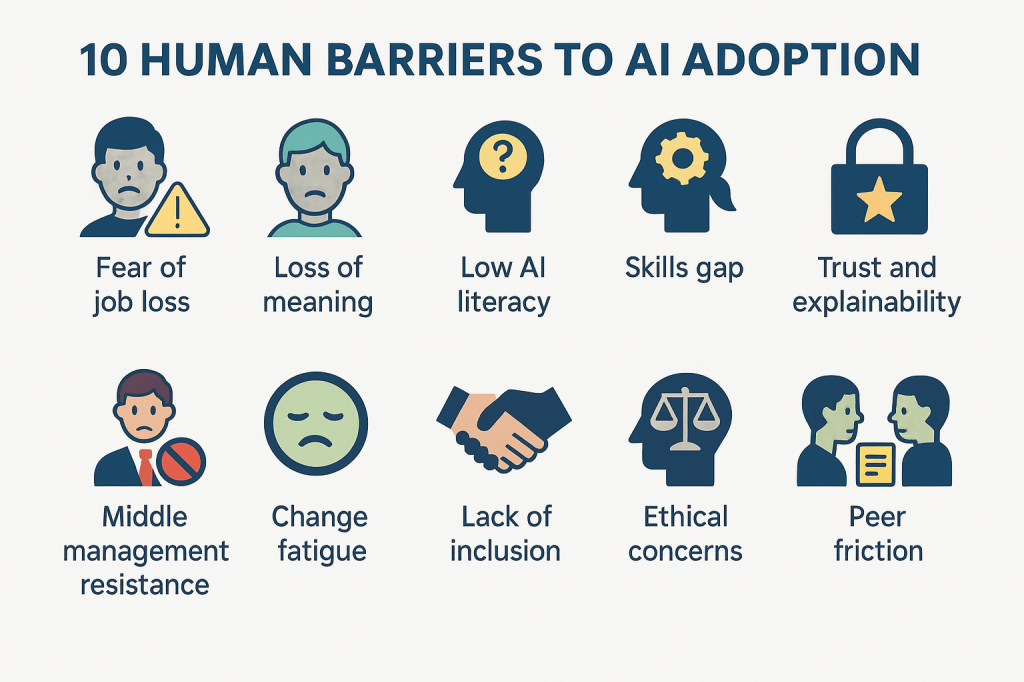
  • Ignoring cultural resistance or trust issues
  • Failing to update roles, reviews, or incentives

Patterns That Work

  • Embedding AI in learning programs led by both HR and IT
  • Using AI to support—not replace—human decision-making in recruiting
  • Creating workforce councils to oversee AI ethics and inclusion

Conclusion: Time to Rewire

AI is a shift in how people, teams, and organizations operate. Making that shift successful requires deep collaboration between HR and IT, clear direction from leadership, and a willingness to rethink everything from team design to performance reviews.

Organizations that embrace this challenge with practical steps and shared ownership will not only manage AI’s impact—they’ll harness its full potential to build a smarter, more adaptive workforce.

Revolutionizing Finance with AI Automation

Finance is one of the business functions most primed for disruption through AI. With its high volume of repetitive transactions, rich data environments, and structured processes, the finance and controlling function is uniquely positioned to benefit from automation and intelligent analytics. As AI technologies mature, they are enabling a shift from transactional finance to strategic finance, unlocking new efficiencies, predictive capabilities, and business insights.

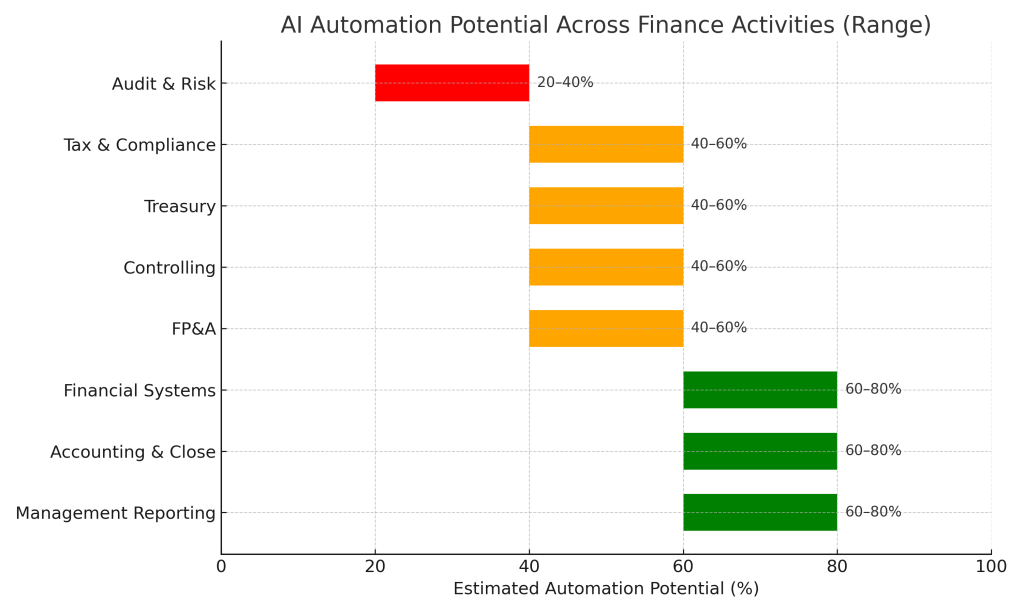
The implications are not just technological but organizational. With automation potential ranging from 30% to over 80% across various activities, it is likely that finance teams of the future will require less than 50% of the current workforce for traditional roles. The roles that remain will be more analytical, advisory, and technology-driven.

This article explores the key activities of the Finance function, how AI is transforming each area, and what the finance function could look like in 5–10 years. We also outline two distinct transformation scenarios—one focused on rapid implementation and another on sustainable foundations—to help finance leaders chart their course.

Key Activities of the Finance & Controlling Function and AI’s Impact

  1. Financial Planning & Analysis (FP&A)
    • Activities: Budgeting, forecasting, scenario modeling, variance analysis.
    • AI Impact: Predictive forecasting, automated scenario generation, and anomaly detection increase speed and accuracy.
  2. Management Reporting
    • Activities: Internal performance reports, dashboards, KPI tracking.
    • AI Impact: Natural language generation and self-service analytics personalize insights and automate commentary.
  3. Controlling
    • Activities: Cost control, investment analysis, policy compliance.
    • AI Impact: AI uncovers cost drivers, monitors ROI, and enforces compliance rules automatically.
  4. Accounting & Financial Close
    • Activities: AP/AR, reconciliations, journal entries, intercompany close.
    • AI Impact: OCR, bots, and smart matching drastically reduce manual work and cycle times.
  5. Treasury & Cash Management
    • Activities: Cash forecasting, liquidity management, FX risk, banking.
    • AI Impact: Predictive models optimize cash positions and detect fraud in real time.
  6. Tax & Compliance
    • Activities: Tax classification, filings, regulatory adherence.
    • AI Impact: Automated tax coding, real-time compliance monitoring, and AI-driven audit trails.
  7. Audit & Risk Management
    • Activities: Internal/external audit support, control testing, risk management.
    • AI Impact: Continuous audit monitoring, real-time risk scoring, and policy breach alerts.
  8. Financial Systems & Data Management
    • Activities: ERP management, data quality, automation enablement.
    • AI Impact: Data cleansing, process mining, and AI copilots transform finance operations.

AI Automation Potential Across Finance

AreaAutomation PotentialComments
FP&AModerateForecasting and analysis are automatable, but strategic planning remains human-led.
Management ReportingHighReport generation and commentary can be mostly automated.
ControllingModerateRoutine cost analysis is automatable; investment decisions are not.
Accounting & CloseHighReconciliations and entries are ideal for automation.
TreasuryModerateForecasting and fraud detection can be automated; decisions require oversight.
Tax & ComplianceModerateClassification and monitoring are automatable; legal interpretation is not.
Audit & RiskLow to ModerateMonitoring can be automated; assessments need human judgment.
Financial SystemsHighData tasks and support functions are highly automatable.

The Finance Function in 5–10 Years: AI-Augmented and Insight-Driven
Finance in the future will be lean, real-time, and forward-looking. The traditional role of finance as a scorekeeper will evolve into that of a strategic partner. Key shifts will include:

  • Near real-time closing and continuous forecasting
  • Proactive risk management through AI-driven monitoring
  • AI copilots supporting analysts with real-time insights
  • Self-optimizing processes and embedded business advisory

This transformation also entails a significant redefinition of workforce composition. Many routine roles will be phased out or reshaped, with the remaining talent focused on analytics, business partnering, and data stewardship. Finance teams may operate with less than half the current headcount, but with higher impact and strategic relevance.

Two Roadmap Scenarios for AI Transformation

1. Go Fast: Rapid AI Deployment in High-Impact Areas

  • Focus on automating high-volume, repetitive tasks for fast ROI.
  • Prioritize areas like reporting, financial close, and forecasting.
  • Launch an AI Center of Excellence to scale use cases.
  • Upskill teams in AI tools and data literacy.
  • Risks: Process fragmentation, change fatigue.

2. Build to Last: Strengthen Foundations Before Scaling AI

  • Begin with standardizing processes and modernizing ERP/data.
  • Use process mining to identify where AI fits best.
  • Pilot AI while building trust in systems and data.
  • Drive long-term scalability through structured change management.
  • Risks: Slower benefits realization, loss of momentum.

Conclusion: Finance Leaders Must Shape the AI Journey
AI offers unprecedented potential to elevate finance from an operational function to a strategic powerhouse. Whether choosing to go fast or build to last, success will require clear vision, strong governance, and continuous upskilling.

But leaders must also prepare for the workforce transformation ahead. With many transactional roles set to disappear, reskilling, talent planning, and organizational redesign must become part of the AI roadmap. Finance leaders who act now—balancing ambition with structure—will define the future of the profession and unlock new value for their organizations.

Key Insights from Digital Forum Amsterdam: AI’s Global Impact

Last week, I had the opportunity to present at the Digital Forum in Amsterdam, where over 100 executives and transformation leaders gathered to explore the future of leadership in the digital era. My keynote, titled “AI Without Borders – Harnessing Artificial Intelligence for Global Impact”, was met with great engagement and sparked many thoughtful discussions afterward.

In this article, I’d like to share the highlights and insights from the session—with the slides embedded between paragraphs for context.


AI is Reshaping Work—Across All Roles and Industries

My opening message was simple: no matter where you work or what your role is, AI will impact your processes, job content, and organization over the next 5 to 10 years. The only uncertainty is the scale and speed of this change.

To reinforce this, I brought in research findings from the WEF, MIT, PwC, McKinsey, Gartner, IBM, and Goldman Sachs. These sources highlight both the immense economic potential of AI (up to $15.7 trillion by 2030) and its disruptive impact on the workforce—millions of jobs created, transformed, or displaced, and a pressing need for upskilling on a global scale.


Staying Ahead: Why AI Fluency Matters

One statement particularly resonated with the audience: “It’s not that your job will be replaced by AI—but it might be replaced by someone who uses AI better than you.”

This is a wake-up call for continuous learning. The pace of development is breathtaking. I shared a snapshot of Q1 2025 breakthroughs and hinted at Google’s recent launch of AgentSpace, which I’ll cover in a future edition.


The Real Impact: AI in Marketing, Supply Chain, and Innovation

We then looked deeper into three core business areas—Marketing & Sales, Supply Chain, and Innovation—to see how AI is already creating tangible value.

In Marketing & Sales, AI is now embedded across the funnel—from awareness to retention. At Brenntag, for example, we successfully used AI to predict customer churn and recommend next-best actions, helping our commercial teams serve customers more effectively.

I also highlighted how large brands are already using AI to generate marketing content at scale. But the exciting shift is that these same capabilities are now accessible to smaller companies too—lowering the barriers to entry and leveling the playing field.


In Supply Chain, we see a dual reality: some companies still struggle with visibility and fragmented data, while others are unlocking efficiency gains with advanced AI tools. My message here: building end-to-end supply chain visibility is foundational. Only then can AI deliver its full potential.

As an example, I shared how, more than a decade ago at Philips, we began using IoT and early predictive maintenance for MRI machines. Today, this has evolved into a sophisticated system combining sensors, analytics, and AI—ensuring optimal equipment uptime and smooth patient flow in diagnostic imaging.


AI Accelerates the Innovation Cycle

AI is also supercharging innovation, reducing the time and cost of development across all phases—from identifying unmet needs to prototyping and testing.

I used the breakthrough example of AlphaFold by DeepMind, which dramatically accelerates drug discovery and the design of new materials. And at Brenntag, we’ve experimented with AI to accelerate lab innovation in the chemical sector—demonstrating that even smaller-scale applications can yield significant gains.


Data: The Essential Fuel for AI

Of course, none of this works without data. But many organizations face persistent challenges: fragmented systems, inconsistent standards, unclear data ownership, and poor governance.

I emphasized that improving data quality, accessibility, and trust is a prerequisite for AI success. Only when teams believe in the data and the systems built on top of it will adoption and results follow.


People and Culture Make the Difference

Finally, I addressed the cultural and organizational shifts required for AI to succeed. This includes:

  • Building trust and transparency into AI solutions
  • Empowering people to work ethically and responsibly with AI
  • Driving change management and adoption
  • And most importantly: ensuring consistent leadership support, with a clear vision and shared purpose

My Closing Message

I wrapped up with four key takeaways for leaders steering AI transformations:

  • AI will change processes, jobs, and businesses – only the speed is unknown
  • Data is the fuel for AI – make it fit for purpose and ready to use
  • The future is Human + AI – a cultural transformation is essential
  • Embed AI in your Operating Model – start small, scale fast, and learn continuously

AI powers Accelerated Innovation

Innovation has always been a critical driver of competitive advantage, but the demands on innovation today are more intense than ever. Companies need to not only generate breakthrough ideas but also bring them to market rapidly and tailor them to increasingly diverse customer needs.

Artificial Intelligence (AI) is emerging as a transformative force in this landscape. It accelerates every stage of the innovation process—from identifying opportunities and generating concepts to prototyping, testing, and scaling. Just as importantly, AI enables a new level of real-time customisation, empowering businesses to design and refine products and services that are more precisely aligned with individual customer preferences.

In this newsletter, I explore how AI is transforming each phase of the product and service innovation lifecycle, supported by research evidence and real-world applications.


1. Research & Opportunity Identification AI enhances the discovery of new product and service opportunities by analyzing vast volumes of structured and unstructured data—from customer sentiment and social chatter to competitive intelligence and emerging macro trends. Machine learning and natural language processing enable companies to identify unmet needs and whitespace opportunities with speed and precision that traditional market research can’t match.

Research Evidence

  • McKinsey (2023): AI accelerates opportunity identification by 37%.
  • MIT (2023): Trend analysis with AI improves opportunity detection by 42%.

Examples

  • Procter & Gamble uses NLP to mine social media and reviews for unmet customer needs.
  • Netflix identifies content gaps via recommendation engine data, informing production.

2. Ideation & Concept Development AI acts as a co-pilot for creativity, expanding the range of ideas and increasing the novelty of concepts generated. Generative AI and collaborative platforms help teams break cognitive biases, synthesize divergent thinking, and visualize concepts early in the process.

Research Evidence

  • Stanford Innovation Lab (2022): AI-enhanced brainstorming boosts novel ideas by 56%.
  • IBM: Cross-functional ideation quality rises by 31% with AI tools.

Examples

  • Airbus generated over 60,000 aircraft partition designs, discovering a solution 45% lighter than legacy models.
  • Designers leverage DALL·E to visualize product concepts rapidly.

3. Design & Prototyping AI accelerates prototyping by running simulations, optimizing form factors, and suggesting alternatives based on performance or customer preferences. It reduces development time while improving the diversity and feasibility of design iterations.

Research Evidence

  • MIT Media Lab: Iteration time reduced by 47%; 215% more design variations explored.
  • Harvard Business Review: AI simulation reduces physical prototype needs by 39%.

Examples

  • Volkswagen runs thousands of virtual car tests before building physical versions.
  • IKEA uses generative AI for furniture design and visualization.

4. Testing & Validation AI transforms validation by simulating real-world use, forecasting product success, and optimizing features through automated A/B testing. It helps teams reduce risk while aligning products more closely with customer expectations.

Research Evidence

  • Forrester (2024): AI improves A/B testing effectiveness by 28%.
  • Cambridge University: Product-market fit predictions enhanced by 41% with AI.

Examples

  • Amazon simulates user responses to product iterations.
  • Unilever uses digital twins to test product performance across different markets.

5. Scaling & Commercialization AI optimizes go-to-market strategies by refining product rollouts, forecasting demand, and personalizing marketing campaigns. It enables faster scaling while controlling costs and maximizing uptake.

Research Evidence

  • Accenture: Scale-up time reduced by 31%, costs by 26% through AI.
  • MIT Sloan: AI-guided marketing improves product adoption by 23%.

Examples

  • Starbucks uses AI to fine-tune new product rollouts globally.
  • Toyota leverages AI in supply chain modelling, improving scale efficiency by 18%.

6. Continuous Improvement AI closes the loop in innovation by turning customer usage and feedback into actionable insights. From predictive maintenance to feature enhancement prioritization, AI ensures products remain relevant and valuable over time.

Research Evidence

  • Deloitte: AI feedback analysis speeds product improvement cycles by 43%.
  • Harvard Business School: Predictive maintenance extends product lifecycles by 27%.

Examples

  • Tesla continuously improves vehicles via AI-analyzed driving data with over-the-air updates.
  • Microsoft uses AI to prioritize software feature improvements based on user behaviour.

Conclusion AI is more than a technological enabler—it is a strategic accelerator of innovation. By embedding AI across the full product and service lifecycle, companies gain the ability to move faster, personalize smarter, and innovate with greater confidence.

As generative and predictive technologies mature, organizations that embrace AI-driven innovation will shape the future.

What I Learned from Google & Kaggle’s Generative AI Intensive Course

Last week, I joined over 100,000 participants in a 5-day Generative AI Intensive Course hosted by Google and Kaggle—a free and fast-paced program designed to equip professionals with practical knowledge on how to harness the power of GenAI in real-world settings.

Why did I join? Because GenAI is no longer a concept—it’s here, and it’s evolving faster than most organizations can absorb. As leaders in digital transformation, we can’t afford to wait. We need to understand not just the what, but also the how of these technologies.

This course offered an excellent foundation of the current status of GenAI technologies, how they can be applied today, and even provided glimpses into where they are likely to evolve next.

Below is a summary of the course—structured for executives and transformation leaders seeking clarity on how GenAI will impact their businesses.


Day 1: Foundational Large Language Models & Text Generation

Why it matters: Understanding the fundamentals is critical before scaling GenAI use cases. Day one unpacked the Transformer architecture, the core engine behind tools like ChatGPT and Gemini.

Key Takeaways:

  • LLMs are the brains behind GenAI—they interpret and generate human-like language at scale.
  • Transformer models help these systems understand context and nuance.
  • Fine-tuning allows you to adapt general models to business-specific tasks, such as customer service or marketing.

Google whitepaper: “Foundational Large Language Models & Text Generation”


Day 2: Embeddings and Vector Stores

Why it matters: Without intelligent data structuring, GenAI becomes just another flashy tool. This session focused on how to make AI actually useful inside your organization.

Key Takeaways:

  • Embeddings turn complex data into searchable formats.
  • Vector stores make this information retrievable at speed and scale.
  • Retrieval-Augmented Generation (RAG) combines LLMs with your proprietary data for smarter, context-rich answers.

Google whitepaper: “Embeddings & Vector Stores”


Day 3: Generative AI Agents

Why it matters: GenAI is moving beyond chatbots—into agents that can autonomously perform tasks, interact with systems, and even make decisions.

Key Takeaways:

  • AI agents integrate tools, logic, and memory to act independently.
  • Platforms like LangChain and Vertex AI Agents provide orchestration layers for real-world applications.
  • Think of these as junior digital employees—capable of assisting operations, support, or analysis at scale.

Google whitepapers: “Agents” and “Agents Companion”


Day 4: Solving Domain-Specific Problems Using LLMs

Why it matters: Generic models only take you so far. Tailoring AI to your industry delivers far more strategic value.

Key Takeaways:

  • Domain-specific LLMs adapt to unique challenges in sectors like healthcare and cybersecurity.
  • SecLM enhances threat detection and response capabilities in cybersecurity.
  • MedLM supports clinical workflows and patient information retrieval in healthcare.

Google whitepaper: “Solving Domain-Specific Problems Using LLMs”


Day 5: Operationalizing GenAI on Vertex AI with MLOps

Why it matters: Scaling GenAI requires more than a good prompt—it demands structured deployment, governance, and monitoring.

Key Takeaways:

  • MLOps for GenAI adapts best practices from machine learning to this new frontier of GenAI applications.
  • Understanding the GenAI lifecycle—from experimentation to production—is key to long-term success.
  • Platforms like Vertex AI help organizations deploy and manage GenAI responsibly and at scale.

Google whitepaper: “Operationalizing Generative AI on Vertex AI using MLOps”


My Reflections

This course reinforced a simple truth: GenAI is becoming more capable rapidly. And like any capability, it needs strategy, structure, and experimentation to create real business value.

If you’re in a leadership role, here are three questions to reflect on:

  1. Where can GenAI complement or augment your current operations?
  2. Do you have the data foundation to make it effective?
  3. Are you equipping your teams to experiment safely and learn quickly?

What’s Next

I’ll be diving deeper into some of these topics in future articles —especially GenAI agents and domain-specific applications.

Let’s continue learning and leading—together


Genesis – Artificial Intelligence, Hope, and the Human Spirit

In Genesis, three titans from the worlds of diplomacy, technology, and innovation—Henry A. Kissinger, Eric Schmidt, and Craig Mundie—collaborate to offer a sweeping, contemplative exploration of artificial intelligence and its far-reaching implications.

What stands out immediately is how clearly the book captures this moment as a historic inflection point: a time when AI is poised to profoundly reshape society, governance, and what it means to be human. It balances an articulate exploration of opportunities—from accelerating innovation to solving global challenges—with a candid warning about the threats and disruptions AI could bring. Most powerfully, it forces us to reflect on the implications for humanity itself: our role, our agency, and our responsibility in shaping the trajectory of intelligent machines.

An Inflection Point in Human History

The central thesis of Genesis is that we stand at a defining juncture. Like the printing press or nuclear technology, AI introduces a new form of intelligence—one that challenges our existing institutions, ethical frameworks, and even our concept of reason.

AI’s ability to generate insights, patterns, and autonomous decisions has already begun to outpace human comprehension. The authors argue that this creates a new epistemology—an AI-driven way of “knowing” that may diverge significantly from human logic. And unlike past technologies, AI does not merely extend our abilities—it begins to redefine them.

Hope and Possibility

The authors make it clear that AI is not inherently a threat. In fact, they devote significant attention to its constructive potential. AI can enhance decision-making, speed up scientific discovery, optimize infrastructure, and help address systemic global issues like climate change and healthcare access.

At its best, AI can serve as a partner to human intelligence, extending the boundaries of creativity and solving problems that previously seemed intractable. The authors envision AI systems that support rather than replace human reasoning—providing tools to elevate, not diminish, the human spirit.

The Ethical and Existential Challenge

Yet, the transformative potential of AI brings existential questions into sharp focus:

  • What happens when AI makes decisions its creators cannot fully explain?
  • How do we preserve human values in systems that learn from data, not ethics?
  • Can AI uphold human dignity—or will it simply optimize for utility?

Kissinger, Schmidt, and Mundie stress the moral responsibility that comes with creating such powerful tools. The systems we build will increasingly influence not only productivity and security, but human identity and freedom. If not guided by clear ethics, AI could prioritize efficiency over empathy, precision over justice, and control over autonomy.

AI and the Transformation of Knowledge

One of the most insightful contributions of the book is its examination of how AI changes the nature of knowledge. Traditionally, knowledge has been built on human reasoning—observation, logic, debate, and reflection. AI, however, learns through statistical association, surfacing patterns and solutions that may be correct but unexplainable.

This shift has enormous implications. If humans increasingly accept AI-generated outputs without understanding them, we risk ceding authority to systems we cannot interrogate or hold accountable. Kissinger in particular warns of the long-term consequences for democratic governance, education, and scientific integrity.

Geopolitical Power and Global Governance

The geopolitical implications of AI are far-reaching. Schmidt and Mundie describe how AI development is currently concentrated in a small group of corporations and nations, creating a technological asymmetry that could rival or surpass those of the industrial and nuclear eras.

Without global cooperation and shared governance principles, AI could be weaponized—not just in military contexts, but through surveillance, manipulation, and digital authoritarianism. The authors urge policymakers to approach AI with the same strategic foresight that defined arms control during the Cold War.

Coexistence: Humans and AI as Partners

At the heart of Genesis is the idea of coexistence. The authors do not suggest halting AI development—but rather, ensuring that humans remain central to its evolution. We must design systems that align with human values and develop the emotional, ethical, and strategic capacities to work alongside them.

This also requires a transformation in education and leadership. Future leaders will need to pair technical literacy with philosophical depth—understanding not just how AI works, but how it fits within a broader human context.

A Call to Action for Leaders

For senior executives and transformation leaders, Genesis offers both insight and urgency. The authors call on decision-makers to:

  • Understand the transformational nature of AI and its long-term strategic implications.
  • Champion cross-disciplinary approaches, combining technology, ethics, and governance.
  • Cultivate AI literacy within their organizations to promote informed adoption and responsible innovation.
  • Advocate for global cooperation, recognizing that competitive advantage must be balanced with collective safety.

Conclusion

Genesis is not a technical manual—it’s a meditation on the choices that will shape our future. It challenges us to move beyond surface-level conversations about automation or productivity and to engage deeply with what AI means for human dignity, identity, and progress.

The authors leave us with a message that resonates long after the final page: the future of AI is not predetermined. It will be defined by the values, courage, and vision of those who lead today.

As we stand on the threshold of an AI-driven era, Genesis urges us not only to ask what AI can do—but to reflect on what we, as humans, ought to do.

Book Review: Digital Transformation – Survive and Thrive in an Era of Mass Extinction

Although already published in 2019 (more than 5 years ago), this book points several concepts still very relevant in the fast changing world of Digital Transformation. Below a summary of these concepts and recommended actions

In Digital Transformation, technology visionary Thomas Siebel offers a compelling and pragmatic guide for business leaders confronting the rapidly converging forces of cloud computing, big data, artificial intelligence (AI), and the Internet of Things (IoT). These technologies are creating an extinction-level event for legacy business models. Siebel contends that digital transformation is not optional—it is a matter of survival.

Drawing on his experience as founder of C3.ai, Siebel presents a clear strategic playbook and numerous real-world examples that demonstrate how companies across sectors can reinvent themselves using digital technologies. His message is direct: act now, or risk irrelevance.


Key Concepts

1. The Four Technology Pillars

  • Cloud Computing – On-demand computing infrastructure enabling scalability and speed
  • Big Data – Massive, diverse datasets that can be analyzed in real-time
  • Artificial Intelligence (AI) – Predictive, adaptive algorithms that learn from data
  • Internet of Things (IoT) – Billions of connected devices generating actionable data

2. A Mass Extinction Event for Legacy Businesses

  • Over half of Fortune 500 companies have disappeared since 2000
  • Disruption is hitting all industries—not just tech
  • Traditional business models are no longer sustainable

3. Digital Transformation Is a Strategic Reinvention

  • Not about marginal gains—requires full-scale operating model redesign
  • Core focus on operational efficiency, customer experience, and new value creation

4. Data as the Foundation for AI

  • Success with AI requires clean, integrated, and governed enterprise data
  • Enterprises must break down data silos and standardize architecture

5. Speed and Scale as Differentiators

  • Companies must move fast, think big, and deliver value quickly
  • Long, drawn-out transformations are no longer viable

6. Real-World Case Studies

  • Enel – Predictive maintenance across its global energy grid
  • Royal Dutch Shell – AI for well safety, energy trading, and asset optimization
  • U.S. Department of Defense – AI and IoT for battlefield awareness

Implementation Recommendations

1. Modernize Your Tech Stack

  • Shift from legacy systems to modern, elastic cloud infrastructure

2. Centralize and Unify Data

  • Build a data integration layer across all business units
  • Ensure governance and real-time accessibility

3. Deploy High-Value AI Use Cases First

  • Focus on predictive maintenance, customer churn, fraud detection, etc.

4. Adopt Agile and DevOps at Scale

  • Encourage continuous delivery and rapid iterations

5. Re-skill and Upskill the Workforce

  • Provide training in AI, data science, and cloud technologies

6. Build a Cross-Functional Operating Model

  • Blend business, IT, and data science in unified delivery teams

7. Create a Transformation Office

  • Establish a dedicated team with budget, authority, and board-level visibility

Siebel’s 10-Point CEO Action Plan

  1. Declare Digital Transformation a Strategic Priority
  2. Establish a Digital Transformation Office (DTO)
  3. Unify Enterprise Data Architecture
  4. Identify High-Impact Use Cases
  5. Deploy Agile Methodologies
  6. Form Cross-Functional Teams
  7. Invest in AI and IoT Capabilities
  8. Lead Cultural Change from the Top
  9. Develop Digital Talent and Skills
  10. Track Progress and Iterate Continuously

Final Thoughts

Digital Transformation by Thomas Siebel is a must-read for executives seeking to lead their organizations through an era of exponential change. The convergence of cloud, big data, AI, and IoT isn’t just a tech revolution—it’s a business survival imperative. With practical insights, a strong strategic framework, and a CEO-focused action plan, this book is a blueprint for industrial-scale reinvention.

Highly recommended for leaders ready to move from intention to impact.

AI and Digital Transformation Insights from the GDS CIO Summit

Last week, I had the pleasure and privilege of attending and speaking at the GDS CIO Summit – Noordwijk | March 12-13 2025, where I joined around 150 senior leaders from the tech industry. Over two days, we explored some of the most pressing topics shaping our industry today and those that will define the near future. It came as no surprise that 84% of CIOs consider AI a top priority, yet many are still figuring out how to effectively integrate it into their business strategies.

From Vision to Value – IT as a Competitive Advantage

The summit opened with a fantastic panel discussion featuring Angelika Trawinska van Bolhuis ( Dyson), Claudio FINOL (Fyffes), and Cameron van Orman (Planview). A key theme that emerged: IT is no longer just an enabler but a core driver of business strategy—capable of creating either competitive advantage or disadvantage.

Organizations are shifting from project-based ROI thinking to a product and business value-driven approach, requiring agile, dynamic planning and tools like Planview to align IT initiatives with evolving business priorities.

AI’s Growing Impact – The Need for Real-Time Insights

AI was a dominant theme throughout the event, and Kai Waehner (Confluent) led a deep dive into how real-time data fuels AI success. Many infrastructures aren’t designed for this shift, but event-driven architectures and data streaming are emerging as critical enablers.

One standout insight: 2025 is poised to be the year of “Agentic AI”—where autonomous AI agents collaborate in real time to optimize operations. Businesses that prepare for this transformation now will gain a significant competitive edge.

The Future of Work – Productivity, Transparency & AI Integration

How can organizations improve productivity and alignment? Sven Peters (Atlassian) shared fascinating insights into modern Systems of Work. High-performing teams don’t operate in silos; they align around OKRs (Objectives & Key Results) with full transparency.

At Atlassian, they have a simple but highly effective approach: ✅ Weekly 280-character updates to keep work visible ✅ Monthly check-ins to assess progress ✅ Quarterly reviews to refine objectives

AI is deeply embedded in this process, assisting teams in defining OKRs and structuring projects in a smarter way.

AI Regulations, Security & Workforce Evolution

The regulatory landscape around AI is evolving rapidly, particularly in Europe, and Ulrika Billström (OpenText) provided a compelling look at how companies must adapt. AI orchestrators are emerging, capable of managing multiple AI agents to drive large-scale innovation.

A key trend: Instead of moving data to AI, AI is now being deployed closer to where the data resides, fundamentally changing how organizations structure their AI ecosystems.

Day 2 – Real-Time Data & Trust

I had the honor of opening Day 2 alongside Ellen Aartsen ( KPN ), Joshan Meenowa (The KraftHeinz Company), and Ben Thompson ( GDS Group) in a discussion on how data fuels real-time decision-making.

A key question we tackled: How “real-time” does data actually need to be? While not every use case requires real-time data, all use cases require trusted data. Transparency, governance, and reducing reliance on alternative, non-trusted data sources are key to success.

AI Lifecycle Challenges – Managing Rapid Evolution

Kevin K. ( Airia – Enterprise AI Simplified ) shed light on a major challenge: the rapid pace of AI development. With 6,000–8,000 new AI models being created every week, companies struggle to keep up.

The solution? AI orchestration layers—which sit between the data, source systems, and AI models—are becoming essential to manage AI lifecycles efficiently and ensure tangible ROI.

The CIO’s Role is Evolving – Business Leadership is Key

In an insightful discussion with Alan Guthrie ( Calderys) and Alexander Press (Sanofi), we explored how the role of the CIO is undergoing a fundamental shift.

Today’s CIOs must: ✔ Operate at strategic, tactical, and operational levels ✔ Set clear technology guardrails while fostering innovation ✔ Shift IT functions toward product-driven organizations

Technology leadership alone is no longer enough—CIOs must now be business leaders.

Maximizing Tech Investments – Understanding TCO & ROI

To close the summit, @ManishNirmal ( Vimeo) provided a valuable session on how to assess the true Total Cost of Ownership (TCO). Hidden costs—such as training, migration, and operational impact—often make or break the business case for tech investments.

His recommendation? Use frameworks like MEDDIC (Metrics, Economic Buyer, Decision Criteria, Identify Pain, Champion) to map tech solutions based on real business value.

One of the most memorable takeaways: Crawl before you walk, walk before you run—but standing still is not an option.


Final Thoughts

The GDS CIO Summit was a fantastic opportunity to exchange insights with industry leaders and explore where AI and digital transformation are headed. A huge thank you to the GDS Group, especially Sophie Charnaud for her support, and all the brilliant speakers and participants for making it such an insightful event!

Competing in the Age of AI

Although Competing in the Age of AI: Strategy and Leadership When Algorithms and Networks Run the World by Marco Iansiti and Karim Lakhani was published in 2021—and much has happened since, including the launch of ChatGPT—it remains highly relevant. It provides valuable insights into why companies that control digital networks are capturing more and more business value.

Unlike traditional firms that rely on human-driven processes, AI-driven organizations leverage algorithms and digital networks to deliver unprecedented efficiency, scalability, and innovation. Companies such as Amazon, Ant Financial, and Google have shown how AI-powered models can create new markets, redefine value chains, and leave legacy competitors struggling to catch up.

For executives and transformation leaders, the challenge is clear: how can traditional organizations adapt to this new era? How can they integrate AI into their operations to drive agility, innovation, and sustainable competitive advantage? This summary breaks down the book’s key insights chapter by chapter, supplemented with real-world examples and strategic takeaways.


Chapter 1: AI-Centric Organizations – A New Operating Paradigm

Key Takeaways:

  • AI-driven firms operate fundamentally differently from traditional businesses, removing the need for human-driven decision-making at scale.
  • These companies leverage digital networks and algorithms to scale without being constrained by physical assets or labor.
  • AI enables firms to create more agile and adaptive business models, continuously refining their offerings through real-time learning.

Example: Ant Financial

Ant Financial, a subsidiary of Alibaba, transformed the financial services industry by using AI to assess credit risk, detect fraud, and approve loans within seconds—without human intervention. Unlike traditional banks, which rely on manual underwriting processes, Ant Financial’s AI-powered approach allows it to serve millions of customers instantly, with a near-zero marginal cost per transaction.


Chapter 2: AI-Driven Scale, Scope, and Learning – Breaking Traditional Constraints

Key Takeaways:

  • AI allows organizations to scale without the traditional constraints of labor and physical assets.
  • AI-driven companies can expand into adjacent industries more easily than traditional firms.
  • Machine learning continuously improves business models, creating a competitive advantage that compounds over time.

Example: Netflix’s AI-Powered Content Strategy

Netflix uses AI to optimize content recommendations, predict demand for original shows, and personalize the user experience. Unlike traditional media companies that rely on executives to decide what content to produce, Netflix’s AI-driven strategy allows it to maximize engagement, reduce churn, and improve content investments.


Chapter 3: AI and the Transformation of Operating Models

Key Takeaways:

  • AI-driven companies automate decision-making, making operations more efficient and responsive.
  • Traditional processes that rely on human judgment are replaced by real-time algorithmic decision-making.
  • AI-powered platforms connect suppliers, consumers, and partners more efficiently than traditional business models.

Example: Amazon’s AI-Powered Logistics

Amazon’s fulfillment centers use AI-driven robotics and predictive analytics to optimize inventory, reduce shipping times, and anticipate customer demand. This allows Amazon to deliver millions of packages per day with unmatched efficiency compared to traditional retailers.


Chapter 4: Rewiring the Value Chain with AI

Key Takeaways:

  • AI disrupts traditional value chains by enabling direct-to-consumer and on-demand business models.
  • AI enables firms to optimize supply chains, reduce waste, and improve efficiency.
  • Traditional firms struggle to adapt because of legacy processes and siloed data.

Example: Tesla’s AI-Driven Manufacturing

Tesla reimagined the automotive value chain by integrating AI into manufacturing, autonomous driving, and direct-to-consumer sales. Unlike legacy automakers, Tesla collects real-time data from vehicles, allowing it to improve its autonomous driving algorithms and enhance product performance over time.


Chapter 5: The Strategic Challenges of AI-First Companies

Key Takeaways:

  • AI-first companies create network effects, making them difficult to compete with once they achieve scale.
  • Traditional companies must choose whether to compete, collaborate, or transform their models.
  • Ethical issues such as bias, data privacy, and regulatory challenges must be addressed.

Example: Facebook’s AI and Ethical Challenges

Facebook’s AI-powered content recommendation system maximizes engagement but has faced scrutiny for spreading misinformation and bias. This demonstrates that while AI offers business advantages, leaders must also consider its societal impact and ethical responsibilities.


Chapter 6: AI and Competitive Dynamics – A New Battlefield

Key Takeaways:

  • AI reshapes competitive advantage, prioritizing firms with superior data and algorithms.
  • The speed of AI-driven innovation reduces the response time for traditional competitors.
  • Regulatory and policy challenges emerge as AI disrupts traditional industries.

Example: Google vs. Traditional Advertising

Google’s AI-driven ad targeting disrupted the traditional advertising industry, replacing intuition-based media buying with precision-targeted digital advertising. Legacy media companies struggled to keep up as Google and Facebook captured the majority of digital ad revenue.


Chapter 7: Managing the Risks of AI

Key Takeaways:

  • AI introduces new risks such as bias, security vulnerabilities, and lack of transparency.
  • Governance frameworks are essential to ensure responsible AI usage.
  • Organizations must navigate regulatory uncertainty and ethical concerns.

Example: Microsoft’s Responsible AI Initiative

Microsoft has implemented governance structures to ensure AI transparency, mitigate bias, and adhere to ethical principles. This proactive approach highlights the importance of responsible AI leadership.


Chapter 8: Leading in an AI-Driven World

Key Takeaways:

  • Leaders must embrace AI-driven decision-making and foster a data-centric culture.
  • AI literacy is essential for executives guiding digital transformation.
  • Workforce reskilling is critical to aligning human expertise with AI capabilities.

Example: Satya Nadella’s AI-Driven Leadership at Microsoft

Under Nadella’s leadership, Microsoft transformed into an AI-powered enterprise by embedding AI into products and services while ensuring responsible innovation.


Chapter 9: Reinventing the Enterprise for AI

Key Takeaways:

  • Organizations must undergo fundamental redesigns to remain competitive in the AI era.
  • Agile, cross-functional teams replace bureaucratic decision-making structures.
  • AI integration must be continuous, not a one-time project.

Example: Goldman Sachs’ AI Transformation

Goldman Sachs is using AI to automate trading, manage risk, and enhance customer experiences, shifting from a traditional financial services model to an AI-powered financial technology firm.


Chapter 10: The Future of AI and Business Strategy

Key Takeaways:

  • AI will continue to reshape industries, creating new market leaders and rendering others obsolete.
  • Balancing technological innovation with ethical and regulatory concerns is crucial.
  • Firms that fail to evolve their AI strategies risk becoming irrelevant.

Example: AI’s Role in the Future of Healthcare

AI is transforming healthcare through predictive analytics, personalized medicine, and robotic surgery, changing the landscape for providers, insurers, and patients alike.


Actionable Steps for Transformation Leaders

  1. Develop an AI Strategy: Align AI with business objectives and competitive differentiation.
  2. Invest in Data and AI Talent: Build capabilities in AI, data science, and automation.
  3. Redesign Organizational Processes: Move from human-driven to AI-driven decision-making.
  4. Embrace Ethical AI Governance: Ensure AI is transparent, fair, and responsible.
  5. Continuously Adapt: AI is not a one-time project—organizations must continuously evolve.

Final Thought

The AI revolution is not a distant future—it is happening now. Transformation leaders must act decisively to harness AI’s potential, reshape their organizations, and build a sustainable competitive advantage. The choice is clear: adapt or be disrupted.