Why your next ERP/CRM decision is really about agents, data platforms, and money flows.
Most large organisations are in a similar place:
- An ageing ERP landscape (often several instances)
- Fragmented or underused CRM
- Rapidly growing investments in cloud data platforms and AI
- A board asking, “What’s our plan for the next 5–10 years?”
For the last two decades, the core question was simple:
Which suite do we standardise on?
In an AI- and agent-driven world, the question becomes more strategic:
Will our core really be ERP and CRM suites – or will it be data platforms and agents that just happen to talk to them?
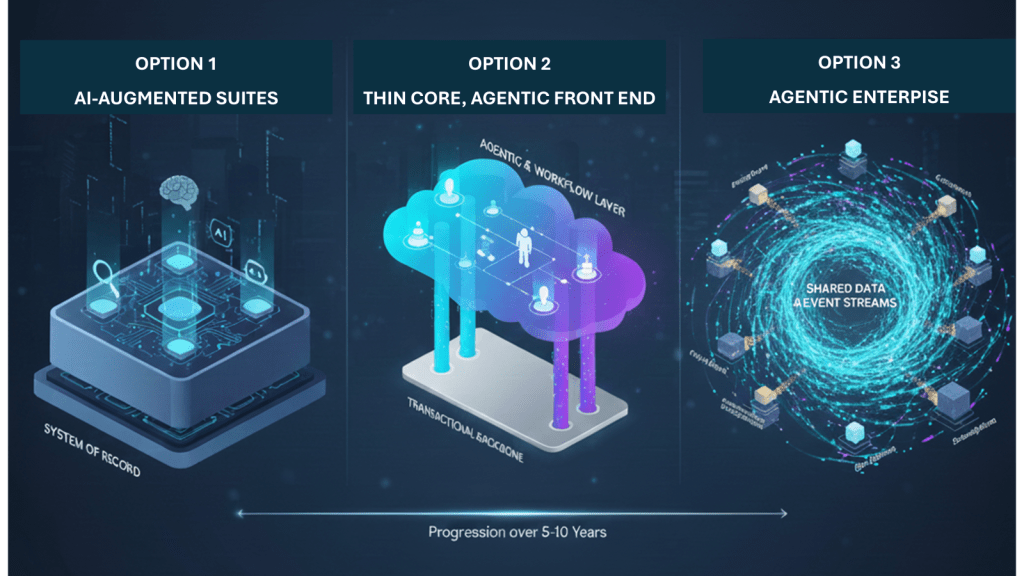
From what I see in digital and AI transformations, three futures for ERP and CRM are emerging. They’re not mutually exclusive, but where you place your bets will shape your architecture, cost base and operating model for a decade.
Three futures for ERP & CRM
Option 1 – AI-Augmented ERP & CRM
In the first future, ERP and CRM remain your system of record and primary process engine.
The change comes from infusing them with AI:
- Copilots and assistants embedded in finance, supply chain, HR, sales and service
- Predictive models for forecasting, anomaly detection and planning
- Built-in automation and recommendations inside the suite
The transformation journey is familiar: upgrade or replace core suites, rationalise processes, improve data, and switch on the AI capabilities that are now part of the platform.
The advantage is continuity: the mental model of “core systems” barely changes. The risk is spending heavily to recreate yesterday’s processes on a new, AI-decorated core.
Option 2 – Thin Core with an Agentic Front End
In the second future, ERP and CRM are still critical, but they are no longer the system of work people experience every day.
You introduce an agentic and workflow layer on top:
- End-to-end journeys like lead-to-cash or source-to-pay are modelled and executed in this layer
- Agents and orchestrated workflows call into ERP, CRM, HR and bespoke systems as needed
- Employees increasingly interact with unified workspaces and conversational agents, rather than individual applications
ERP and CRM become transactional backbones and data providers. The real differentiation – and day-to-day productivity – lives in the orchestration layer.
This opens up flexibility and speed, but it also adds a powerful new layer that must be governed and paid for.
Option 3 – The Agentic Enterprise (Beyond ERP & CRM as Products)
In the third future, ERP and CRM stop being “big systems you buy” and become behaviours of your architecture.
- Core business facts (orders, inventory, contracts, customer interactions) live in event streams, ledgers and shared data platforms, not only inside monolithic applications
- Agents and policy engines handle much of the business logic and user interaction
- Composable services provide domain capabilities – pricing, risk, subscriptions, entitlements – which agents combine to run processes
In this world, your data and event platforms are as central to running the business as any traditional application suite. ERP and CRM don’t disappear as concepts, but they are no longer the obvious centre of gravity.
Very few organisations are here end-to-end today, but many are already making decisions that either keep this option open – or quietly close it off.
Who is shaping these futures?
Once you have the three options in mind, it’s easier to see how the main players line up.
1. The suite giants – anchoring Option 1
The large business application vendors are doubling down on AI-augmented ERP and CRM – their suites for finance, operations, HR, sales and service:
- SAP – core finance and supply chain suite, plus customer experience applications
- Microsoft – Dynamics 365 for finance, operations, sales and customer service
- Salesforce – cloud platform for sales, service and marketing
- Oracle – cloud applications for finance, operations, HR and customer experience
- Workday – integrated platform for HR and finance
- ServiceNow – backbone for IT, employee & customer service in many organisations
Their common play:
- Modernise their suites
- Embed copilots and domain agents
- Extend their own low-code and workflow tools
Goal: keep the system of record and main process engine in their platform, and make it smarter.
2. Agentic & workflow fronts – powering Option 2
A second cluster focuses on becoming your system of work – the main place where employees and agents operate.
Suite-centric fronts:
- Microsoft: Power Platform and Copilot as the agentic layer across Dynamics and Microsoft 365
- Salesforce: Agentforce and Slack as the agentic front for CRM and analytics
- SAP: Joule and SAP Build/BTP to orchestrate across S/4HANA and line-of-business apps
- Workday: emerging agent frameworks on its unified data model
- ServiceNow: Now Platform with AI Agents and workflows across IT, employee and customer service
Vendor-neutral fronts:
- Pega, Appian, OutSystems, Mendix – workflow and low-code platforms used to model and run journeys that cut across multiple systems
- UiPath, Automation Anywhere – automation and “agentic” platforms that orchestrate work across ERP, CRM and legacy
- Celonis and other process-intelligence tools – providing the process “map” and telemetry layer that agents need
All of them are, in different ways, working to own the agentic front end over a mixed application estate.
3. Cloud & data platforms – foundations for Options 2 and 3
Cloud and data platforms are the quiet foundation for the second and third futures:
- Hyperscalers: AWS, Microsoft Azure, Google Cloud – providing compute, managed models, agent frameworks (e.g. Amazon Q/Bedrock, Azure OpenAI/Fabric, Google Vertex)
- Data platforms: Snowflake, Databricks, and cloud-native warehouses and lakehouses
Increasingly, these platforms hold the shared operational truth: the consolidated view of customers, products, transactions and events that both applications and agents rely on.
Many organisations are already investing heavily here. The strategic question is whether these platforms remain analytics add-ons, or become part of your core system-of-record and execution layer.
4. AI-native and event-sourced challengers – the Option 3 edge
A final group rethinks ERP-like capabilities from scratch:
- Rillet, ContextERP and other AI-native or event-sourced ERPs
- Vertical or regional challengers that are event-driven, API-first and agent-friendly
Today they mostly play in mid-market segments or specific industries, but architecturally they look closest to the Option 3 end-state.
What the options mean when you start from legacy
Most organisations don’t choose between these options on a clean sheet. They start from multiple ERPs, several CRMs, custom code and fragmented data.
So what does it mean to lean into each path?
Leaning into Option 1 – modernise & augment the core
You are committing to:
- Selecting strategic ERP/CRM suites and running classic, multi-year core transformations
- Using the move to modern platforms to simplify processes and master data, not just lift-and-shift
- Turning on embedded AI features where they are safe and valuable
Technology leaders clear technical debt and consolidate control. Finance leaders get large but relatively predictable investments with a familiar licence profile. Business leaders gain stability and better data, but day-to-day work may feel similar – just on a newer system.
The risk: over-indexing on the core and delaying cross-silo improvements.
Leaning into Option 2 – build an agentic layer on top
You are choosing to:
- Make one or two workflow / agent / low-code platforms your main improvement engine
- Redesign end-to-end journeys that span multiple systems
- Put agents and orchestrated workspaces in front of employees, and increasingly, customers
Done well, this can deliver visible progress in 12–24 months without waiting for every core system to be replaced.
But it also changes your cost and control model:
- You may reduce some “power user” licences in ERP/CRM
- You increase consumption spend on orchestration platforms, data platforms and AI inference
It is not automatically cheaper. It is a reallocation of spend from application licences to data, AI and orchestration – and it must be managed that way.
Steering towards Option 3 – design for an agentic, data-centric future
Very few organisations will jump straight to Option 3, but you can lean in that direction when you invest:
- Build new capabilities (for example, subscription management, partner platforms, pricing engines) as services on top of shared data and events, not as deep customisations inside ERP
- Let more business logic live in agents and policy layers that call into applications, rather than being fully hard-coded in those applications
- Treat your data platform as part of the operational nervous system, not just the reporting layer
This demands stronger engineering and architecture capabilities and a board that understands it is a long-term platform strategy, not a one-off project.
No-regret moves for the next 24 months
Whatever balance you choose between the three futures, some steps are almost always sensible.
1. Stabilise and simplify the core
- Retire the most fragile legacy systems
- Reduce bespoke code where it doesn’t create differentiation
- Use any ERP/CRM upgrade to simplify processes and data, not just modernise technology
2. Pick your strategic orchestration and agent platforms
- Decide whether your main system of work will be suite-centric or vendor-neutral
- Avoid ending up with multiple, overlapping agentic layers because different teams picked their own favourites
3. Use process intelligence as the map for agents
You should not unleash agents on processes you don’t understand.
- Use process mining and process intelligence (for example, Celonis, Signavio and similar tools) to discover how key flows actually run and where the real bottlenecks and risks are
- Treat this as the map and telemetry system for your agent strategy: it tells you where to start, and whether changes are helping or hurting
4. Start with bounded agent use cases and clear governance
- Begin where agents prepare work for humans or act within tight financial and policy limits
- Put in place shared governance for agents: which systems they can touch, what actions they can take automatically, and how you monitor them
ERP, CRM and the long game of AI
ERP and CRM are not going away. But they are no longer the only, or even the obvious, centre of gravity.
Over the next decade, three design choices will matter more than any feature list:
- Where your core operational data and system-of-record live – primarily in suites, primarily in shared data platforms, or a deliberate mix
- Where your business logic runs – inside applications, in an agentic layer, or in composable services
- Where your money flows – mostly into licences and implementation, or increasingly into cloud data and AI consumption
The real risk is not picking the “wrong” vendor.
It is drifting into an AI and agent future that recreates today’s complexity and cost in a new shape.
The organisations that pull ahead will be the ones whose executive teams treat this as a shared design decision, not just an IT refresh – and consciously decide how far they want to travel from Option 1, through Option 2, towards Option 3.
 Best of Digital Transformation