Herewith my final summer reading book review as part of my newsletter series.
GAIN – Demystifying GenAI for Office and Home by Michael Wade and Amit Joshi offers clarity in a world filled with AI hype. Written by two respected IMD professors, this book is an accessible, structured, and balanced guide to Generative AI (GenAI), designed for a broad audience—executives, professionals, and curious individuals alike.
What makes GAIN especially valuable for leaders is its practical approach. It focuses on GenAI’s real-world relevance: what it is, what it can do, where it can go wrong, and how individuals and organizations can integrate it effectively into daily workflows and long-term strategies.
What’s especially nice is that Michael and Amit have invited several other thought and business leaders to contribute their perspectives and examples to the framework provided. (I especially liked the contribution of Didier Bonnet.)
The GAIN Framework
The book is structured into eight chapters, each forming a step in a logical journey—from understanding GenAI to preparing for its future impact. Below is a summary of each chapter’s key concepts.
Chapter 1 – EXPLAIN: What Makes GenAI Different
This chapter distinguishes GenAI from earlier AI and digital innovations. It highlights GenAI’s ability to generate original content, respond to natural-language prompts, and adapt across tasks with minimal input. Key concepts include zero-shot learning, democratized content creation, and rapid adoption. The authors stress that misunderstanding GenAI’s unique characteristics can undermine effective leadership and strategy.
Chapter 2 – OBTAIN: Unlocking GenAI Value
Wade and Joshi explore how GenAI delivers value at individual, organizational, and societal levels. It’s accessible and doesn’t require deep technical expertise to drive impact. The chapter emphasizes GenAI’s role in boosting productivity, enhancing creativity, and aiding decision-making—especially in domains like marketing, HR, and education—framing it as a powerful augmentation tool.
Chapter 3 – DERAIL: Navigating GenAI’s Risks
This chapter outlines key GenAI risks: hallucinations, privacy breaches, IP misuse, and embedded bias. The authors warn that GenAI systems are inherently probabilistic, and that outputs must be questioned and validated. They introduce the concept of “failure by design,” reminding readers that creativity and unpredictability often go hand in hand.
Chapter 4 – PREVAIL: Creating a Responsible AI Environment
Here, the focus turns to managing risks through responsible use. The authors advocate for transparency, human oversight, and well-structured usage policies. By embedding ethics and review mechanisms into workflows, organizations can scale GenAI while minimizing harm. Ultimately, it’s how GenAI is used—not just the tech itself—that defines its impact.
Chapter 5 – ATTAIN: Scaling with Anchored Agility
This chapter presents “anchored agility” as a strategy to scale GenAI responsibly. It encourages experimentation, but within a framework of clear KPIs and light-touch governance. The authors promote an adaptive, cross-functional approach where teams are empowered, and successful pilots evolve into embedded capabilities.
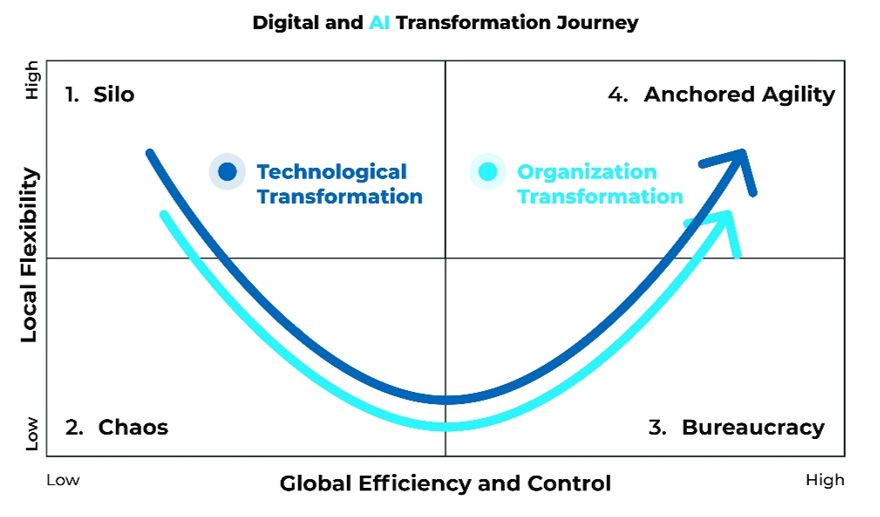
One of the most actionable frameworks in GAIN is the Digital and AI Transformation Journey, which outlines how organizations typically mature in their use of GenAI:
- Silo – Individual experimentation, no shared visibility or coordination.
- Chaos – Widespread, unregulated use. High potential but rising risk.
- Bureaucracy – Management clamps down. Risk is reduced, but innovation stalls.
- Anchored Agility – The desired state: innovation at scale, supported by light governance, shared learning, and role clarity.
This model is especially relevant for transformation leaders. It mirrors the organizational reality many face—not only with AI, but with broader digital initiatives. It gives leaders a language to assess their current state and a vision for where to evolve.
Chapter 6 – CONTAIN: Designing for Trust and Capability
Focusing on organizational readiness, this chapter explores structures like AI boards and CoEs. It also addresses workforce trust, re-skilling, and role evolution. Rather than replacing jobs, GenAI changes how work gets done—requiring new hybrid roles and cultural adaptation. Containment is about enabling growth, not restricting it.
Chapter 7 – MAINTAIN: Ensuring Adaptability Over Time
GenAI adoption is not static. This chapter emphasizes the need for feedback loops, continuous learning, and responsive processes. Maintenance involves both technical tasks—like tuning models—and organizational updates to governance and team roles. The authors frame GenAI maturity as an ongoing journey.
Chapter 8 – AWAIT: Preparing for the Future
The book closes with a pragmatic look ahead. It touches on near-term shifts like emerging GenAI roles, evolving regulations, and tool commoditization. Rather than speculate, the authors urge leaders to stay informed and ready to adapt, fostering a mindset of proactive anticipation.posture of informed anticipation: not reactive panic, but intentional readiness. As the GenAI field evolves, so must its players.
What GAIN Teaches Us About Digital Transformation
Beyond the specifics of GenAI, GAIN offers broader lessons that are directly applicable to digital transformation initiatives:
- Start with shared understanding. Whether you’re launching a transformation program or exploring AI pilots, alignment starts with clarity.
- Balance risk with opportunity. The GAIN framework models a mature transformation mindset—one that embraces experimentation while putting safeguards in place.
- Transformation is everyone’s job. GenAI success is not limited to IT or data teams. From HR to marketing to the executive suite, value creation is cross-functional.
- Governance must be adaptive. Rather than rigid control structures, “anchored agility” provides a model for iterative scaling—one that balances speed with oversight.
- Keep learning. Like any transformation journey, GenAI is not linear. Feedback loops, upskilling, and cultural evolution are essential to sustaining momentum.
In short, GAIN helps us navigate the now, while preparing for what’s next. For leaders navigating digital and AI transformation, it’s a practical compass in a noisy, fast-moving world.
 Best of Digital Transformation