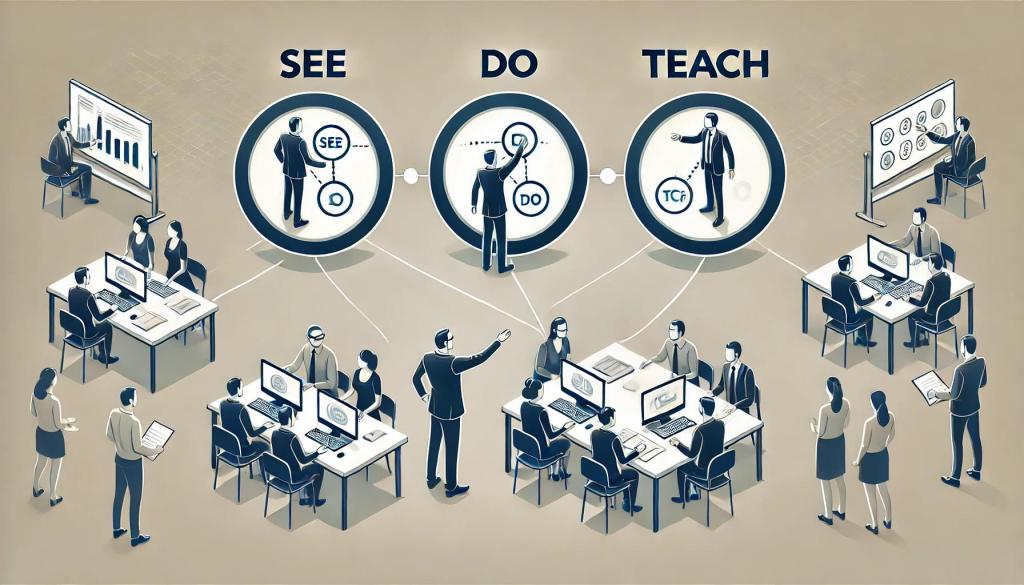
The See Do Teach method is a transformative approach to skill acquisition, team development, and leadership building. Rooted in experiential learning, it creates a dynamic cycle of observation, practice, and instruction that ensures not only the mastery of tasks but also the empowerment of individuals to become educators themselves. Here’s why it works so effectively and how it can be applied.
Why the See Do Teach Method Works
The See Do Teach method is built on the principle of active engagement, which is proven to improve retention and understanding. Each stage builds on the last, creating a progressive learning pathway that embeds skills deeply: 1. Observation Enhances Understanding: Seeing a task performed by an expert provides learners with a clear example of success, demystifying the process and showcasing best practices. 2. Practice Solidifies Skills: Doing the task immediately after observing allows learners to apply their newfound knowledge in a safe environment, with room for feedback and improvement. 3. Teaching Deepens Expertise: Explaining and demonstrating a skill to others reinforces the teacher’s mastery and ensures that knowledge is disseminated effectively across teams.
Breaking Down the Steps
Step 1: See
Observation is the foundation of the See Do Teach method. In this stage, learners watch a skilled individual perform a task, noting critical steps, techniques, and nuances.
Example: In order to train people inside the organization to become transformation managers, I worked with one of the big 4 strategic consultancies to show actual projects in the organization to our candidates.
Step 2: Do
After observing, learners move on to hands-on practice. Here, they replicate the task under guidance, applying what they’ve seen while gaining firsthand experience.
Example: After observing the expert consultants on one or two projects, the roles changed, with the internal teams executing the projects and the expert consultants reviewing and giving advice.
Step 3: Teach
The final stage involves teaching the newly learned skill to others. This step requires learners to organize their understanding and communicate it effectively, cementing their knowledge.
Example: After executing a couple of projects themselves, the internal teams became teachers to the next cohort of candidates (and the external consultants phased out) in their See-Do cycle.
The Flywheel Effect
The See Do Teach method operates as a flywheel—a self-reinforcing cycle that gains momentum over time. As learners become teachers, they perpetuate the process, creating a culture of continuous learning and growth. Over time, this approach not only spreads knowledge but also cultivates leadership qualities and drives organizational excellence.
Example in Practice: A company adopts the See Do Teach method to train employees on a new software system. Initially, a few experts demonstrate its usage (See). Next, these employees practice and refine their skills (Do). Finally, they teach the system to others (Teach). Within weeks, the organization’s proficiency with the software grows exponentially, reducing reliance on external trainers and fostering a collaborative learning environment.
Conclusion
The See Do Teach method is a simple yet profound approach to learning that combines observation, hands-on practice, and teaching. By embedding this cycle into your organization or personal development strategies, you can create a robust framework for skill acquisition, team growth, and leadership development. Over time, the method becomes a powerful flywheel, driving sustainable success and empowering individuals to achieve their full potential.
 Best of Digital Transformation